
The Spiritual Democracy of Moby-Dick:
Herman Melville’s Vision for a Divided World
by
Book Cover & Preview Text
Formats


Book Details
About the Book
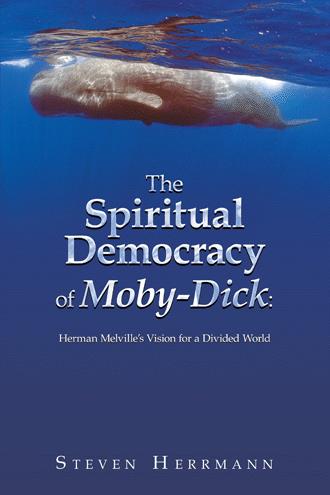
More than 170 years after its publication, Moby-Dick continues to challenge readers with its vastness, ambiguity, and immense visionary power. Yet beneath its tale of whaling, obsession, and adventure lies a profound spiritual quest that speaks directly to the challenges of the post-modern world. Drawing upon decades of study as a Jungian analyst, poet, and teacher, Steven Herrmann explores Herman Melville’s masterpiece as an epic journey into the depths of the human psyche and the evolving nature of the sacred. Through close readings of key passages, historical context, dream imagery, mythology, psychology, and symbolism, Herrmann reveals how Melville’s White Whale became one of the most powerful and enigmatic God-symbols in American literature. This book argues that Moby-Dick presents a deeply democratic and pluralistic vision in which diverse cultures, religions, races, and perspectives participate in a larger wholeness. At the heart of Melville’s vision is the recognition that ultimate reality can never be exhausted by any single creed, doctrine, or ideology. Instead, the novel points toward a dynamic relationship between unity and multiplicity, suggesting that the many are rooted in the One and that the One reveals itself through the many. Illuminated by eight iconic illustrations from Rockwell Kent’s celebrated 1930 edition, this study invites readers on a voyage with Ishmael beyond certainty and dogma toward a richer understanding of imagination, nature, psyche, and the enduring mystery symbolized by Moby Dick himself. This book will appeal to Melville scholars, Jungians, mythologists, spiritually oriented readers, ecopsychologists, and general readers interested in Moby-Dick.
About the Author
Steven Herrmann, Ph.D., is a Jungian analyst and author whose work explores the intersections of psychology, mythology, religion, and literature. Drawing on decades of scholarship and clinical practice, he offers a depthpsychological reading of Herman Melville’s Moby-Dick and its enduring relevance.