
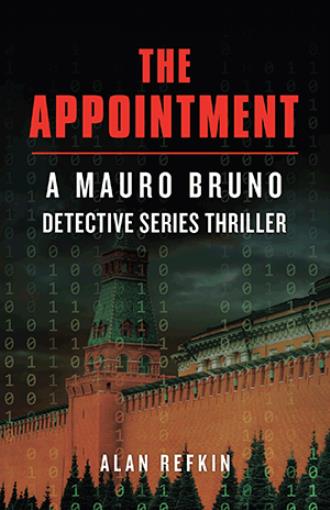
The Appointment
A Mauro Bruno Detective Series Thriller
by
Book Cover & Preview Text
One week from now Vladimir Putin lay bedridden in the hushed opulence of his Novo-Ogaryovo residence, twelve miles west of central Moscow along the elite Rublyovo-Uspenskoye Highway. The sprawling dacha, a fortress of privilege nestled amid dense woodland near the village of Ussovo and the gentle curve of the Moskva River, was encircled by towering twenty-foot walls and an invisible web of surveillance. It was guarded with fanatical devotion by the Federal Protective Service—Putin’s personal “Praetorian Guard,” the elite cadre entrusted with the physical security of Russia’s highest officials and the most sensitive state installations. No one entered or left without undergoing layers of biometric scans, background cross-checks, and silent watchers who anticipated threats before they could even form. The estate itself, built in the neoclassical style favored by post-Soviet Russia's new aristocracy, sprawled across more than two hundred acres of birch forest, its main residence a study in deliberate excess: hand-carved marble fireplaces imported from Italy, a private chapel modeled loosely on one in St. Petersburg, an indoor pool complex that rivaled anything found in the palaces of the old tsars. None of it mattered now. The president's private wing, ordinarily a hive of aides and advisors shuffling between briefings, had been reduced to a single hallway of hushed voices and closed doors, the air thick with the particular silence that settles over a household when everyone inside already suspects the truth and no one has been permitted to say it aloud. The Russian president had abruptly canceled all scheduled appearances and meetings, offering no explanation even to his innermost circle. To smother the inevitable whispers of frailty, or worse, the Kremlin swiftly released carefully selected archival footage: Putin astride a white horse, bare-chested and seemingly invincible, galloping through the compound’s private grounds. The unchanging autumn light and foliage made the clips indistinguishable from footage shot yesterday. State media played them on a loop, and no one outside the innermost sanctum dared question their recency. A junior producer at Channel One who'd idly wondered aloud, during an editorial meeting, whether the footage looked a season old, found himself reassigned by the following morning to a regional affiliate in China, seven time zones away. The lesson was not lost on his colleagues. In truth, the man who had ruled Russia for decades was dying. His physicians had exhausted every advanced protocol their state-of-the-art facilities could offer—antivirals, experimental immunomodulators, and even the most aggressive supportive therapies. Yet Putin, with the cold clarity that had always defined him, understood exactly what was killing him and, more importantly, who held the only viable cure. When his lead doctor finally withdrew, leaving a final injection of powerful stimulants to buy a few more hours of lucidity, the president summoned Dima Kolesnikov, the newly appointed director of the SVR. The slender, six-foot-one spymaster—with his close-cropped gray hair, thin mustache, and the quiet, predatory economy of movement that marked lifelong practitioners of the craft—drew a simple wooden chair to the edge of the massive bed. He sat with the deference of a man who knew the precarious balance of those in power. He had learned, over three decades in Russian intelligence, that proximity to a dying king was its own kind of exposure; men who witnessed weakness at the top rarely survived long once the weak man recovered, and rarely survived at all if he didn't. “Have you found Bruno?” Putin rasped, his once-commanding voice now reduced to a dry whisper that barely carried across the room. Kolesnikov offered the slightest nod. A thin, predatory smile cracked the president’s pale, waxen face. “Where?” Kolesnikov told him. Putin’s eyes, still sharp despite the toll, gleamed with satisfaction. “Per your instructions, the Mafia has accepted a twenty-million-dollar contract to locate and capture Bruno alive,” Kolesnikov continued. “The requirement to keep him alive was absolute: he’s not to be harmed. They have the resources and reach across Italy. They’ll deliver him.” “If he dies, I die,” Putin said flatly. “The doctor has given me a week—perhaps less. I require his blood plasma, uncontaminated and viable. One of our own physicians must extract it under controlled conditions. I will not risk a clumsy intermediary degrading the plasma.” Kolesnikov swallowed hard but kept his expression impassive. He had always seen the Mafia as blunt instruments—thugs for hire, efficient at violence and intimidation but crude when finesse was required. Their DNA was soaked in blood and vendettas; capturing a high-value target like Mauro Bruno without inflicting lasting damage tested their discipline to the limit. Yet he voiced none of these reservations. Ill or not, Putin still held the power of life and death over the entire Federation. Questioning the wisdom of outsourcing to organized crime wasn’t good for his longevity. “I won’t let any harm come to him,” Kolesnikov replied, offering exactly the assurance expected. “If you fail,” Putin said, his gaze locking onto the spymaster’s, “we’ll both suffer the same fate.”
Formats





Book Details
About the Book
Italy’s most classified intelligence archive has been breached by a man the world believes is dead. A deadly, fast-mutating pathogen is already on its way to Moscow. And somewhere in Rome, a professional assassin is calibrating an eight-hundred-yard shot at Italy’s president—while the Kremlin watches and waits.
Pia Lamberti, Italy’s intelligence chief, has spent her career in the shadows so ordinary people never have to know how close to catastrophe the country comes. This time, threats arrive simultaneously from every direction, and behind them all stands the same hand: Vladimir Putin, whose determination to secure a permanent foothold in Italy has made the country’s president, its secrets, and its sovereignty expendable.
Private investigator Mauro Bruno and his team are drawn into the storm’s eye—racing with stolen biological samples along Sicily’s back roads, eluding the Mafia, the SVR, and a Russian special-forces unit intent on leaving no witnesses. But Lamberti has engineered something no amount of Russian firepower can stop: a trap so precisely constructed that pursuing it will cost the Russian leader everything—including his life.
What Putin does not know—what almost no one knows—is that Lamberti did not merely set a trap. She set an appointment. And he has already kept it.
The Appointment is a relentless thriller about power, survival, and the kind of revenge that arrives not with a weapon but with a handshake.
About the Author
Alan Refkin is the author of eighteen fiction novels and the co-author of four acclaimed business books on China, including The Wild Wild East and Piercing the Great Wall of Corporate China, both of which received Editor’s Choice Awards. His thrillers include the Mauro Bruno detective series, the Matt Moretti–Han Li international action-adventure series, the Gunter Wayan private-investigator novels, and the Prague Detective Juraj Adamik series. He lives in Southwest Florida with his wife, Kerry, and is currently writing the next Mauro Bruno thriller. Visit alanrefkin.com for more about the author, the real-world locations featured in his books, and upcoming releases.