
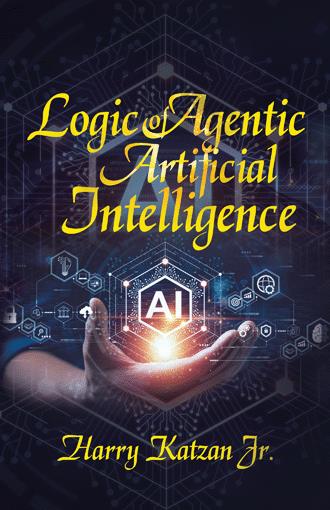
Logic of Agentic Artificial Intelligence
by
Book Cover & Preview Text
Formats




Book Details
About the Book
We are here to inform you of yet another subject in the expanding world of Artifi cial Intelligence. This book includes signifi cant information for persons involved with Artifi cial Intelligence, and will be especially useful for management, analysts, and educators. It is not specifi cally intended for designers and developers, who might refer to the methods as superfl ous. It is for people involved with learning about, describing, and using Agentic Artifi cial Intelligencce (AAI). This book covers the methodology and ontology of AAI, and not the design and development of artifi cial intelligence systems.. On the other hand, it can be viewed as an elementary book on the logic philosophy of the subject matter. Philosophical Ontology and Logic are branches of metaphysics that deal with with “what exists” and is concerned with the fundamental nature of reality, being, and existence. Philosophical ontology is introduced in the beginning of the book. It is useful in learning and thinking about AAI. There is also ontology and logic of computer science, information systems, and artifi cial intelligence. To start with, this ontology is a formal representation of knowledge about a domain – a set of concepts, categories, and the relationships between them – so as to permit humans and computers to share and process informatin in a consistent manner. Logic suppports that objective. This is also covered early on. The development described herein involves AI agents, where the two letters A and I are a short name of the terms Artifi cial and Intelligence. At this point in time, it is estimated that there are more than 500 books on AI in existence and this book is one of them. It is planned that this book is more useful and informative than most if not all of them. If it is not useful, then the author is truly sorry. The objective is to provide an interesting product that is apropriate to readers at all levels. In everyday life, an agent is a person or organization that helps someone or some organization. There are sales agents, agents that negotiate for the salaries of professional athletes, and so forth. Usually the agent knows more than the person being helped about the subject involved. The use of an agent is a normal step in the value chain, implying that an agent is simply a person that helps someone or something, as previously mentioned. In AI, an agent is a computer program or set of programs that do something for another entity – either human or nonhuman, and possibly an organization or a group of organizations. The agent applies the AI system to that particular person, department, or a large business unit. The personal assistant to an executive could be an AI system that applies AI technology to that person using learning technology to do the job. An AI program that takes over and manages a sales department would be an AI agent. It’s complicated, but that is the idea. Back to the book at hand. This isn’t a math book and you do not need to read the chapters in sequence. The book is diveded into three parts. The fi rst two parts are a review of artifi cial intelligence and of ontology. There are no new developments described therein. It’s there to help the reader get into the AI frame of mind, and perhaps introduce topics that the reader might have missed along the way. The third part covers Agentic Artifi cial Intelligence and its ontology, the major subjects in the book. If AI is to become successful, then the use of AI agents is defi nitely the way to go. In this book, the AI part is longer that the agent part. The third part covers the subject of the ontology/logic of AI and of argentic applications. This is a new subject so the applications are special. That is because we know more about AI than the agent part, which is relatively new, and the application part and associated ontology/logic that is even more recent than the agent part.
About the Author
Harry Katzan, Jr. is an AI specialist and formerly a professor, department chairman, and computer consultant. He has also worked for Boeing, Oak Ridge National Laboratory, and IBM. He is the author of several books on computers and artificial intellligence. He and his late wife have lived in Switzerland where he was an AI consultant and a visiting professor. He holds bachelors, masters, and doctorate degrees.