The Favor
A Detective Adamik Thriller
by
Book Cover & Preview Text
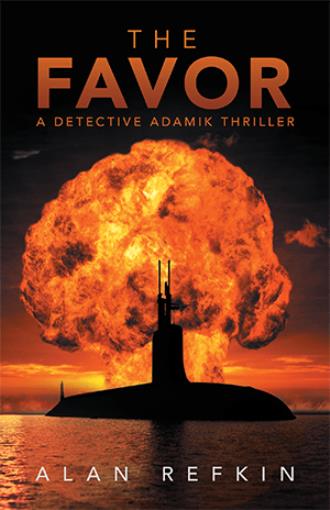
June 24, 2025 Majeed Ahmadi gazed out from the twin-engine, four-bladed Saba-248 helicopter, surveying the destruction American forces had inflicted on the Natanz nuclear facility. Following Ahmadi’s instructions, the pilot maneuvered the helicopter in a slow circle above the ruined site and the adjacent mountain pass. They then flew toward the shattered ring of Russian Dragon Fire anti-aircraft batteries that he’d been repeatedly assured would protect the facility. He had just returned from inspecting the ruins of Fordow—buried three hundred sixty feet beneath a mountain near Qom—and the scarred Isfahan Nuclear Technology Center farther south. Fordow had taken the worst of it. Multiple thirty-thousand-pound GBU-57 penetrators, delivered silently by B-2 stealth bombers, had punched straight through the mountain, collapsed both tunnel portals, and brought the centrifuge halls crashing down in avalanches of steel and rock. This was particularly alarming to Ahmadi. Fordow had historically produced only low-enriched uranium—three point five to five percent U-235, suitable solely for civilian nuclear power reactors. But Jafari had quietly overseen an expensive refit: three thousand advanced centrifuges installed in new cascades, pushing enrichment levels to sixty percent—perilously close to the ninety percent threshold for weapons-grade material. Now they lay crushed under half a mountain, and with them, months of irreplaceable progress. Isfahan had also suffered extreme damage, particularly to the targeted above-ground sections. The general staff informed him and Ayatollah Farhadi that two dozen Tomahawk missiles had substantially destroyed the sprawling research hub of ten buildings and twenty-four workshops. Ahmadi knew Isfahan primarily focused on fuel fabrication for reactors, the manufacture of centrifuge components, and related research. Since the facilities had been evacuated before the attack, the scientists and technicians survived and could resume work once new buildings were constructed and their equipment—removed before the bombings—was reinstalled. Yet this did not interest Ahmadi nearly as much as the news that their underground facility, a closely guarded secret, had emerged unscathed. Buried deeper than both Fordow and Natanz and smaller in scale, it was embedded in hard rock, making it highly resistant to conventional weapons like the GBU-57. Consequently, Ahmadi was relieved to learn that the thousands of centrifuges and the enriched uranium stored there remained undamaged. Before Operation Midnight Hammer, Israeli aircraft had spent a week systematically destroying Iranian radars and air defense systems, enabling deeper aerial penetrations. As a result, the general staff anticipated that American aircraft and missiles would soon target Iran’s nuclear facilities. While not everything in these facilities could be relocated to safe storage sites, the enriched uranium stockpiles—particularly the near-weapons-grade material—were moved to secret dispersal locations built expressly for this purpose. The most secretive and secure site, used for both operations and storage of enriched uranium, was the underground nuclear facility at Kūh-e Kolang Gaz Lā, located ninety miles south of Fordow and, ironically, just beyond the southern fencing of Natanz, connected to it by an underground corridor. Although intelligence analysts were aware of the facility’s existence, they did not know its precise location, which spared it from targeting. All they knew was that it lay somewhere in the same mountain range as Natanz—a vast geographic footprint. Consequently, Western intelligence nicknamed the site “Mount Pickaxe,” a name inspired by the secretive digging and tunneling activities that seemed continual in the area, evoking the imagery of a pickaxe as an excavation tool. Whether referred to as Kūh-e Kolang Gaz Lā or Mount Pickaxe, this facility was subterraneously linked to the Natanz nuclear complex. Ahmadi flew over the twisted, scattered debris of what had once been described to him as an impenetrable defensive umbrella around Natanz—a description also applied to similar protective systems at Fordow and Isfahan. He recalled how the Russians had repeatedly assured him, Farhadi, and the general staff that these defenses would destroy any intruding aircraft or missile currently in another nation’s military inventory before it could reach the nuclear facilities. Judging from the obliterated anti-aircraft systems below—and those at the other two sites—they had been wrong. The estimated one hundred twenty-five American aircraft and dozens of cruise missiles that had obliterated these defensive sites had, despite all assurances, left Iran’s key nuclear facilities vulnerable during what the Americans called Operation Midnight Hammer. Because Mount Pickaxe was highly secretive and entirely off the grid, any reference to it in print, text, or email was strictly forbidden, with construction and architectural details kept in hard copy rather than electronic form. Only a select few knew that the large underground facility was connected to the Natanz complex by a tunnel. Those who had taken the tunnel to the cluster of labs on the other side were technically in Mount Pickaxe, but believed they were still at Natanz, which, in a sense, they were. To them, Natanz was a sprawling underground network of tunnels branching into large work areas. None knew that beyond the vault-like door at the back of the laboratories, which they believed was a large safe for storing nuclear materials, lay a sister facility to Natanz. Those who worked at Mount Pickaxe had a separate surface entrance, with the ”vault door” used only in an emergency. Although the Massive Ordnance Penetrators destroyed much of the Natanz complex, the Mount Pickaxe facility remained intact. The camouflaged entrance to Kūh-e Kolang Gaz Lā, located outside Natanz’s perimeter fence, was also undamaged. The Natanz scientists, unaware they had been relocated to the Mount Pickaxe labs before the bombing and believing they were being moved to another section of the nuclear facility, were all unharmed. Consequently, nuclear weapons production continued without interruption following Operation Midnight Hammer.
Formats






Book Details
About the Book
Ten years ago, a Prague police officer died in a darkened parking lot after stumbling upon a secret rendezvous between an Uzbek special forces operative and an Iranian official.
Several months ago, a sightseeing boat erupted in flames off Trieste, Italy—claiming the life of one of the world's leading nuclear scientists.
Two weeks ago, a mother and her young daughter vanished into the night, seized as pawns in a conspiracy deadlier than any ransom demand.
Present day, beyond the reach of American bombers, Iran has constructed three devastating nuclear devices, specially engineered to exploit fatal, uncorrectable flaws in Israel’s defenses, poised to erase three of their largest cities from the map in a strike for which there would be no defense.
These seemingly random events are threads in a single, shadowed web of betrayal and terror.
Enter Prague detective Juraj Adamik: cynical, brilliant—never having failed to solve a case—and boarding at a high-end brothel run by the enigmatic Madam Irenka—in exchange for the occasional off-the-books favor. In this case, the favor is to locate the missing mother and daughter, even though they disappeared in a city outside his jurisdiction, where he has no investigative authority. Nevertheless, Adamik reluctantly agrees.
But as he delves deeper, the horrifying truth emerges: the abducted pair hold the key to stopping Iran's apocalyptic strike on Israel.
Time is slipping away. The fuse is lit.
Fail to find them, and three cities vanish—turning fertile land into irradiated wasteland for generations.
One man stands in the way of Armageddon... while the shadows close in.
About the Author
Alan Refkin is the author of seventeen novels and co-author of four acclaimed business books on China, including The Wild Wild East and Piercing the Great Wall of Corporate China—both of which received Editor’s Choice Awards. His thrillers span the Mauro Bruno detective series, the Matt Moretti–Han Li international action-adventure series, and the Gunter Wayan private-investigator novels. The Favor introduces Prague detective Juraj Adamik in a gripping new series. He lives in southwest Florida with his wife, Kerry, and is currently writing the next Adamik thriller. Visit alanrefkin.com for more about the author, real-world locations in his books, and upcoming releases.