
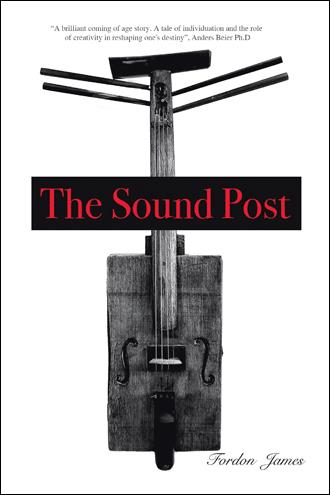
The Sound Post
by
Book Cover & Preview Text
David and James purchase a large quantity of groceries in a warehouse grocer the size of an Olympic gymnasium, and just as well lit. The building sits inside a perimeter of deepcreekwater green pines on lower Tchoupitoulas. Some of the largest people he’s ever seen push shopping carts big enough to cage lions, and you’d think they were feeding a lion at home. Wrapped trays of red meat as long as your arm, half-gallon cans of vegetables, or beans, 50 pound bags of rice. Hundred count bags of bite sized Snickers Bars, and Halloween is months away. There’s a frenzy to the shopping. As if the store had granted shopping sprees, but only as much as you can grab in a half hour. The cashier rings their purchases with wrist supports on both arms. She is simple and graceful, almost separate. He wants to take her from the checkout line, speak to her intimately and sincerely and look her steadily in the eyes. He is feeling contented, possibly because of Virginia. He wants to show this hard working check girl his impoverished, but rich life. He helps the bagboy, a black boy, and the boy is nearly shocked, suspicious. She moves her small hands quickly and watches the infrared closely, as though shyly. He splits the grocery bill with David. Never finds an opportunity to speak to her. Thinks about leaving a tip for her, a mute expression of admiration, but realizes the sheer ridiculousness of such an act. It’s just that now he wants what David has. A woman to love him. He can imagine her leaning happily against the wall of the kitchen while he cooks dinner. A big worn wood table in a beautiful and aged apartment. They are poor but as rich as any because they are in love, and because other people have been in love before them, and more will be in love after them. The world is simply a beautiful place, and love is the only reason the whole planet exploded into existence. They sit on the kitchen floor to eat their meal; David eats from his lap, and James capsizes a five-gallon bucket and presses his back against the wall. After dinner, James sits on his bed thinking of the young grocery clerk, her fair skin, her delicate hands. He wants feelings for her to well up in him like hot air in a balloon and carry him off somewhere. He wants to do something, immediately. Compose a melody and wait in the lot until she leaves work in the evening, play it for her. He rubs the front and back of his violin to a glossy patina with a t-shirt. David’s flipping through a coverless copy of Rollingstone, the unsold copies he gets from work, says: “Can’t believe you play the violin.” “Why?” “I don’t know. It’s odd to know someone my age playing an instrument like that.” “Like this? What kind wouldn’t seem odd?” “A guitar, drums, a horn, something. Something modern.” “Then who’d play the violin?” “Nobody. You can’t make any noise with a violin. It’s too . . . whiny.” “Yes, it can be,” James says, staring at the instru-ment, unoffended, the voice of the instrument loud in his mind. He continues, offhandedly, “as decorous accompaniment to other instruments, but alone it’s much different. In fact, unlike any instrument I know, its more infinite and perfect in its versatility.” David is apparently put out of place, or at least his raised brows suggest as much. Or rather he is impressed. James assumes the worse. He immediately feels ridiculous, pseudo-sophisticated. The very sound of the language he used, pretentious. He says, dismissively: “That is, if I knew how to play it to its potential. Still have a lot to learn.” David asks, unconditionally: “How long have you been playing?” “Not very long,” James protectively lies. Should David think he does not play well, he doesn’t want him to know that he has been playing for almost four years. David gives Virginia a thorough tour of the small, shotgun apartment. She shows undue excitement in the spartan dwelling. She says, repeatedly: “This is a very nice apartment. You guys are lucky. God, I’m so envious.” David tells her about all the little things he wants to do in the place. She watches him explain, a large in-terested expression on her face. When they pass through James’s room again, she sees his violin case. She asks James: “Oh, this must be your violin? Can I see it?” “Sure.” She kneels in front of it. James kneels beside her. “Wow, terrific. What do you play?” “Well, just a few songs. I’m working on some more.” David says, very dryly: “He plays on the streets.” “Really. You didn’t tell me that part.” “Sorry, it didn’t occur to me, but yes.” She looks deep into his eyes and becomes lumi-nous. “I think I remember seeing you. Did you play for a couple days at the Cathedral?” “I did play very near it, yes.” “I saw you, in fact, I think I put money into your case.” “Wow,” James says, lowly, checked exhilaration in front of David. “Do you remember?” He tries to; he was very nervous back then, saw a lot of faces but was too nervous to really see any of them. He wishes he could remember her and see what she was wearing so that he can bring back the meet-ing and have it now. But he can’t, everything is dissolved into memory. Virginia says to David: “It was when Alice and I were coming to see you at work, remember?” David can’t remember. Virginia says: “Play something for us?” “No, I can’t play that well, like that.” “Oh come on, you play very well.” “Not really. You see, I only know a few songs. On the streets it doesn’t matter because people are always walking by. They just hear a few notes.” “Oh, play something for us. I’ll make you a deal. If you play your violin for me, I’ll play the piano for you next time you’re at my house, and I’m horrible, so it’ll be very embarrassing for me” James raises his brows. David says: “She actually can play the piano pretty good.” “Really?” “Yes.” “Well, I bet not nearly as good as you can play your violin,” she adds. “I doubt that.” “I don’t practice a lot, not as much as I should, but I’m willing to embarrass myself in front of you.” “All right, then,” and he takes the instrument from the case and stands in the door with it under his chin. Virginia stands perfectly straight, her shoulders straight, a large smile across her dark-skinned face, eyes large with excitement, one hand resting on her purse and the other holding the thin leather strap. David slouches against the wall and runs his yellow-nailed fingers through his orange hair. He begins with high notes that he knows as the middle of a song. He plays them poorly. Stops. Plays them again and continues with the piece. He feels at the same time uncomfortable with the close audience and flattered by Virginia’s interest. He wishes he had the anonymity of a painter or a book writer, where his work could be experienced without him present, to not be personally on display. Or rather he wishes he could play so well the music took all attention away from him. He cuts short on a mistake. Virginia claps enthusiastically, which obligates a half-hearted cap from David, worse than not clapping at all it. He puts the instrument away and tries acting like he is not completely embarrassed. He thrusts his hands into his pockets and leans against the doorjamb. Virginia looks at him, trying to see in his eyes his unique per-son. She is genuinely impressed. He could never know just how impressed. She might have decided she loved him, right then. He looks away from her innocent, consuming stare. .
Formats

Book Details
About the Book
New Orleans in the early 1990's, the country in a low grade recession, of a hot summer night, with a few dollars in his duffel and a second hand violin latched up in a blistered case, an "unlikely" James Buck steps off the bus from the sad farmlands of nowhere. An autodidact, he busks the streets of this ancient town with Bartok and Tchaikovsky, while Nine Inches Nails hammers a lustful angst into the floor boards of every drinking hole from Rampart to the West Bank, and clear up to Claiborne, just as the era of Grunge blows in from the North West, ravaging the youth with a gorgeous industry of apathetic noise, an alienating and infectious roar, calling out the depravity below the thin skin of mainstream America.
Opportunities scarce, income feast or famine, racism seething on every stoop, a disenchanted and impoverished Buck tries to make some sense of himself in this choleric world, in this lyric novel about love, trust, youth, morality and a search for something meaningful. Here is a story sad, yet so beautiful it breaks the heart, and then mends it, stronger for the repair.
About the Author
Fordon James is an artist and writer residing in Seattle, Washington. He is currently at work on another fictional novel based loosely on real experiences.