
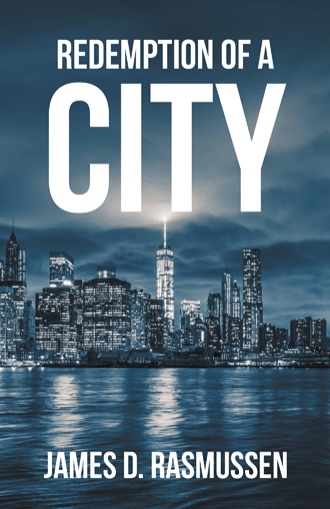
Redemption of a City
by
Book Cover & Preview Text
A woman wakes to the beautiful classical music of her alarm clock. She rolls over and gives voice commands, “Alarm off. Start coffee.” After a long yawn, she puts her feet down on the cold floor. A few seconds later, she stands, brushes her long dark hair back, and reaches for her robe. In her small, modest, simple apartment, drinking coffee, she watches the news on her monitor. “Open mail.” The woman's messages are displaying on half of her monitor. She gives another voice command, “Channel 537.” The news station then changes to a channel play-ing relaxing music. “Close mail.” The monitor is then put back to full screen dis-playing relaxing images—beaches, mountains, and sunsets—to coincide with the soft music playing. The dark-haired, thin, nicely shaped woman takes off her robe and goes into the tiny bathroom to prepare for her day. The steam from the water cascading down in her shower starts to fog up her bathroom mirror. This lets her know the water was warm enough, ready for her to enter the cramped shower stall. As Stephanie Czarniak drinks her coffee, she finishes applying her makeup and drying her hair. Her long, straight hair is not just dark, but jet-black. Her black hair was the type of color that a farmer would crave his soil to resemble, pure and deep. The deep black hair sits upon a thin statuesque body. Her skin glistens with a natural tan glow, and a flawless com-plexion compliments the entire package. She doesn’t require much makeup; she only ever wears a natural color lip-gloss, mascara that extends her already dark, endless lashes, and black eyeliner that frames out her big, beautiful eyes. Now showered and dressed, she grabs her shoulder bag and heads out of her apartment. As she shuts her door, she looks back inside and says, “Bye, Gus.” Stephanie steps out into a world of large buildings, no roads or flying cars, which 20th-century science fiction had depicted. The few roads that do exist are limited to the few cars owned by the wealthy. The rail system is the main use of transportation—the only way of transportation for most people, except for walking. Cities of the 21st century had become totally over-hauled after the turn of the century. The main inner city is now all offices, high-end retail stores, and real estate. The inner city is also where the only few roads remained. The central, or middle city, is where tall, plain, apartment buildings are housing 20% of the popula-tion. These people are poor but have steady work that enables them to have semi-decent living accessible to their employment by the rail system. The main facto-ries and warehouses are also in this section of the modern, 21st-century city. The outermost part of the city is where almost 80% of the population lives, mostly unemployed or partial-ly employed. The outermost part of the city consists mainly of thirty- to sixty-year-old mobile homes or makeshift homes—shacks. These people have no pos-sessions of any value. They cram their small homes close to the middle city as possible because the rail system does not go beyond the tall apartments and warehouses of the middle city. With 99.999% of the population being poor em-ployed or unemployed, the remaining .001% is the wealthy—not just wealthy, but super wealthy. These people live in the inner city, luxurious homes, electric cars, high-end retail stores, and restaurants. This is the city of Chicago in the year 2056, the new type of mega-city where Stephanie Czarniak lives, a typical modern city of the middle 21st century.
Formats

Book Details
About the Book
Redemption of a City is a fictional, futuristic look at consequences of a technically and economically challenged present and future contentment.
The story is fast-paced with a look at controversial subject matters and situations, based upon the fictional aspects of the story.
Stephanie is an Investigative Journalist in the city of Chicago in the year 2056. She is investigating the events of the past 44 years that have led to the current state of her city. She exposes corruption and deception. But her biggest discovery is unbelievable.
Will the story end here? The sequel to Redemption of a City, entitled The Search for Them, will be released in fall 2017.
About the Author
James Rasmussen was born in Burlington Wisconsin in 1965. He has lived in Milwaukee, Wisconsin; Syracuse, New York and Las Vegas, Nevada. He is currently in back as a resident in Burlington with his cats. ‘Redemption of a City’ is his first novel.