
Starting from Scratch
A Memoir
by
Book Cover & Preview Text
As we had long planned, Charlotte and I married on June 20, 1953, in the parsonage of the Gosport Christian Church. In Indianapolis, our introduction to big city life was rough. We were moving into our new home when we heard a commotion from an apartment across the courtyard. It looked like a man was beating his wife. When he saw us watching, he closed the curtains. We were shocked. Was this what marriage was about? I was a typesetter at Precision Rubber Plate, then a draftsman at a company that printed cardboard boxes. I realized I needed more training, so enrolled in a night school for draftsmen. Charlotte, who had finished a business school course, was administrative assistant to the chief engineer at Schwitzer Corporation, a company that manufactured automotive products. When Schwitzer was hiring, I got on there as a draftsman in Charlotte’s department. Six engineers developed specifications that twenty draftsmen used to draw illustrations for the machinists, who in turn built prototypes. For the first time, I was seeing a profession in action. Mechanical engineers specialize in translating ideas into products, and the team at Schwitzer designed water pumps and turbo superchargers. It was my first taste of fluid mechanics and fluid dynamics, which were to be so important to my research in a few years. The work was interesting and I began to understand the engineers’ ideas, especially after a transfer to the R&D (research and development) lab. Not long after, I thought I had blown my chance to stay in R&D. I was responsible for setting up the lab each evening. One morning, I walked in and was horrified to see a flooded floor and my boss pushing water with a broom and his boss pushing a broom. I had left a hose running and they were cleaning up my mistake! I was frantic. What should I do? Well, there were only two alternatives. I could sneak out the door, go home, and call in sick. Or I could grab a broom and start sweeping up water. I swept. I became determined to know more about how the pumps I was drawing functioned. My first idea was to go for an associate degree, but some of my co-workers recommended that I seek a bachelor’s in mechanical engineering. They explained the curriculum was more rigorous but would make me eligible to become a professional engineer. Because of my dismal high school record, I was admitted as a provisional student in engineering, starting at Purdue University’s Extension program’s Indianapolis campus. I had to meet some special conditions, including taking non-credit solid geometry and algebra, plus the general education courses required for all freshmen and sophomores. I worked full time while taking two courses a semester, attending classes two or three nights each week. For a while I thought that I was not going to make it. I was required to have a C or better grade point average by the end of the first year but after the fall semester I had only managed a C in history and a D in English. If I had a poor spring semester, I would be dropped. I worked very hard the next few months and got an A in chemistry and a B in calculus. It took me three grueling years to finish the first two years’ curriculum. For the rest of the baccalaureate curriculum, I had to attend classes fulltime on the main campus in West Lafayette, sixty miles northwest of Indianapolis. The chief engineer at Schwitzer tried to convince me that I really didn’t need a bachelor’s degree to rise up very high in the company. I had almost decided to follow his suggestion but the other engineers were adamant that I should go on. They were good advisors. Getting that degree was very, very important for me and opened up many doors to go further than I had ever dreamed.
Formats

Book Details
About the Book
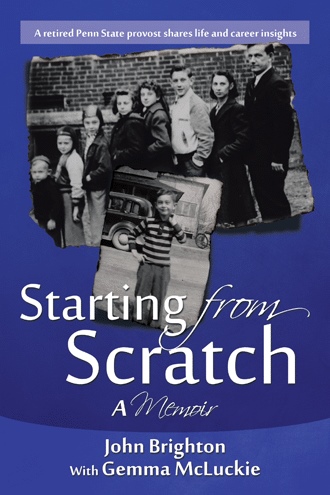
Raised in a chaotic household during the Depression and World War II in a small Indiana town, Dr. John Brighton felt trapped from the first day of school. Because of undiagnosed hearing damage and ADHD, he was labeled as “slow.” It wasn’t until he discovered engineering that he even considered going to college. Counselors predicted he would certainly fail. Instead, he proved the naysayers wrong and earned a mechanical engineering PhD from Purdue University. In Starting from Scratch, John Brighton, former provost at Penn State University, shares insights gained during almost fifty years at prestigious institutions such as Michigan State and Georgia Tech. His work as a teacher and administrator touched thousands of students, while his fluid mechanics research was vital to assisting damaged hearts. Parents whose children are in difficulty can take heart in how John Brighton overcame his own challenges. Professionals seeking to improve their skills will find sage advice on management. Starting from Scratch weaves a fascinating story that traces the arc of a successful academic career, but shows that loss can come even in ivory towers.
About the Author
John Austin Brighton, a native of Gosport, Indiana, retired as senior executive vice president and provost at Penn State University in 2002. A professor of mechanical engineering, he also directed departments at Michigan State University and Georgia Tech. He and his wife, Dr. Cheryl Achterberg, live in Columbus, Ohio.
Gemma McLuckie, an award-winning writer and editor, retired as a communications director at The Ohio State University. She lives in Gahanna, Ohio.