
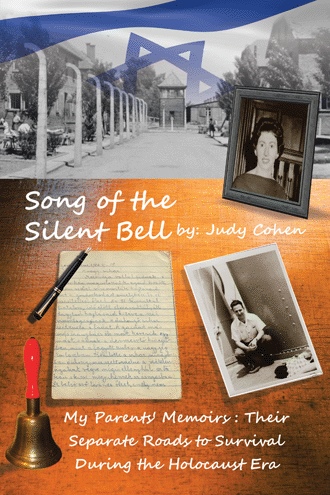
Song of the Silent Bell
My parents' memoirs: Their separate roads to survival during the Holocaust era
by
Book Cover & Preview Text
“Grandma, Grandma!” My seven-year-old grandson Itai ran into the kitchen. He couldn’t wait to share the good news with me. “I beat Papa at chess again!” I looked at my father and saw the twinkle in his eye. He could no longer move his incapacitated body but his eyes were dancing with happiness.
On December 1, 2013, my father, George Kay, passed away peacefully at my house in Sha’arei Tikva, Israel, two days before his 94th birthday. A few months later, I went with my mother, Olga, to help clean out their apartment in Netanya, a city located in the northern central region of Israel. As we were sorting through my father’s papers, we discovered an old, tattered notebook filled with his hand-written, native Hungarian. My mother, also a native of Hungary, began reading through the journal curiously. After some time, she looked up at me in awe. Puzzled by her expression, I asked my mother what she had read.
“It looks like poetry and letters”, she answered. Her eyes looked at me questioningly as she ran her hands through her hair, obviously perplexed. “I had no idea he was so gifted. He never told me about this. Never mentioned that he wrote poetry.”
I carefully took his notebook and gazed at it searchingly. Its cover was cracked and the pages inside yellowed with age. Since I could not read Hungarian, all I could do was stare blankly at my father’s handwriting. Some entries were written in blue or black ink. Others in pencil. I was trying to imagine my father - such a quiet man - having a secret gift from G-d which he had never shared with anyone. Not even his wife. I asked my mother if she could translate some of it. She tried but it was too difficult for her since English is not her mother tongue. We continued sifting through the rest of the papers for other written works but did not find anything.
The first thing I wanted to do was translate his poetry into English. My mother was thrilled with the idea. After making a few inquiries, I hired a lovely, young native Hungarian woman named Juli Elroie Kristof and sent her a copy of my father’s thirty page manuscript.
Two long months after my mother and I had first discovered his writings, after waiting impatiently to read his work, Juli finally sent us the completed translation of my father’s journal. As I read my father’s poetry in English, I was struck by the power and emotion that exuded from his words; both characteristics so contrary to the person we thought we had known. The thought of leaving my father’s poetry lying in a drawer seemed so unjust, but maintaining the secrecy of his hidden talent fit exactly who he was. He would never have wanted any praise. However, despite his having chosen to keep his writings private, I have chosen to publish them, albeit quietly and modestly.
The poems and letters in his notebook were dated from 1940 to 1946. Those were the years my father had spent in Palestine. We didn’t find any other of his works written before or after those years. I still often wonder why he wrote only during this period. Perhaps it was the turmoil he had experienced during those years that brought out the poet in him. The passion he put into his writing touched me profoundly. Having my own affinity for poetry, I felt like I understood the intense need he had for writing at that time in his life. I lamented not being privy to this part of my father’s personality while he was alive and I felt that writing this book would help me grieve. My sister, Evelyn, and I both have children and grandchildren who knew my father. It is important for me to document his works so that his grandchildren and great-grandchildren can learn about the side of him they never knew.
As I pondered over the idea of publishing my father’s works I thought of my mother’s own compelling story of survival, the story my sister and I had been hearing since we were children. I knew then that I needed to put both stories down in writing. This book contains the memoirs of my mother, and my father, and the tragic fates of their families. My mother is a Holocaust survivor, who endured the horrors of three concentration camps. My father escaped Hungary on the Sakarya, one of the largest ships that brought illegal Jewish immigrants to Palestine at the beginning of 1940.
I decided to write my parents’ memoirs not only to help preserve the Holocaust memories of a generation that is dying out, but also to incorporate my father’s literature and breathe new life into the poetry that had been lying locked away and dormant for almost sixty years. The chimes of his bell will be silent no more.
Judy Cohen
Formats

Book Details
About the Book
"You were the crown of your tree and you held your head high among your branches. Your sprouts reciprocated the care they got from you with joy. But you left us so young, dried out before it was your time, you left your sprouts to the mercy of the wind..."
"I took his notebook and gazed at it. Its cover was cracked and the pages inside yellowed with age...all I could do was stare at my father's handwriting. Some entries were written in blue or black ink...I was trying to imagine my father - such a quiet man - having a secret gift...which he had never shared with anyone..."
The poems and letters in his notebook were dated from 1940 to 1946; the years my father had spent in Palestine after escaping war-ravaged Europe. Torn from his family and uprooted from his native country, he took to writing poetry as a way of coping with the torment and emptiness that had engulfed him.
Song of the Silent Bell contains my parents' memoirs and the tragic fates of their families. My mother endured the horrors of three concentration camps and my father escaped Hungary on the Sakarya, one of the largest ships that brought illegal Jewish immigrants to Palestine at the beginning of 1940.
This book, born from an astonishing discovery, describes an intimate family portrait of a lifetime journey of courage, opportunity and love.
About the Author
Judy Cohen grew up in New York City and moved to Israel when she was 19 years old. She works as a technical writer and enjoys writing poetry.