
Nigeria
Contemporary Commentaries & Essays
by
Book Cover & Preview Text
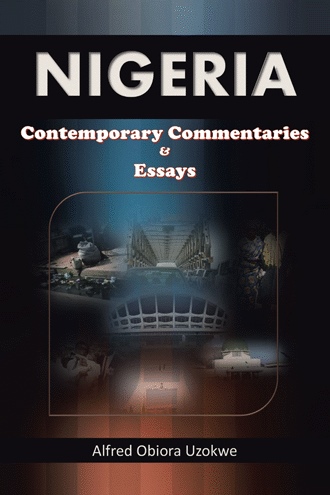
This book is a collection of published and unpublished commentaries I have written, over the years, about Nigeria. The subjects are diverse, ranging from politics, aviation, infrastructure, health and welfare to economy, accounts of some of my visits to Nigeria, the 2015 presidential elections and more. Policy makers in Nigeria, as well as scholarly researchers, have often inquired if there is a one-stop repository of my writings. This compendium effectively answers their questions.
Nigerians are resilient, ingenious and resourceful. Add that to the fact that the nation has one of the most sought-after natural resources in the form of oil and the image of an Eldorado or land of milk and honey begins to develop in one’s mind. Unfortunately, the country has not made appreciable progress since independence. The country continues to flounder, plagued by corruption, unemployment, runaway inflation, insecurity and poor standard of education. Many of the major roads are pothole-ridden and the currency continues to slide downwards vis a vis other currencies.
Nigeria’s problems can be traced to the fact that 54 years after independence, she is yet to be blessed with truly selfless leaders. Her leaders lord themselves over the masses and treat the nation’s treasury as their personal purse. In the end, they leave the nation more wretched than they met it. Oil has sustained the economy for very many years but instead of using proceeds from oil to diversify the economy, Nigerian leaders continue to preside over a one-dimensional economy. Now that oil price is plummeting and the United States has ceased to buy Nigeria’s crude oil, the nation’s economy has gone from bad to worse. Her foreign reserve is being depleted at a rate so drastic that it may be gone before Nigeria even experiences a truly catastrophic economic event!
When Nigeria began her current democratic experiment, there was hope that being extricated from military dictatorship would throw a major life line to the masses. Sixteen years later, the expected lifeline has been a mirage at best. Until May 29, 2015, the Peoples’ Democratic Party(PDP) bestrode the land like a colossus, fostering corruption and creating a nation where citizens go hungry in the midst of plenty. This national malaise created an unbridled yearning for change of leadership and direction. When, therefore, a couple of political parties pulled together and developed a formidable opposition party called All Progressive Congress(APC), with General Muhammadu Buhari as their flag bearer, Nigerians flocked towards the party and eventually dethroned the ruling party. Buhari is now the new president of Nigeria and the world is keenly watching to see if the soldier-turned politician would make a positive difference.
It has not been all doom and gloom for Nigeria though. The advent of democracy meant the banishment of military rule, hopefully to oblivion. Today, Nigerians can at least freely express their opinions verbally or in print, a far cry from what happened during the military rule. The just-concluded presidential election, which was adjudged successful by many, as well as the peaceful acceptance of defeat by President Goodluck Jonathan, is a huge progress when compared with the uncertainty and subsequent carnage that seemed to follow most elections in the country. In spite of this partial progress, the nation is not yet where she needs to be. Nigerians must continue to strengthen democracy and its institutions by unashamedly demanding that her leaders operate the ship of state in line with the dictates of the constitution and tenets of democracy. There is no better way to ensure accountability than by calling the leaders to the carpet, on the pages of newspapers, the internet and other available forum, whenever they head down the wrong path.
I have closely followed Nigerian politics and development for many years, even after I left the shores of the country. Since July of 2001, I have been writing sociopolitical commentaries about the country, many critical of the leadership and their modus operandi. Where warranted, I have proffered solutions. Hopefully, my writings have helped keep the spotlight on the failed policies of our leaders while reinforcing awareness of the populace about the excesses of Nigeria’s selfish leaders, something that is necessary for eventual positive change.
In spite of the difficulties of the present time, I foresee a great future for Nigeria and I intend to, along with many other writers, help shape same through the power of the pen. My goal is public enlightenment, influencing opinions, setting discussion agenda and shinning the searchlight on often-neglected issues in Africa’s most populous nation.
This compendium of some of my commentaries about Nigeria is my own modest contribution towards the national discourse. It brings my writings into one volume as a reference material for those conducting research about the country. Also, it will be another tool for policy makers in their everyday decision-making process.
Formats

Book Details
About the Book
This book is a collection of Alfred Obiora Uzokwe’s critical commentaries about Nigeria’s triumphs, woes and the way forward. It brings his writings into one volume as a reference material for those conducting research about the country. It will also serve as another tool for Nigeria’s policy makers in their everyday quest for better decision-making. The subjects of the commentaries are diverse, including politics, aviation, infrastructure, health, welfare and economy.
Nigerians are resilient and ingenious but the country continues to flounder, plagued by poor transportation infrastructure, corruption, unemployment, inflation, insecurity and poor standard of education. The problems of Africa’s most populous nation can be traced to rudderless and selfish leaders that have continued to preside over a unidimensional economy. With plummeting oil prices, the nation is now in dire straits more than ever before.
Yearning for a change in leadership and direction, Nigerians recently voted in a new government at the center, headed by a former military leader who has vowed to institute change. The world is keenly watching to see if the soldier-turned politician would make a positive difference.
In spite of the difficulties of the present time, Nigeria still has the potential of becoming a great economy. Social media where citizens freely vent their thoughts about their leadership is slowly gaining the attention of leaders. Furthermore, the sometimes scathing commentaries about Nigeria’s leaders by the media and commentators like Alfred Obiora Uzokwe, can no longer be ignored by the leaders because of their reach in this internet age. Nigerian leaders are slowly being forced to listen to and pay heed to the yearnings and aspirations of the masses and that is a step in the right direction.
About the Author
Alfred Uzokwe was an Architectural Designer for many years in Nigeria before moving to the United States. His first book - Surviving in Biafra, The Story of the Nigerian Civil War, was published in 2003. He has keynoted many Nigerian organization events in the United States. He holds advanced degrees in architecture and civil engineering and directs architecture and engineering work. He is a professional engineer licensed to practice in the states of Pennsylvania, Maryland and Washington DC.