
The Good, the Bad, the Butlers:
Story of a Texas Pioneer Family
by
Book Cover & Preview Text
When the time came for William G. Butler to start cattle drives, he was not lacking for ranch hands to ride the trail to Nebraska or Kansas. Butler had his brothers, his in-laws, and some black and Mexican vaqueros. The cattle drives would be going through dangerous Indian Territory. Some of it was a virtual no-man’s land – places where even Native Americans didn’t venture – where outlaws, Confederate renegades, and deadly Indians hid out.
The blacks had to be on their best behavior for fear of skirmishes breaking out in the Southern and Border States which saw the end of slavery three years ago. The Ku Klux Klan and their lynch mobs were just getting started so Butler, who was only a private in the war but called Colonel by friends and acquaintances for his leadership skills, had to keep a tight rein on everything, not just for getting the cattle to market, but for his ranch hands’ safety.
The Butler family sold some cattle the year before their first official trail drive, according to the county transaction book. Acting as an agent for different people, W.G. Butler would buy or sell anywhere from just one cow to hundreds of cattle. Whether it was a rancher or an ordinary citizen, the goal was the same for every transaction – get the cow to market in the north and turn a profit, hopefully as much as tenfold. Some people were selling only one or two cows from a brand which indicates a poor farmer or widow with a very small income trying to scrape together whatever money they could.
W.G.’s first full cattle drive to Abilene, Kansas, was in 1868 when he and his group took the cattle (numbers vary from 500 to 1,000) up north. Pleas went on this trip but ventured only as far as Gonzales before heading back.
The 1868 group went north through Austin, Belton, Valley Mills, Cleburne, Fort Worth, and on up to Kansas. There was no Oklahoma yet, just Indian Territory. There were no big stores after Fort Worth so the store operated by Daggett and Hatcher became a popular stop for cattle drivers to load up on supplies that would last a month. Supplies included flour, beans, coffee, dried fruit, and bacon. Each man’s daily ration of flour and bacon was about three-quarter of a pound each.
The ranch hands on W.G.'s cattle drive of March 1868 were his brothers Robert and Wash; L.C. Robin, Buck and Jess Little, Boxie White, John Brady, Juan Mendez, Juan Concholes, John Sullivan, Jim Berry Nelson, and former slaves Levy and William Perryman.
Butler and his men were riding up the Chisholm Trail, which was more or less a basic direction. There were some markers if you could find them but it didn’t matter that much because your path may be a half a mile wide with cattle and cowboys spread so far away that you might not see all of your group, just the dust that it kicked up. They were bound for Abilene, Kansas, and once they arrived they sold the cattle for top dollar and began the journey back.
Crossing Indian territories sometimes called for extra expenses, whether it was termed bribery for the Indian tribe or tribute money or tax for the right to enter the Indian territory. Sometimes, the fee was cash but others accepted food. Most of Butler's cattle drives went to Abilene or Dodge City, Kansas or Ogallala, Nebraska. Wherever they went they had to pass through what is now Oklahoma which then was Indian Territory and dangerous with different tribes, ex-Confederate soldiers turned renegades and other cutthroats.
Brothers Albert, Robert, and Wash took part in the drives and Dan and Pleas joined them when they got old enough. Pleas and W.G. were partners for several years before Pleas branched out on his own with his own cattle and men.
It was not uncommon for a cattle drive to go west to California or as far north as Canada. Sometimes, the cattle drive would set out for one city but continue on when it was discovered that the prices weren't as high as expected. Or they heard of a bigger grazing area where the cattle could fatten up some more before going to market. It was all about timing, and several pounds plus or minus per cattle or a few cents on each cow, could make the difference between a weak or prosperous year.
Butler was one of the first to employ blacks as cowboys and trail drivers. Some of the black cowboys who drove cattle to Kansas, according to family historian Charlotte Nichols, were Levy Perryman, William Perryman, Alfred Perryman, Juan Concholes, and Moses Johnson.
Formats

Book Details
About the Book
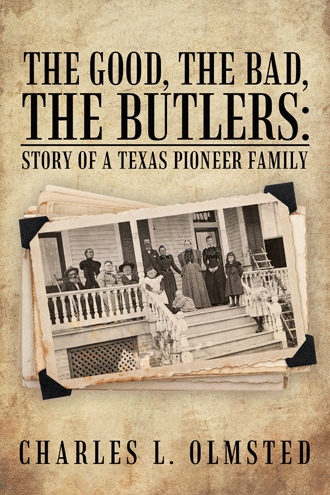
Despite his challenges as a deaf-mute, Burnell Butler was one of those who dreamed of a better life in Texas. Lured by all the twenty-eighth state offered, Butler, his wife, twelve children, and seven slaves gambled big in 1852, migrating from Mississippi in covered wagons to the unknown prairies of Texas. It was there that the Butlers would begin a new chapter, fueled by their rugged, hard-working spirit.
Charles Olmsted, a former award-winning sports writer, relies on extensive research and anecdotes to chronologically capture the fascinating history of the Butler family. Beginning with a cattle drive during the Civil War, Olmsted details how Burnell’s son, William G. Butler joined in helping build the foundation for the multi-billion dollar beef industry, rode the Chisholm Trail with his family from the 1860s to the 1880s as part of the transformation to cattle cars on railroads, and often settled disputes with gunfights. Included are excerpts from letters, newspapers, and books as well as details from land purchases, proclamations, and real-life accounts.
The Good, the Bad, the Butlers shares the true story of a pioneer family as they built a new life in Karnes County, Texas, and attempted to survive all the challenges of living in a dangerous and dusty land.
About the Author
Charles L. Olmsted started his career as a sports writer for the Lake Charles American Press where he earned several Louisiana Sports Writers Association awards. Charles now divides his time between South Texas, South Louisiana, and South Korea.