
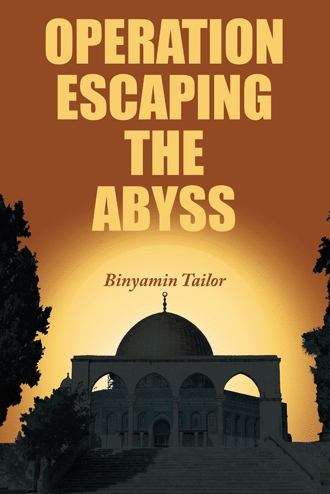
Operation Escaping the Abyss
by
Book Cover & Preview Text
Eryn stepped off the bus smiling. “Grandpa how’s my dog?” she asked excitedly. “Oh fine” he replied, preferring not to give her the details of the recent mess he just cleaned up. G.P. knew whatever he told his only grandchild would soon find its way back to her mother. “Grandpa, do you know what the Holocaust was? We’re studying it and I have to write a report on it. It’s due soon. Did you know any Jews who died in it? What did our church do to save children from the ovens?” She excitedly rattled off her questions. “Let’s wait until we get into the house, wash up and get a snack. That’s a powerful subject for such a little girl,” he spoke in a quiet tone. G.P. decided not to go into too much detail, but instead to find out what she already understood and then keep his responses brief. Mehmet thought it best to protect her from the truth as he saw it. His church, as well as the vast majority of other organized Christian churches did nothing, spoke nothing, and did not encourage anyone else to do anything to stop the butchery in Europe at the time. Yet, his personal guilt was not diminished knowing that other religions were equally compliant with their silence. Mehmet rationalized the Jews eventually got a homeland out of it, even if part of it belonged to his people. Talking about Jews and the Jewish religion was difficult. G.P. had grown up in an era where Jews were thought to be responsible for the death of Christ. This was reinforced at home, when talking with friends and even from the priests at St. George’s Academy. The latter made a point of never mentioning the Holocaust; however, it was generally agreed that the Jews got what they deserved. Attending parochial schools for his elementary and secondary education in the Chicago area, Mehmet found his environment tightly structured, with established group stereotypes rarely challenged. Questions such as Eryn’s would not have been tolerated. In fact, she would have been chastised just for asking. G.P. became part of a group of high school boys, each from different backgrounds, who attended the same school and saw themselves as the local defenders of Christianity. On their way home, they would intentionally seek out apartment buildings where Jews were thought to live and shout out “Kike” or “Dirty Jew” at the top of their lungs. “We kids were stupid and insensitive,” G.P. reflected. He kept in touch with some of his friends who carried their prejudices with them into adulthood and transmitted them to their own children. “It’s amazing how contagious hate is under the right circumstances,” he would later mention to Eryn. Mehmet thought the State of Illinois law mandating education on genocide and the Holocaust in particular, had merit. He believed that if his generation had been exposed to such teachings, perhaps they might not have acted as such "intolerant assholes." Yet, even he still held some subtle resentment because Jewish kids were now heir to some of his peoples' heritage in the Middle East. With this background, Mehmet hoped he and Eryn could quickly gloss over the entire matter. “Grandpa,” Eryn said looking down as she ate her dinner, “Did you…" she hesitated, "do anything to stop what was happening?” “Eryn, I was born just as World War II ended. There wasn’t too much a baby could do, was there?” Eryn persisted. She asked the same of her great-grandfather, my dad. G.P. knew all too well that his father despised Israel and those who were responsible for its creation, a result of his upbringing and experiences in the Arab Quarter of Jerusalem. It was there he would encourage his family to avoid Jews as much as possible. “Sweetie, your great grandfather didn’t have the opportunities to know too many Jews in a pleasant way. His upbringing in Palestine and the people he hung around were biased against anything they did not understand. Largely, they feared the Jews, who seemed content to be amongst themselves. Most were financially stronger than his family and he hated that. He and his parents worked very hard clearing the land in order to grow their fig trees, but had little to show for it. He resented the Jews who accomplished so much. He did not appreciate the pain of Jewish history, particularly the Holocaust. Instead, he perceived discrimination against his own people, everywhere he looked. That’s why our family came to America. Life was easier here for those of Arab decent, but certainly not easy and some of our historical biases traveled with us.” G.P. continued, "In a culture such as your great grandpa’s, they were used to settling disputes with violence. Because of the appearance of primitiveness, Arabs were frequently made the butt of jokes. Here, where I grew up, Jews were taught by their parents to resolve problems with their heads and for the most part not to rely on their fists. That is to say until 1948, when they established their State of Israel and survived an Arab onslaught from all sides. Then, they were respected for their unexpected strength in battle, while at the same time resented for what they took away from us. The original plan was that the land was to be divided, but many Arabs would not accept this. Some felt the Jews had no rights to the area allotted to them, and Arabs from many nations lined up to drive them into the sea” “Grandpa, are you saying your father stood by and did nothing, while innocent Jewish babies were murdered?” “It’s more complicated than that, Eryn. The Holocaust was taking place in Europe and our family lived in Palestine in the Middle East. I think my family really did not understand the extent of what was happening to the Jews. It wasn't a tribal conflict to get even with a group of Jews suspected of wronging a clan of our people. Rather, it was the European governments organized efforts to exterminate every trace of the Jews from the European continent. If it had been successful there, which thank God it was not, I believe it would have carried over to every other corner of the world, with disastrous results.” “Honey, my father, didn’t have the luxury to think of anybody other than his own family. He was very involved with keeping them fed and housed. It’s difficult to worry about someone else when you are barely making it yourself. Don’t judge my father and our people too harshly, as they didn’t have the advantages you or I have. Under other circumstances, I would like to believe your great grandfather would have shown empathy in efforts to seek justice for Jews.” G.P. hoped this would have been an acceptable end to this distressing conversation, but that wasn’t to be the case. Eryn persisted, “Grandpa, if you were older, during those bad times, what would you have done?” Lucky for me the telephone rang. It was her mom, and Eryn took the phone, happily relaying the events of her day, with just a brief reference about our discussion. "What would I have done?" I thought aloud. This question would haunt me for some time. Perhaps I would have been my father.
Formats

Book Details
About the Book
While exchanging innocent emails with the son of a Lebanese diplomat, ordinary housewife, mother, and teacher Abbie Wolf learns of a nuclear terror plot years in the making. The family’s quiet, Midwestern lives are no longer safe, which forces her husband, Jon, to seek outside help to bring the plot to light and save the people he loves most. He meets G.P. Mehmet, a retired FBI agent of Palestinian descent. At first, the two men have sharply differing opinions and even some prejudice towards the other. Due to the crisis at hand, they are forced to make an alliance. Together, they must untangle a web of terror and deceit that hides the man responsible for a violent plan to alter the balance of power in the Middle East. Mehmet’s family is soon in danger, too, including his daughter, Malak, and grandchild, Eryn. He begins to question his resolve: are the Jewish people worth the risks he’s taking at Jon’s side? He is spurred onward by an unexpected question from his granddaughter, and together, these two family men fight for the lives of an entire nation.
About the Author
Ever hopeful Israel and her Arab neighbors will come to terms, Binyamin Tailor has worked tirelessly to assure Israel her rightful place among the family of nations. Since the 1993 Declaration of Peace Principles were announced, he has authored well-received, critical articles regarding the ongoing failures to achieve a credible Middle East peace.