
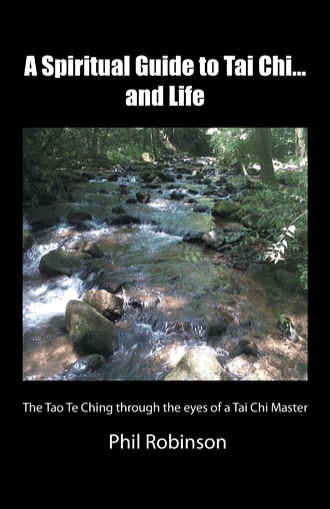
A Spiritual Guide to Tai Chi...and Life
The Tao Te Ching through the eyes of a Tai Chi Master
by
Book Cover & Preview Text
Introduction
Allow me to introduce myself. My name is Phil Robinson. I enjoy the plain, simple things of life. I have a large family, including sons, daughters, grandchildren and several dogs. I also have 50 years experience in studying Tai Chi and the philosophy that weaves itself through Tai Chi by means of the Tao Te Ching. Many who read my first book, Tai Chi The Way Of Balance In An Unbalanced World, wanted more detailed information about the Tao Te Ching and how its philosophy can apply to our life today. So, here we go again...another two years or more spent at the keyboard.
It may surprise you that the people who were the founders of Tai Chi Chuan, the ones who perfected its healthy moves accompanied by deadly techniques, were common men. These were men who ate plain, simple food, lived in small basic dwellings, often could not afford a pair of shoes and usually died in poverty. They were your basic soldiers who were determined to survive by defeating the enemy and remaining healthy in the process. That was Tai Chi at its beginning.
In the 1700s, Taoist Philosophy was introduced into Tai Chi Chuan by means of a man named Yang (pronounced Young). Yang realized the pages of the Tao Te Ching had much to offer Tai Chi. It is this Taoist philosophy that sets Tai Chi apart from many of the other ancient martial arts.
It also should be no surprise that these holy men who were adept with Tai Chi Chuan, and were equally knowledgeable about the Tao Te Ching, were also common men. Oh yes, these were educated men, brilliant holy men with plenty of wisdom to offer, and yet we would never see these men wearing a $4,000.00 suit in a stadium full of frantic people. They too, often died with nothing to show for their years of endeavor.
The point is this: These men that lived hundreds of years ago who were responsible for Tai Chi and its spiritual guidance that we enjoy today were probably more like you and me than you imagine. These ancient philosophers and warriors were set apart from their contemporaries by the burning quest for knowledge and their unrelenting pursuit of the truth.
Remarkably, here we find the common thread you and I have with these ancient holy men/warriors. We have a sincere desire for the real truth of the matter. We find ourselves in a constant search of not only the how but also the why of things. As for me, much of this quest for the best spiritual way has involved a detailed study of the Tao Te Ching. I have learned much from this spiritual guide, and now I am going to share it with you. Enjoy - Learn - Smile
My sincere blessings, Phil Robinson
Chapter 1
Our Journey Begins
Have you ever walked along a nature trail, or in a park and came upon a small, babbling creek? To cross this creek, you had to walk across a small wooden bridge that appeared to be about one meter above the water. Most likely, you found yourself stopping at least once along the way, just to see what was down there. I do that all the time. Whether it is a small bridge made of wooden planks with no side railings, or one of the engineering feats of the world, such as the Chesapeake Bay or Golden Gate Bridge, I must look at what is beneath.
In this book, we are going on a journey that will take us into the minds of ancient wise men. We are taking a trip to an ancient culture, and we plan to use a narrow bridge to cross from our way of thinking to the ancient way of thinking. Let's plan on stopping a few times along this bridge to admire the different scenery. Although we want to confine our thoughts to Tai Chi only, we may find that a bit difficult because the Tao Te Ching is all-encompassing and applies in so many areas of our life.
As this journey unfolds, our understanding of the Tao Te Ching will increase, and we will see its principles apply more and more to life in general. Gradually, we may see our bridge expanding, getting larger and stronger. And that is how it should be. Therefore, in addition to the applications to Tai Chi, we will also have applications to life.
But for now and throughout this book, we will try to keep the journey on the straight and narrow. We will stay focused on our Tai Chi as a primary focus, and life in general as a secondary one. This book was written with the Tai Chi student in mind. It is my intention to share with you the spiritual side of Tai Chi. So, if you are not a student of Tai Chi and you are reading this book anyway, so much the better, because you are about to become acquainted with a wealth of information.
Any trip requires advance knowledge. If you are going to the grocery store it is a good idea to know ahead of time what you need to buy and how much it costs. If you are going across the ocean the more you know in advance the better. For example if you are going to France, you may need to learn some basic French because you just might run into someone who does not speak your own native tongue. The same principle applies with our journey. Before we set our first foot on the bridge, we must make a few advance preparations. What we will do is put a few necessary things in our backpack; it will be called advance knowledge.
Our advance knowledge entails we answer a few questions:
• What is Tai Chi?
• What is The Tao Te Ching?
• Who was Lao Tzu?
• What is Taoism?
Once these questions are answered, we can take our first step on the bridge that will connect us to the ways of ancient China. The first thing on our list that goes in the back pack is what is Tai Chi?
Formats

Book Details
About the Book
We all have a common denominator. We all would like something easy to follow that could make a difference in the quality of our lives. This book does just that. Mr. Robinson takes us on a journey back in time where we explore the minds of the wisest in ancient times. Although written for the Tai Chi student, Mr. Robinson makes it clear the Tao Te Ching can be a guide for everyone. This is one of those books you can't put down and will find yourself referring to it for years to come.
About the Author
Mr. Robinson was born, raised and educated in the Southeastern United States. Currently, he lives in the foothills of the North Georgia Mountains with his family and five dogs. When he is not writing, he teaches Tai Chi and Taoist philosophy at Kennesaw State University in Atlanta, Georgia. He helps special needs adults and children by educating them on Tai Chi exercises. As an avid dog lover, he does much charity work for homeless dogs.