
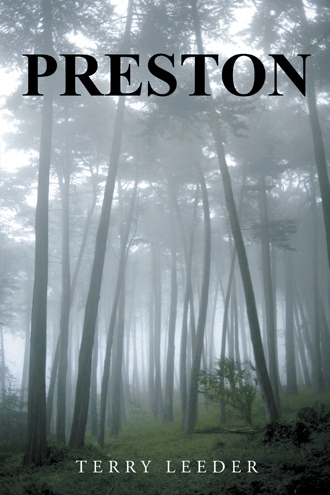
Preston
by
Book Cover & Preview Text
It actually is interesting to drive down to the city along a road that stabs through a gully and suddenly we’re at the edge of the mountain and turn right and go down an elaborate twisty road and come out among the scruffy old wooden houses in the east end and finally along a street that goes right through the steel plant and we can see, on each side of us as Richard drives slowly by, the inside of the steel plant with fire blobs jumping out and a long steamy aisle with dark happenings and men vague inside there, walking around. “That is a horrible way to make a living,” I say. And then we go through more scruffy neighborhoods and by vacant neglected lots with junk and weeds and finally along the road by the beach where the skyway soars above us and the cottages look even more run down than the houses we passed ten minutes ago. Just before we arrive at the lift bridge across the channel that leads from the lake to the harbor, bells start clanging and black and white striped barriers come down. While we wait, the entire body of the bridge in front of us starts to move up, a great blocky thing criss crossed with girders and an open net for the roadway when the bridge gets high enough that you can see it and hear it later when the bridge comes down and you drive across and your tires make smirring sounds. I open the door and get out of the car because I’m getting cramped, even though Richard has got hold of a big white luxurious thing with a sliding door in the roof and windows that move up and down with a button and a car door he can lock by holding some black little oval with a ring at one end and four silver squares along one side and pressing one of the silver squares and the car locks itself with a clack. He doesn’t have a key. He just gets in the car and pushes a button below the steering wheel and the car starts. What’s to prevent anyone from doing that? I asked. “This,” he said, and held up the same black oval. We walk to the end of the road, by the barrier, and around that to the edge of the pavement, and watch an old lakeboat towed through the channel. The pilothouse at the front has a sort of visor hat and the railings and the decks are speckled with rust. A poor old boat going to the steel plant to die. To be cut up in pieces and melted down. Like the steel plant itself, now that the new owners have taken over, says Richard. I watch the old fellow, painted bravely black and white. It used to be young and useful and the pride of its fleet. Now it’s being cut up, like the rest of us. No more use than scrap. But it moves by majestically. A big boat. Even now, a big magnificent boat. Paint her up and put a new crew on and she’ll be as good as new. Not wanted. It always sounded strange, how the navy types used to call their ships “her.” The pilots did the same thing, with bombers. “That was interesting,” I say to nobody in particular when we are back in the car and the bridge has slid back down and the barrier lifted up and we stream off with the rest of the cars that were waiting with us. “Greasy,” says Beverley. Richard has been gone for two years, but he remembers, and we stop by a boarded-up store that used to be an art gallery, and grocery or hardware store before that, and many long years before, a railroad station on the train line that went across the sand barrier that blocks off the harbor and makes a roadway for the Skyway, which has been arching above us and gradually come down to ground level again. Up the street a bit is the old Mohawk Chapel, set back among trees, a small thing as far as churches go with a nice spire and a well proportioned front entrance and steps with a railing going up to the double doors and down the street an ancient tree knobbly at its foot, stuck out in the road and lifting three sections of the cement sidewalk up around its roots. The trees are huge and green and arch across the street and they won’t last long, now that the city has decreed that the street will be repaved. So says Richard. “I don’t know how I’ll manage the next few months,” he says. “I’ve spent all my money in Africa.” “This is a pretty luxurious car,” I point out. “Rented. Just for you. Just for today.” “We can lend you something. We really don’t need it,” Beverley says. I can see what’s been going on here. “It just sits there.” “No Mom,” Richard replies and the subject is dropped, but it’s clear it won’t disappear. We eat at a place across the road from the lake and Beverley insists on paying and then we walk along the waterfront and I stop by a memorial to the corvettes of the war and their crews. These names sound familiar. I must have known some of these people. Nobody challenges me. They are both being very agreeable today, which makes me suspicious. I am somewhere on the other side of a glass partition watching everything passing by and nobody notices I’m even here, and talks as if I’m not. Where they are, everything changes, but nothing happens, everything remains the same, where I am. I’m tied up to a muddy bank with scrap and weeds in the long grass, waiting for the torches to cut me up and feed me to the steel plant. Head first with my feet stuck out. My toe is sore. A breeze is coming in off the lake and like Richard says, it’s getting colder, some sailboats out there are flinging spray and leaning dangerously as they swing about, in some kind of race it looks like. There are people walking along the cement breakwater, kids and dogs and parents and young lovers and teenagers acting stupid. A parade. I’m feeling good. I need to get out. This is good.
Formats


Book Details
About the Book
Something is not quite right. Preston has dealt with all sorts of difficult situations, but can he deal with this one? What is it like to have to cope with the gradual disappearance of all the abilities you have valued your entire life? We see through Preston’s eyes as he copes with all the wrenching changes in his body and mind, and as he describes what he thinks and feels. But the story he tells is also a story of love, the love of two married people for each other, a love that is tested by a disease that changes Preston in the most profound way imaginable.
About the Author
Terry Leeder has written and published 12 books, including Melissa’s Daughters, A Trip Across Canada, The Iron People, The Great River, and Pioneer Among the Mountains. He is married, has 2 sons, a daughter-in-law and a granddaughter, is a member of the Royal Astronomical Society of Canada, and lives in Oakville, Ontario.