
The Thorny Road to Success
A Memoir
by
Book Cover & Preview Text
In 1944, when the Nazis occupied Budapest, a number of Polish Jews who’d escaped from ghettos in Poland to Hungary were able to cross from Hungary to Romania. Among them were Kamil and Irena Hammer, whom we met during an outing on Lake Baneasa one Sunday morning. We immediately liked the couple, and it turned out that Irene Hammer’s birthday was on the same day as my wife’s, November 15. At that time, another couple arrived in Bucharest—Wira and her husband, Joseph Jarosz. She was from Chernivtsi, Bukovina, and he was from Lodz, Poland. They met when Joseph escaped from Poland to Chernivtsi, but he was soon caught and sent to Transnistria by the gestapo. Wira, with the help of her parents, was able to bring Joseph back, and they got married. Joseph’s real name was Silberschatz, and after the war was over, Wira and her husband returned to their real names.
We met almost daily with the two couples. One day, Irene Hammer told us that before the outbreak of the war, she had helped her wealthy uncle in Lodz by typing confidential letters for him. She remembered that her uncle transferred money to a friend, Mr. Nadel, who had emigrated to London before the war and was keeping the money for her uncle. She wondered whether there was any way to find out whether Mr. Nadel was still alive and, if so, what his address was. I thought that if I could find a telephone book of London in Bucharest, perhaps we could locate this Mr. Nadel.
One of my colleagues at the plant pathology department of Professor Savulescu at the ICAR (Institutul de Cercetari Agricole Romaniei) had a distant relative who worked in the main office of the Romanian telephone company. A search by this person came up with a telephone book of London from 1936, but the book could not be removed from the building. I went there and was shown the large volume. It did not list a Nadel in London, but there was someone by the name of Nardel. We figured out that perhaps after arrival in England, Mr. Nadel had anglicized his name and become Mr. Nardel. I composed a letter in which I mentioned that someone was searching for a Mr. Nadel originally from Lodz, Poland, because a large amount of money was due to Mr. Nadel from some inheritance. I asked if, by chance, Mr. Nardel might know something about the missing Mr. Nadel. It was like looking for a needle in a haystack, but I thought that the promise of a large inheritance from some unknown source might do the trick. I gave my own name and address and did not mention anything about the uncle of Irene Hammer.
The letter worked! A few weeks later, a letter arrived from the son of Mr. Nardel (Nadel), who said that his father, who’d emigrated from Poland, had changed the family name by adding the letter r. The letter contained the address in London, and the son and his father, still alive, wanted to know more about the inheritance. Kamil Hammer decided to travel to London. This trip was not simple, because he had to pass borders illegally without a passport and visa. It took him a couple of weeks to reach London, where he confronted Mr. Nadel, requesting the money left by the murdered uncle of Irene. Mr. Nadel first hesitated to admit how much money was involved and also what he had done with it, but Kamil was able to persuade him to disclose the truth. Mr. Nadel told the truth because he himself was no longer able to get the money. Before 1939, he’d deposited $5,000 in the Chase Bank in New York, but the money, marked as property of a Polish citizen, had been blocked when the war in Europe broke out, and it was still blocked in 1946.
In February 1947, Irene and I arrived from Sweden in New York. Kamil and Irene Hammer were in Paris at that time, where Kamil worked hard, sewing fur remnants into fur pieces large enough to make fur coats. It was the business of Kamil’s distant relative. The Hammers gave us all of the information they had obtained from Mr. Nardel, and they hoped I would be able somehow to get the blocked dollars from the Chase Bank and send the money to them.
I took the subway to Wall Street, and armed with a notarized power of attorney, I went from office to office in the highrise Chase Bank headquarters building until I found the proper employee, who agreed to check the list of blocked accounts. He found the Nardel account but was reluctant to release the $5,000 at first. I tried, in broken English (I was only three weeks in the States at that time), to explain that the war was long over and that there was no reason to continue the blockage. After half an hour, the employee went to his superior and returned with a check for the full amount of $5,000, less fifty dollars for some procedural expense. I grabbed the check and decided that I could not carry this amount, larger than any I had ever seen, in the subway. Downstairs in the bank, I opened a savings account for Karl Maramorosch, jointly with Kamil Hammer, and they gave me a booklet and told me that the deposited amount would bring approximately 1 percent per year in this savings account. Happily, I returned by subway, paying the five-cent fare, sure I had done what was in the best interest of my friends in Paris.
I wrote a letter to Kamil and Irene and described the affair in detail. Promptly, their answer came. They did not want the security of the savings account or the 1 percent interest after one year; they needed the money right then in France. Kamil asked me to take the money out from the bank and pay it to a Mr. Friedman in Queens. This gentleman did not have a phone. I took the subway that I was told to take, but this took nearly two hours, because I was instructed to take the Djemejka line, and no train with that direction arrived at the station. Finally, I asked someone, and when I wrote down Jamaica and the man pronounced it “Dje-mei-ka,” I realized that the proper train had passed me several times while I stood on the platform.
I came to the address Kamil had given me and found a small one-family house. When I knocked at the door (they had no electric bell), a middle-aged man who looked like an orthodox rabbi answered the door. I told him that I had gotten his address from a friend in Paris and was to deliver $5,000 to him. “Okay,” he said. “But be sure you come with only twenty-dollar bills—nothing larger than twenty dollars.”
I returned to Manhattan’s Chase bank, closed the savings account, and asked for $4,950 in twenty-dollar bills. The large amount was awkward, and I was scared to carry it in my leather bag by subway, but there was no other way. When I returned to Mr. Friedman, he counted the bills with a speed that amazed me. Then he simply thanked me and said good-bye. “Can you give me a receipt?” I asked.
“No!” was all he said. I did not know what to do and told him that I needed some sort of a receipt, but he replied that he would not give me anything in writing. “If you had my address and your friend told you to leave the money with me, your friend must have known what he wanted, and obviously, he trusted me. If you do not trust me, take the money.” He handed me the stack of bills. I had to make a fast decision—and I agreed to leave the $4,950 with Mr. Friedman without any receipt from him.
For several days, I worried and waited impatiently for a confirmation from France. It came in due time. Everything went well, and the Hammers received the black-market equivalent of the $4,950. With the money, in Germany, Kamil purchased the machinery for his factory, which he soon built in Herzlija, Israel, where he was making rubberlike compounds for mattresses and other items. His factory thrived, and he got large orders from the Israeli army in the following years. The seed money recovered from Nardel was well invested.
In later years, we visited the Hammers several times, and they visited us in the States. Irene Hammer passed away several years ago. As far as I know, Kamil, his son, and his grandchildren are living in Tel Aviv and Herzlija.
Formats

Book Details
About the Book
Karl Maramorosch may be best known for his accomplishments as a top scientist, but the story of how he became such a success has never been told—until now.
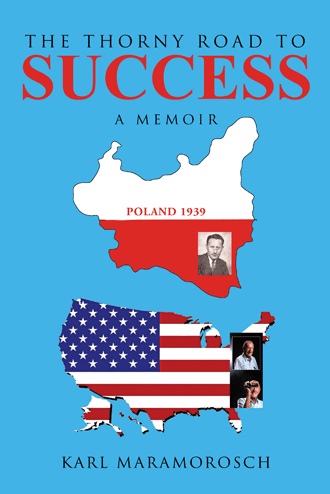
Born in Vienna in 1915, his family moved to Poland, and he fled with his wife, Irene, to Romania in September 1939.
They spent four years in Polish refugee camps and were in Soviet-occupied Romania until October 1946, before coming to the United States in January 1947 on an immigration visa.
But they did not arrive unscathed: Maramorosch’s father died in the gas chamber in Belzec in 1942, and his mother also died at the camp. His brother died in the Kolomyya jail on Yom Kippur in 1942. His wife’s closest relatives died in Treblinka in 1942.
The inseparable couple refused to let any of that stop them from forging ahead: He began a scientific career that spanned more than sixty years, and she became a librarian at the New York Public Library, where she worked thirty years.
Maramorosch recalls the painful losses of the past and the brutalities of war, but he also celebrates his love for his wife and life in The Thorny Road to Success.
About the Author
Karl Maramorosch was born in Vienna, Austria. Growing up in Kolomyya, Poland, he studied in Warsaw, and escaped in 1939 with his Warsaw-born wife, Irene, to Romania, where they spent four years in Polish refugee camps. He has won the Wolf Prize in Agriculture and two Fulbright awards.