
The Fabulous Carousels
Hitchhiking the American Cultural Revolution
by
Book Cover & Preview Text
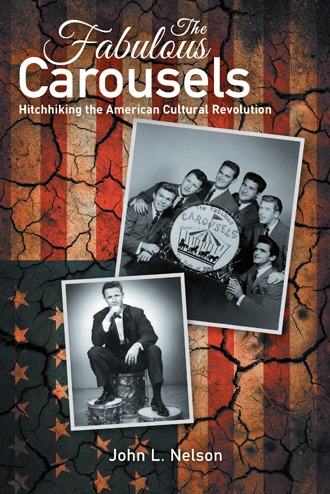
The Fabulous Carousels
Hitchhiking the American Cultural Revolution
John L. Nelson
A Historical Novel Based on a True Story
PRELUDE
The looking glass never lies. It stares back at us in stark indifference, mirroring our lives and culture. Likewise, music never lies. It reflects our character, reveals our psyche and melodically records our culture. Music is our looking glass into the past and present.
The music we sang and danced to between 1957 and 1967 echoed the disturbing cultural undercurrents that triggered the American Cultural Revolution. Earlier events, such as Sen. Joseph McCarthy’s paranoid hunt for communist sympathizers, the unpopular war in Korea, and the 1954 U.S. Supreme Court decision in Brown vs. the Board of Education of Topeka all foreshadowed the dramatic change that would begin at the close of the ‘50s.
American optimism ran high during the Eisenhower administration, when many Americans were achieving the American dream, with steady paychecks, intact families and two cars in a new garage. Yet, a lingering Cold War between America and the Soviet Union kept the threat of global nuclear war on everyone’s mind. And when Sputnik blasted into space, it sent shock waves of embarrassment and anger across our country for being upstaged by the Russians.
It was left to iconoclast philosophers to fill the gulf between prosperity and disillusion. Jack Kerouac created a sensation with On the Road. Ayn Rand posed, “Who is John Galt?” and a former adman with a pen name of Dr. Seuss revolutionized the way kids learn to read.
For the second time in a hundred years, rumblings of civil war crept from the shadows of racial and political disparity. Still struggling to rationalize a slave based cultural heritage, scores of aging Southerners fanned the flames of discontent. On the national stage, a younger generation pitted itself against the status quo, embracing birth control pills, free love, easy drugs, the hippie generation and Vietnam War protesters.
On the cusp of an emotional breakdown, Americans agonized over the assassination of their president, conspiracy theories, the Cold War, faux reality and societal anarchy. The only thing certain was change.
Throughout this period of turmoil, Rocky Strong was a college student and self-supporting professional musician, struggling to deal with the truth he witnessed – but sometimes refused to see – in the looking glass. Living through tectonic events in American society during the ‘50s and ‘60s, Rocky tells the story of the Fabulous Carousels, a band of six southern musicians on the road for six years, covering 30 states, 64 cities, 132 venues and 300,000 road miles.
You are invited to step through the looking glass and share their youthful dreams, hopes, fears and free love – not to mention the subterraneans, drugs, wiseguys, JFK’s assassination, betrayal – and, ultimately, self-actualization. Join the Fabulous Carousels, The Pride of Dixie, as they pursue dreams of becoming celebrity heroes in America during the tumultuous American Cultural Revolution.
CHAPTER 1
May 1967
A PLEASURABLE PEACE RUDELY INTERRUPTED
Adrift in a dark gymnasium, my life is a puzzle, my future ambiguous. “Curiouser and curiouser” defines me. A man in the looking glass. Why am I here? Where is my promised nirvana? Is any of this lunacy God’s plan? Who is Rocky Strong?
I have to reach the high bar set by my dead father – a 33rddegree Mason – his 12 Masonic brothers and Mom’s mantra, “Make your father proud.” Until my 20th birthday, I consistently hit their marks. Then escapades on the road interrupted God’s providence. But tomorrow morning…
“Freeze!”
A gruff male voice sent a chill through the air above and to my right, shocking me from my meditation as I sat in the center balcony of the Louisiana Tech Varsity gym, fifth seat from the aisle on the third row, on the night of May 28, 1967.
“Put your hands where I can see ‘em. Now!”
The voice came closer.
“Identify yourself. What ya doin’ here?”
Darkness had been my companion for the past hour. Now, a flashlight’s beam bore into my eyes.
“I said identify yourself!” the voice repeated, louder and more forcefully.
Blinded by the glare, but regaining my composure, I filled my lungs to capacity and shouted back, “Who the fuck are you? And turn off that goddamn flashlight!”
My anger echoed off gymnasium tiles, an important survival lesson learned on the road about when and how to display grit. If the person in the shadows was an acquiescent North Louisiana born-again Christian, Bible-thumpin’ Baptist redneck, I hoped to regain the advantage.
“Okay cocksucker. If that’s the way you want it, prepare for an ass whuppin’,” was the reply of the shadowy figure moving down the stairs. “What name should we put on your body bag?”
Obviously, this was not your typical born-again Baptist. Nonetheless, I wasn’t backing down.
“Rocky Strong,” I replied, with emphasis on strong.
In a slow and deliberate motion, I stood up, stretched out my 5’ 11”180 pound frame and turned to face the threatening voice. I spread my feet apart and hoped to create a formidable image, capable of handling most anything that came my way.
The flashlight beam lowered to my waist.
That’s a good sign, although I still can’t see shit.
The gruff voice behind the flashlight softened, “Did you say Rocky Strong?”
“Yep. Rocky Strong. What’s it to ya?”
He lowered his flashlight again, and the silhouette of a huge bear with a baseball cap on his head and a uniform trying to contain the physique of a bodybuilder began to materialize. I guessed him to weigh in at 230 pounds. He had a cherubic face that didn’t match his buffed body, and ears like open doors of a taxicab. Oh, and he packed a 1911 Colt .45.
Speaking in a more normal tone, the bear said, “Rocky Strong? The only Rocky Strong I ever heard of was leader of the Fabulous Carousels. You wouldn’t be that Rocky Strong?”
“One and the same. Who are you, big guy?”
“Daryl Wallace. Louisiana Tech Security Department. I’m covering the night shift at the gym.
“You look like a football player or wrestler,” I said, beginning to relax the tense muscles in my arms and legs.
“Starting linebacker for the Bulldogs, but got rolled up, taking out both my knees. Just lost my scholarship in December. Coach got me this gig mostly to run up and down stairs for rehabilitation. Hopefully, I’ll get my scholarship back and complete my senior year, majoring in English.”
With a quizzical smile, Daryl then asked, “What the hell are you doing here?”
“Daryl, tomorrow morning I’ll sit in one of those chairs down there, waiting for my name to be called. It’s taken me ten years, but I will finally walk across that stage to pick up my sheepskin. I’ve been sitting here reflecting on my life, particularly the Carousel years, trying to make sense of it all.”
Formats

Book Details
About the Book
The Fabulous Carousels is a historical novel based on a true story. You will love this book if you ever played in a garage band and dreamed of going on the road. Children of the ’60’s, JFK conspiracy theorist, historians, psychologists, and open-minded readers who enjoy a fast-moving picaresque novel with a good laugh and cry will also be rewarded.
This edgy comedy/tragedy is spun by saint and sinner Rocky Strong, leader of the Carousels. Rocky chronicles youthful dreams, free love, easy drugs, the American Mafia, CIA black ops, JFK’s assassination, tectonic cultural shifts, and, finally, a path to self-actualization.
Join the Fabulous Carousels, The Pride of Dixie, as they chase dreams of becoming celebrity heroes in the early ’60’s—struggling to keep time with changing times in America.
About the Author
John L. Nelson graduated from Louisiana Polythnic Institute and served 40 years in the computer industry, 35 as a senior executive. He launched Nelson Consulting, Inc., (www.NelsonConsultingInc.com) in 2000, delivering merger, acquisition and investment banking services. Married with two grown children and two grandchildren, John lives in Tampa, Florida with his wife of 45 years. Although John has written countless business and techincal documents, this is his first novel.