
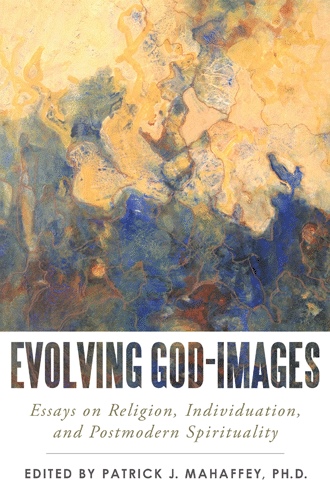
Evolving God-Images
Essays on Religion, Individuation, and Postmodern Spirituality
by
Book Cover & Preview Text
The depth psychology of C. G. Jung presents a different interpretative response to the death of God in the West. Jung wrote extensively on religion and used the word “God” more than six thousand times in his writings (Dyer x). However, he paid little attention to God as transcending the universe and dealt with images of God that arise in the psyche. Jung recognized the common tendency of people to anthropomorphize or attribute a human form or personality to God. Consequently, he often stated that when he uses the word “God” he is always referring to the “God-image” in the psyche. Jung posited the reality of a God-image as a unifying and transcendent symbol capable of drawing together heterogeneous psychic fragments or uniting polarized opposites. Like an image, the symbol is a psychic product different from the object that it attempts to represent and to which it points. The God-image points to a reality that transcends ego consciousness, is extraordinarily numinous, compels attention, attracts energy, and is analogous to an idea that in similar form has forced itself upon humankind in all parts of the world and in all historical epochs. As such, it is an image of totality and “as the highest value and supreme dominant in the psychic hierarchy, the God-image is immediately related to, or identical with, the self” (CW 9ii, para.170).
Jung’s perspective was often misunderstood because it requires that a person think about the divine in psychological terms. He wrote, “It is the fault of the everlasting contamination of object and imago that people can make no conceptual distinction between ‘God’ and “God-image,’ and therefore think that when one speaks of the ‘God-image’ one is speaking of God and offering ‘theological’ explanations. … It is equally clear that the God-image corresponds to a definite complex of psychological facts, and is thus a quantity which we can operate with; but what God is in himself remains a question outside the competence of all psychology” (CW 8, para. 528; italics added). Viewed therapeutically, the God-image functions as “a church within” or psychic container; it is a frame of reference and system of values by which one lives. He accepted as a God-image whatever an individual claimed to experience as God; it is that which presents a person’s highest value, whether expressed consciously or unconsciously (Samuels, Shorter and Prout 61-62).
Jung’s interest in religion is focused on direct experience rather than doctrines and beliefs. His father was a Protestant minister and it was his experience of his father’s crisis of faith that led him to rely on his own experience. Jung wrote: “It was the tragedy of my youth to see my father cracking up before my eyes on the problem of faith and dying an early death” (Letters 257; Memories 91-96). The courage to find one’s own way is the path of individuation and is, in my view, a form of postmodern spirituality.
Individuation, for Jung, is the process by which a person differentiates from others and becomes a unique individual. At a deeper level, it may also be described as the path to wholeness and is the ultimate concern of Jung’s psychology; it is the opus or work of a lifetime. The process of individuation, when consciously pursued, leads to the realization of the Self as a psychic reality greater than the ego. Jung’s own process of individuation is exemplified in experiences he recounts in his memoir, Memories, Dreams, Reflections. Jung experienced a midlife crisis after the demise of his close friendship and collegial relationship with Sigmund Freud just prior to the outbreak of World War I. The period that followed was one of isolation and inner chaos wherein Jung was assailed by material that made him doubt his own sanity. These were the years of his confrontation with the unconscious. Throughout this time he carefully observed and documented the dreams, fantasies, and visions that are now available to us in The Red Book. As he made mandala drawings and understood their significance he began to emerge from his inner darkness. As an image arising from the unconscious that takes place in times of psychic disorganization, the mandala offers the psyche a way of restoring balance and order. As his psychic state changed, so did the mandalas. As Jung explained:
I was being compelled to go through this process of the unconscious. I had to let myself be carried along by the current, without a notion of where it would lead me. When I began drawing the mandalas, however, I saw that everything, all the paths I had been following, all the steps I had taken, were leading back to a single point—namely, the midpoint. It became increasingly plain to me that the mandala is the center. It is the exponent of all paths. It is the path to the center, to individuation. (Memories 196)
This insight gave Jung stability and gradually restored his inner peace and held great significance for his life and his psychology. As Jung put it, “I knew that in finding the mandala as an expression of the self I had attained what was for me the ultimate. Perhaps someone else knows more, but not I” (197). Thus the mandala symbolized for Jung the ultimate goal of the individuation process: the realization of the Self and the attainment of wholeness.
Jung’s entire psychology centers upon the relationship between the ego and the unconscious, although this relationship is often a problematic one. The first half of life involves ego development accompanied by progressive separation between the ego and the Self. The second half of life, however, requires the surrender or relativization of the ego as it establishes a reconnection to the Self through dialogical processes such as dream work and active imagination. The conscious work of individuation requires, from a psychological standpoint, a “religious attitude” or careful and scrupulous observation of one’s psychological life (Von Franz 201). The process entails an effort to discover the Self and to keep attuned to it so that it becomes an inner partner toward whom one’s attention is continually turned (Raff 2-13). In this way Jung’s psychology can function as a religious path, especially for individuals who are no longer able to find meaning in traditional religions. For such persons, neither sin nor redemption, nor ignorance and wisdom, but rather fragmentation and wholeness form the center of the religious quest (C. Smith 118). Jungian analyst Marion Woodman has made the theme of the return of the divine feminine a central feature of her work. In Leaving My Father’s House: A Journey to Conscious Femininity, she writes:
The eternal feminine is thrusting her way into contemporary consciousness. Shekinah, Kwan Yin, Sophia, whatever her name, she is the manifestation of the divine in matter. Among her many faces are Black Madonna, White Buffalo Woman, Shakti, Kali, Aphrodite. Hers are the ways of peace, compassion, reverence for life and death in oneness of nature. Knowing her has nothing to do with blindly stumbling toward a fate we think we cannot avoid. It has everything to do with developing consciousness until it is strong enough to hold tension as creative energy. In the turmoil of our time, we are being called to a new order of reality.…It is our immediate task to relate to the emerging feminine whether she comes to us in dreams, in the loss of those we love, in body disease, or in ecological distress.
Formats


Book Details
About the Book
This collection of reflective essays explores spirituality and its changing relationship to culture, individual identity, and society in our increasingly globalized, postmodern world. Born out of a doctoral seminar at Pacifica Graduate Institute entitled The God Complex, the essays provide a personal understanding of diverse and conflicting worldviews and attitudes about religion, secularity, nature, and the purpose of human existence. With a rich range of perspectives, each offering provides a powerful testament to the interdisciplinary study of myth, religion, and depth psychology as a means for revisioning one understands of the divine.
Dr. Christine Downing, author of The Goddess: Mythological Images of the Feminine and Gods in Our Midst: Mythological Images of the Masculine
A marvelous and unique collection of essays devoted to re-visioning conceptions of divinity.
Dr. Evans Lansing Smith, author of Sacred Mysteries: Myths About Couples in Quest
About the Author
Patrick J. Mahaffey, PhD, is a core professor and the associate chair of the Mythological Studies Program at Pacifica Graduate Institute, where he teaches courses on Hindu and Buddhist traditions, psychology of religion, and dissertation writing. His publications include essays on Hindu yoga traditions, Buddhism, and religious pluralism.