
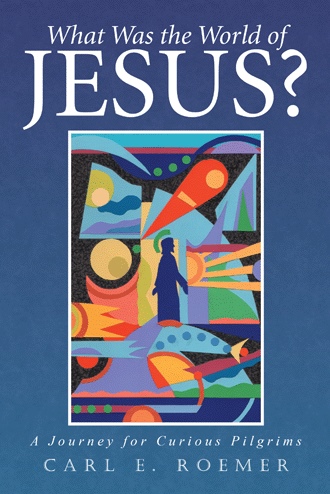
What Was the World of Jesus?
A Journey for Curious Pilgrims
by
Book Cover & Preview Text
There were a multitude of reasons that ignited the revolution. No one factor is capable of explaining its origin. Rather, a multiplicity of forces and reasons alone can explain the rise of the war that proved ultimately so devastating for the land and the people.
One of the driving ideals of the revolutionaries was the memory of an independent Israel ruled by native leaders. The reign of David in particular must have been a powerful archetype that inspired the zeal of the revolutionaries, particularly that of Simon, who made messianic claims. The more recent rule of the Hasmoneans and their unexpected success against a powerful empire would have been another compelling paradigm of divine assistance in overcoming Israel’s enemies. Their success would have worked vigorously in the memory of many.
The Roman mismanagement of their governance of the Holy Land was a direct contributor to the conflict that resulted from their ignorance of the sensibilities of their Jewish subjects. The Romans vacillated in their policy of how the land was to be governed. Now it was a procurator and then a Jewish prince, a vacillating policy, which never allowed the development of a strong center of authority with traditions that could eventually be accepted and recognized by the people. There was no one, strong religious and political center, outside of the temple and its services, that provided a focal point for Judaism and capable of eliciting the loyalty and an effective leadership for all the people except for Agrippa I. But his reign was short lived. For Rome, Israel was but a geopolitical concern: a buffer state between them and the Parthians in the east and a land bridge to Egypt, the bread basket of the empire. They were ultimately expendable as a people.
The Romans did, however, grant the Jews of the empire special privileges such as exemption from service in the legions, guarantees of their right to follow their ancestral customs, and the collection of the annual half-shekel temple tax. But as the policies of the procurators make clear, they did not respect the Jews but held them in contempt. They were not cognizant of the Jewish world view and how they understood themselves as the people of the one God of Israel and the Torah as the revelation of his will. Suffering under this contempt, it was explicable that the doctrine of the “Fourth Philosophy” arose which interpreted Roman rule as illegitimate and a usurpation of God’s rightful place in the life of the nation.
However, it seems clear that the people as a whole were divided in their support for the war. At least half the nation thought as Josephus did. The rebels were indeed protesting the inequities in society and the humiliating Roman hegemony, but it must have been so that the “little people” did not unanimously support their violent means for righting the wrongs and bringing in the kingdom of God by force.
The fact that Vespasian spared some towns and villages and razed others indicates the less than universal support for the war effort. Josephus repeatedly reports the hostilities the war parties waged against some segments of the population of Jerusalem demonstrating a lack of total support even within the capital. It often looks like a bloody proletarian regime reminiscent of the macabre coups of the 19th and 20th centuries. In fact, there was a strong peace party in Jerusalem that tried to mediate a compromise with the Romans but which ultimately failed with the initial success of the rebels in defeating Cestius Gallus’ forces. Josephus himself, as a cosmopolitan, was quite aware of Roman prowess and the ultimate futility of the enterprise, (how easily Tiberias, Gishala, Tarichia, Jamnia, Azotus and Samaria fell!). But, in spite of these misgivings, he made a valiant effort to make effective preparations for the war in the Galilee. According to his account he acquitted himself well as an inveterate fighter and commander, particularly at Jotapata, even though he was a priest and not a trained military commander.
Josephus takes every opportunity to castigate the rebels for causing the destruction of the Holy City and its Holy Place. His moderate stance and his status as a priest make his acrimony understandable. But, as noted, he did not stand alone in his attitudes. But even as he castigates the leaders of the war parties he often recounts the heroic and valiant deeds of the rebels for he cannot but proclaim his pride in his people in their defense of the homeland. Repeatedly he describes their resourcefulness and fierce fervor in the struggle for liberty as they claimed independence of all foreign domination. He was also doubtless proud of the resourcefulness of his compatriots, rebels though they were, as they devised ever new and clever strategies for whittling away at the Roman attackers. With his repeated vignettes of both the heroism and foibles of the men on both sides of the conflict, he humanizes them, providing his narrative with an admirable objectivity and authenticity.
However, Josephus did not have, or at least does not indicate that he had, an understanding of the forces, economic, political and religious, which drove the passions of the people. Or perhaps he felt he could not explain them adequately to his non-Jewish readers. Primary was the apocalyptic belief that now was the time to strike against the Roman oppressor and God would establish his kingdom and justice and liberty would reign. This religious fervor was inflamed by the economic and social disparities between the rich and the poor and the hated gentile seizure of God’s prerogatives as the true King of Israel. It is only within such a matrix of belief and experience that the war and its prosecution are to be understood. The people’s propensity and susceptibility to following prophets, messiahs and bandits is comprehensible under the dire circumstances in which they lived.
The Jewish leadership, on the other hand, was in the thrall of the Romans and held captive in a position of dependence. They did not actively work to ameliorate the conditions of oppression: the high tax rates, the expropriation of and foreclosures on land and the economic inequality that resulted. Their policy was to maintain the status quo and the political equilibrium between the nation and Rome. That policy, coupled with the lack of mediating structures that could have provided the means for the expression of the legitimate grievances of the people, served to radicalize the people and lead them to accept the claims of the “Fourth Philosophy” holding that payment of taxes to Rome was tantamount to idolatry.
As important as socio-economic factors were in igniting the war, religious faith was and is a powerful social force and serves as a catalyst for change toward which other factors are driving. At the core, Israel’s faith is a rebellious faith. It is an inherently revolutionary faith suspicious of all worldly powers and claims. This faith would contribute to the people’s dissatisfaction with any overlord no matter how benign. Her ancient history provided both motives for rebellion as well as motives to “seek the peace” of the overlord under which she lived. The egregious arrogance of Roman governance led the people into armed rebellion. But in this, they did not realistically assess the power of Rome, an assessment all too plain to the cosmopolitan leadership. The people themselves were divided between competing claims to leadership and divine authorization. This history reveals a fractured and broken society which, under external and internal pressure, could not continue to operate. The animosity between leaders and people, between moderate, radicals and conservatives of all classes, between competing claims of various charismatic leaders, between rich and poor and between various and diverse understandings of Judaism all contributed to the breaking down of civil life.
Formats

Book Details
About the Book
In some ways, the Gospels are like the text of a drama. If you’ve read the script of a play and then seen it performed, you realize how different a text can be interpreted when it is transferred from page to stage.
All of the Gospels were originally read aloud to an audience that was intimately familiar with the background, and that gave the words immediacy, meaning, and vibrancy. In today’s world, we are no longer privy to that scenery. In order to fully grasp the message of the gospels, we must bring that context to our minds’ eyes as much as possible.
What Was the World of Jesus?: A Journey for Curious Pilgrims seeks to provide the necessary scenery so that the Gospels can again be heard in a way that is closer to the experience of that original audience hearing them read aloud. Author Carl Roemer presents it in the form of a journey or pilgrimage, leading us on an adventure into a world that is very different from our own world. On this journey, we can encounter the story behind the story—a background that opens up a fresh, new experience of the Gospels and shares the words and actions of Jesus as they were experienced by early Christians.
About the Author
Carl E. Roemer is a freelance scholar. He received his doctorate in intertestamental literature and history from the Lutheran School of Theology. He taught as an adjunct professor with the Judaic Studies Department at State University of New York–Binghamton. Now retired, he resides in Williamsburg, Virginia, with his wife, Dorothy.