
April’s Revolution
A Modern Perspective of American Medical Care of Civil War Soldiers and African Slaves
by
Book Cover & Preview Text
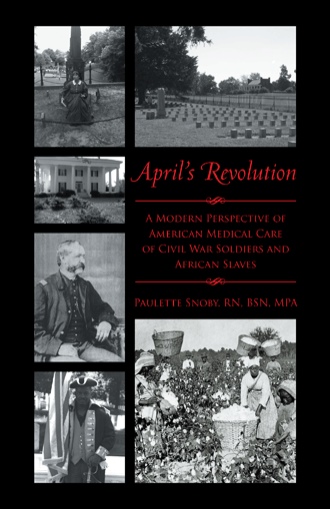
I begin with the emergence of early hospitals and the accepted theories of disease and treatments during the Revolutionary War era. Next the antebellum period and the American Civil War demonstrate the growth of physician knowledge and beginning role of the professional nurse. As a registered nurse I am proud to present an overview of nursing history that changed America forever. Leaning on my nursing training and experience, I detail the care delivered to specific soldiers in a case history format.
Several of the chapters include the medical care and Negro medicine given to the African slave of the South. The slaves’ health care was administered quite differently from the European white race; specifically, the slaves were cared for in Southern slave infirmaries, medical school dispensaries, and plantation hospitals (sick houses). The slaves also had their own doctors and medical knowledge brought with them from West Africa and/or the Caribbean. This self-care included herbal therapies that were adapted from the American Indian, folk practitioner, or the white doctor.
The 18th century doctor treated symptoms (not diseases) where medications played a large role. Their errors lay in the selection of caustic substances and the amount of the medicinals administered. They thought if one dose caused improvement, more repeated and higher dosages of the medicine would cure. This was the beginning of heroic medicine, which resulted in a high death rate and horrible side effects.
Another Southern surgeon whose experiments cause us alarm is Dr. Thomas Hamilton of Jones County, Georgia. Dr. Hamilton performed agonizing experiments on a slave named John Brown, who was on loan from another planter. Hamilton was searching to find a treatment for sunstroke, a very common occurrence in the South. He tested various medications to determine if any would overcome the greatest degree of heat one could experience.
Plantations were crude factories, isolated, and raised almost everything they needed. They also provided for the health and care of family members and slaves. It should come as no surprise that slave owners wanted to keep their workers healthy since the success of the plantation rode on the backs of the workforce. Beating and starving the slaves would not be wise, if crippling would prevent them from doing their tasks.
The new Letterman system included a more efficient method of triage. Triage, sorting casualties into priorities for care, remains a fundamental principle in modern military medicine. It must be applied at all levels of medical care. When Letterman’s system shortened the time for the hemorrhaging wounded to be treated, it prevented the most common cause of death, hypovolemia. Hypovolemia remains the most common cause of death among those killed in action during military conflicts.
Little surgery was done prior to the war in America; only a few military surgeons had experience with trauma surgery. Confederate surgeon Dr. Julian Chisholm had viewed the care received by the wounded in several European battles prior to the American Civil War. His manual written in 1863 gave specific details to guide the Confederate surgeons in surgical techniques, wound care, cleanliness, and various hospital staff duties. 12 Much of what he addressed would reveal the progressive approach demanded of surgeons providing care in the traveling Confederate field hospitals and surgical staff.
Prior to the administration of chloroform anesthesia, Dr. Chisholm recognized that morphine given by hypodermic syringe or opium orally would enhance the effect of the chloroform. The soldier experienced less fighting and thrashing during injection and awoke much easier. He also supported the routine use of anesthesia during “serious painful operations”.24 The use of chloroform from the beginning of the war and throughout proved valuable in the surgical realm. It was also found helpful given during wound irrigations and treatment of persistent muscle spasms that occurred with tetanus.
The African American herb or root doctor studied plant and herbal medicinal properties in the woods and fields of their new home. Oral traditions included religious, magical and plant properties brought from Africa and the Caribbean to North America.
Now that the female nurse was socially permitted to care for “strangers” as trained nurses graduating from American nurse training programs, the value of the nurse started to grow. This was not until the Spanish American War where the value of trained women in nursing led to a permanent Army Nurse Corps. Congress authorized 8000 volunteered nurses to be placed under contract and employed at $30 per month. Catholic orders, such as the Daughters of Charity, and 1600 new graduate nurses served. These nurses were stationed at Army hospitals in the United States, Puerto Rico, Cuba, Hawaii, and the Philippines. Thirteen nurses died while rendering nursing car during the war.7
Immediately at the close of the war, slave families separated by sale tried to reunite. Throughout the South, African Americans tried to create a better life within their communities. They strived to obtain education and healthcare through various governmental agencies. Reconstruction proved a time of turmoil and controversy. It finally ended in 1880 with the final withdrawal of Federal forces from the South. “The Federal government had abandoned the African Americans. Although the 14th and 15th amendments had given them civil rights and voting rights in theory; in fact, many would be prevented from exercising these rights for the next century.”
Another expanding market developed as a result of the vast number of amputees – artificial limbs. “ Two years after the war, the Federal Medical Department authorized the purchase of 4,095 prosthetic legs, 2,391 arms, 61 hands and feet. For many former Confederate states, prostheses constituted the largest single expenditure in their postwar budget since the Federal government provided no pensions or medical care for veterans.
Formats

Book Details
About the Book
The American Civil War is often studied because of its battles, but people tend to ignore how it helped revolutionize the medical field. Bloodshed on the battlefield and the spread of disease led to advances in medical decision making and clinical knowledge. The war also triggered the birth of the nursing profession, the organization of the American health system, and the clinical usage of diagnostic equipment in approaches to disease management.
Author Paulette Snoby, a registered nurse and award-winning research nurse, examines primary and secondary sources to show how medical treatments advanced during wartime, focusing on the explosion of innovation during the Civil War. By examining case histories, soldier and surgeon diaries, cemetery records, and other sources, she highlights important medical advances and also explores how African slaves in the South were cared for differently from the general population.
A thorough scholarly study, April’s Revolution offers information on slave infirmaries, early herbal remedies used by the slave population, and a better understanding of how our nation’s past wars affect the history of medicine.
About the Author
Paulette Snoby, RN, BSN, MPA, a native of Connellsville, Pennsylvania, is a registered nurse. She graduated from University of Pittsburgh School of Nursing and GSPIA. She is a member of the Society of Civil War Surgeons, Museum of the Confederacy, National Civil War Medical Museum, and Daughters of Union Veterans of the Civil War. She currently lives in Roswell, Georgia.