
Life of a Salesman
Advice and Diversions
by
Book Cover & Preview Text
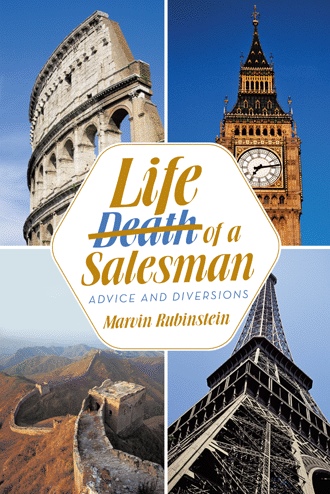
My father was a salesman. One of the old kind who went from door to door. When he was young, he followed the carnival trail, hawking balloons and pennants and stuffed dolls. Later, he sold sewing machines for Mr. Singer, when they were the newest and hottest sales item in town. He sold life insurance when people were not used to the idea, when they superstitiously feared that having a life insurance policy was a sure way to tempt the fates and bring on an early death. For most of the later years of his life, he sold blankets and sheets and pillowcases and household furnishings from door to door. Everything was sold on a dollar down and a dollar whenever they catch you basis.
Dad was a familiar figure in the poorer parts of town, pulling his bundle of samples out of his Model -T Ford, and spreading them out for the ladies to see. He mimicked an Irish brogue for the shanty or lace curtain Irish ladies, and he offered a simple English mixed with the “soul talk” of the time in the local black (now called “African American”) neighborhoods. Incidentally, his talent for mimicry seems to have skipped a generation. Neither I nor my siblings are good at it, but my daughter Sari is a whiz. Dad worked from early morning to early evening in summer sweat and in the blustery winter cold of Rochester, New York. He worked his ass off.
He labored hard and long to ensure his family a livelihood, but mostly he worked to see that his two sons should receive a college education and become professionals––not peddlers like him. Both my brother and I became professionals. He earned a Bachelor of Arts, wanting to become a teacher. But the 1929 recession decided otherwise, and he ended up working for New York State, heading up an Unemployment Insurance Office. I hold two degrees––a B.S. in Chemistry and a J.Dr. in Law. You may call me Dr. Rubinstein. But blood is thicker than water. Twenty years back, I retired as Chairman of the Board and owner of a small but prosperous engineering firm with worldwide offices and representation. When we first developed our products, I used my skills in chemistry. From time to time, when we needed a business contract or a dunning letter, I used my skills in law. However, the success of the company depended, not on building a better mousetrap, but in selling it. It wasn't long before my partner found himself in charge of the factory, while I was out beating the bushes to market our products, first in the Northeast, then in the entire United States and eventually overseas. I had my two degrees, but the financial success of the company depended upon my sales ability, so I became a salesman. Of course, I call myself a “sales engineer.” But basically, I'm a peddler. The doors I knock on are a lot fancier than those my father knocked on, but we both knocked on doors. And I make a hell of a lot more money and live more lavishly than Dad could ever have imagined. But I'm still a peddler. If that sounds self-deprecatory, it is not so intended. Isaac Stern proudly calls himself a “Fiddler.” I am proud to be a peddler.
Some time back, I sold my business for millions of dollars. My father never lived to see the great financial success his son achieved, and I'm not sure if he would have been pleased or disappointed in how I turned out––rich but not a professional. But, as for me, I am a salesman and have never regretted it.
This book is about the life of a salesman. In truth, it will not deal with salesmen in candy stores or boutiques or Macy's. Nor will it deal with the salesman in a showroom, be it clothing or automobiles. These salesmen will have shared some of the experiences I shall discuss, but not most. This book is about the life of a salesman in the great outdoors, the one who goes from door to door or office to office or factory to factory. Much of my experience has been in selling overseas, practically all over the world, so I will write about that in some detail. However, I also spent years selling throughout the United States and Canada, and that will not be neglected.
This will not be an instruction book about the art of selling. It is instead an anecdotal reminiscence of one man who spent over 50 years in national and international sales—the places he has been, the people he has met, the pleasures and perils of travel and the trials and tribulations of his chosen profession.
Without making any specific promises as to order or degree of importance, I should also like to convey some idea as to what the balance of this book will be about. There will be chapters or sections dealing with the following subjects: Building a Sales Business. Publicity and Promotion on a Piggy-Bank Budget. Some observations on Major U.S. cities. Further observations on the major cities of the world. Making the Best of Airline Travel—Some Tips and Suggestions. Sightseeing on a Fly-By-Night Schedule. Local Flora––Wining and Dining Around the World. Local Fauna––Meeting Some Lovely Ladies Internationally. Doing Business Overseas. Some So-Called National Characteristics and How to Deal With Them. The above are provided to give the reader some idea as to where this book is going. To some degree, it will be a sales manual, but to a much larger degree it will be an adventure story about the funny and serious things that happened to me while living the Life of a Salesman.
Formats

Book Details
About the Book
National and international salespeople experience a variety of difficulties in the course of their profession, but they don’t get much understanding from the public.
In this personal account, Marvin Rubinstein looks back at a career traveling from city to city and country to country trying to make a buck in this eye-opening account of what it’s reallylike to be in the sales business. Even if you’re a salesperson sitting in a comfortable chair and calling people on the phone, you can find entertainment and valuable lessons in this instructive narrative. You’ll discover
• tips on converting prospects into customers;
• guidance on avoiding cultural missteps;
• advice on making air travel cheaper and more comfortable; and
• ground rules for meeting friendly members of the opposite sex (if you’re in that market).
Part memoir, part travelogue, and part sales guide, Rubinstein’s story recalls the wide range of trials, tribulations, opportunities, and disappointments that he experienced during his lifetime of sales adventure.
About the Author
Marvin Rubinstein has been an engineer, attorney, professor, and entrepreneur. He taught a course titled “Quixotic English” at the Monterey Institute, resulting in his Compendium of American English, one of ten books he has written. He was the international sales manager at his engineering firm and has spent time in seventy countries and forty-nine states. He has lived in New York; Carmel, California; London; Tel Aviv; and Bangkok.