
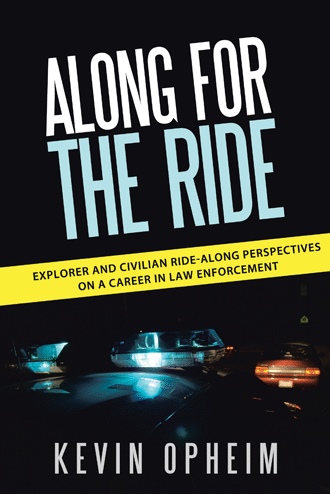
Along for the Ride
Explorer and Civilian Ride-Along Perspectives on a Career in Law Enforcement
by
Book Cover & Preview Text
THE ANATOMY OF A RIDE ALONG... At 15 minutes before the start of the shift, I seek out my partner for the day, introduce myself if we are working together for the first time, and take a seat in the briefing room. Briefing begins promptly at 2pm so I spend a few minutes reviewing the information boards containing the announcements and BOLO’s. BOLO’s are notices to be on the lookout for, including crime suspects and vehicles. During briefing the sergeant walks in, takes roll call to confirm everyone’s assignments and makes important announcements affecting our shift work. If there are enough available, I am allowed to carry a radio. The deputies pick out and load their shotguns. As a ride-along, although we are fully trained in their use, I am not allowed to carry or touch a shotgun for any reason. Each deputy may choose to share their own method of loading the guns (the order of how the slugs and buckshot come out), in case of extreme emergency. We place our gear in the trunk and complete a quick safety check of the vehicle. All lights, siren, the PA system, and such are sequentially marked off a checklist. A thorough check in the back seat for contraband is made. I describe for my partner what I can do, including operate the radio, keep the written patrol log, and I tell him I will always exit the car with him unless he directs me otherwise. Once our pre shift check is complete, I pick up the microphone and announce over the radio, “fifty-one-paul-one-baker, ten-eight with explorer ride-along Opheim.” A dispatcher responds, “fifty one paul one ten four and stand by for a call.” Driving out of the lot we head toward our assigned patrol beat. The city is separated into 3 distinct areas that each car is assigned to. The deputy drives the car and I operate the radio. “51-P-1, check a 459 audible at Santee Storage, 9876 Mission Gorge Road. Time received 1438.” This is a burglary alarm that is going off and the caller reporting this contacted the communications center at 2:38pm. I write the information on our patrol log, including the time we received the call and look it up in the map book if needed. This call could be a burglary occurring now or an alarm malfunction, so we prepare for the more severe case and hope for the best. We discuss our knowledge of the area and the businesses surrounding it. As we approach the facility I call on the radio, “51-P-1 ten ninety seven the area”, telling dispatch and other units we have arrived in the area but haven’t made contact yet. Dispatcher replies, “ten-four, station M.” We discover a man at the side gate fiddling with the keyless code box and when he sees us he turns and waves. Deputy Collins puts the car in park, the engine remains running, while he quickly gets out and takes in the whole scene. I call on the radio, “51-P-1, making contact with a white male at the west entrance”. Another “ten four station M” is heard over the radio. I step out and watch beside the car. The white male begins apologizing to my partner; he forgot the pass code and set off the alarm accidentally while trying to lock up for the afternoon. We take his information and write down the number on the alarm box. Once we confirm that he is a legitimate employee and the facility is secured, we return to our car and radio “51-P-1, ten eight, false alarm, owner will co-op. ASP number 1234.” With no immediate call being dispatched after going back into service, we begin patrolling though our assigned area. While driving north on Cuyamaca Street we both recognize a vehicle with a load of tree limbs spilling over the road and the truck looks as if it is driving faster than it should be. After following for a few blocks, we determine the speed is within the limit but decide to stop the driver before the spillage creates any hazard. “51-P-1, eleven forty nine.” I call on the radio. “51-P-1, go ahead” says the dispatcher. I announce “51-P-1, 11-49 on California 2Unit89734, north on Cuyamaca at Mast Blvd.” “Ten four, California 2Unit89734, station M,” the dispatcher repeats and records the vehicle license number so that if there are any difficulties it can be re-announced later. My partner turns on the overhead lights and makes a quick blast of the siren to instruct the driver to pull over. When both vehicles are safely on the right side of the road, Deputy Collins steps up to the truck window cautiously watching the occupant and checking for anyone else. I remain near the right side of the patrol car watching for safety hazards and the right side passenger compartment. After talking a few minutes with the driver, the deputy returns to my side of the car with a driver’s license and registration. He hands it to me asking me “Why don’t you run these?” I picked up the radio, “51-P-1, switching to F7.” This indicates I am changing to another channel to check for wants and warrants. I change the radio channel, listen to ensure there is no one talking and announce, “51-P-1, on F7.” “51-P-1, stand by, you are number 3 in line.” Since this radio frequency handles all inquiry for the county, we have to take turns with many units. After a few conversations with other units the dispatcher asks, “51-P-1, go with your traffic.” “51-P-1, twenty eight and twenty nine on California 2 unit 89734, break.” “Go ahead” “also 10-29 on John Loughlin, that’s, Lincoln, Ocean, Unit..."
Formats

Book Details
About the Book
Author Kevin Opheim enjoyed the time he spent as a young man volunteering for institutions ranging from his church to the Boys and Girls club. What’s more, he was rewarded with the life and career experiences he gained every day—particularly when he decided to learn more about a career with law enforcement. Ride-alongs offer young people the opportunity to explore law enforcement firsthand while they learn what to expect from careers as police officers and deputy sheriffs. In Along for the Ride: Explorer and Civilian Ride-Along Perspectives on a Career in Law Enforcement, Kevin shares his five-year experience riding in patrol cars, working in the offices, and fulfilling field work duties as a volunteer for the San Diego County Sheriff’s Department. He describes everything he experienced, from the exciting to the mundane, and offers insight into how to prepare for success as a public service professional. If you’re interested in learning more about what a career in law enforcement entails, then this collection of personal experiences can help. Get in, buckle up, and prepare to go along for the ride.
About the Author
Kevin Opheim was born and raised in San Diego County, California, and works as a registered nurse in the psychiatric field. He earned his bachelor’s degree from University of Phoenix. He volunteers for the local Red Cross chapter and Boy Scout council.