
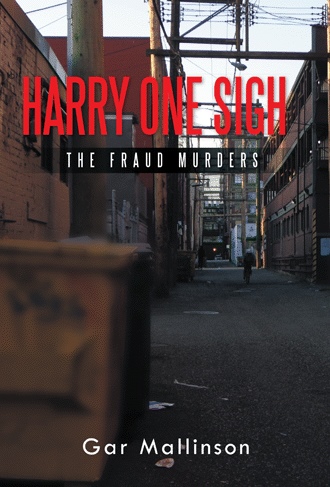
Harry One Sigh
The Fraud Murders
by
Book Cover & Preview Text
Indian and his partner, Stringbean, the skinny rodent-like gofer he kept around, dismounted the bike and Indian entered the scruffy shop. He raised a hand to the old man leaning on the counter, pointed to the office door at the rear, raised his eyebrows, got a nod in return, and walked back and knocked. The grunt from inside revealed a huge bearded, leathered biker who looked Indian over before stepping aside to let him enter. Behind the desk was a small, sharp-featured, narrow faced, intense looking man in a suit obviously tailored anywhere but here, a very white shirt and yellow tie. The man put down the paper he was reading, tapped his pen on the desk top, and looked Indian over.
“So what the fuck happened? One fuckin’ girl and you can’t get her back? Thought you were such a hot shot with the ladies. The boss is pissed, I’m pissed, and you’re in the shit.” The pen was now pointed at Indian. The slim man in the suit let the silence build. “This you gotta fix, now! You don’t and you won’t need to worry about anything much anymore. Last chance, and if I were making the decisions, you wouldn’t get it.”
He nodded at Indian and said, “Get out and get it done. Bring her here. I’ll let Jerry know we’re taking over the mess he’s made and we’ll clean it up, all of it. You included if you fuck up.”
Indian said nothing, turned on his heel, nodded at the big guy, and left. The suit watched, shook his head, went back to his papers, and said to the biker, “Follow that prick, make sure he’s got it done or do him. Go!”
They heard the bike start up outside. The big man nodded, left the office, and watched them take the path by the river before he grabbed one of the bigger bikes and went after him. He took his time, let Indian and Stringbean get well ahead, and followed.
Indian headed into Surrey’s industrial section, moving in and out of the warehouse streets at random. After about fifteen minutes, he left Stringbean, his skinny sidekick, in front of a plumbing supply house, backed his bike into an alley up the way, and waited. He heard the rumble of the bike as it entered the industrial mall, heard it enter his street and move toward him. Indian smiled and nodded, No way, he thought, that fucker’d know which street to hit without already knowing. He searched the fender wells, then the tank. Too hot below that, he thought. He felt under the saddle tail and there it was, a tiny transmitter tucked up near the leather seam.
Indian took it out, slid backwards on the bike, pushed himself around a corner of the building, and dropped the tracker through a slot into a drop box inside the rear door of a service area. He walked the bike behind a dumpster, left it next to the wall on the far side, and climbed in lying flat on the top of the bags of waste. The other bike stopped in the street. He heard it shut down, heard the biker coming down the alley, leather creaking, chains jingling, and heard him stop at the mouth of the cross alley.
Indian knew the biker would assume the tracker was still on the bike. The biker wasn’t particularly clever, but he was street smart, and grinning he pulled a length of chain from his jacket pocket, wrapped one end around his left hand, pulled a nine from his belt and kept it in his right. He listened, heard nothing, moved as quietly as he could toward the service door.
The biker heard the sound from behind the dumpster, a kind of sliding noise, and moved toward the end of one side. A quick peak around the corner revealed the bike, so he edged toward the back and the narrow opening between wall and bin. When he bent over a little to peer around the corner, Indian leaned down from the top and drove down hard with his hunting knife, sliding it with practiced skill through the muscle and deep into the heart.
The biker dropped where he stood, and Indian smiled, climbed out of the dumpster, rubbed the blade on the biker‘s leather, and put it back on his belt. He kicked the biker in the head, hard, not that that was necessary, and grinning with pleasure, wheeled the bike out of the gap, climbed on, and went back for Stringbean. He considered the biker’s bike, figured Stringbean could handle the smaller of the two, and gave him the keys to his bike.
"Stay with the bikes,” he told the bean. “Move ‘em in behind there.” Indian searched the biker’s saddle bags, found more chain that he added to the one wrapped around the biker’s hand, pocketed the nine, looped the chains through his belt loops, then grabbed the biker’s hair and the ass of his low-slung pants and in one swift movement, hiked the dead man over his shoulder. He stood slowly and started down the alley toward the rear of the industrial mall.
Indian knew the river had to be close; he’d been following it all the way. The alley ended at a battered fence, the collected debris of months clinging to the ends of the wire mesh. Beyond the fence stretched the greasy brown waters of an inlet gouged out of the river flats extending along the length of the mall. A large loading dock with a pair of long wooden piers extended out into water deep enough to take the small freighters that plied the river and the Salish Sea. Down the fence just beyond the next building stood two large frost fence security gates. They were locked but old, and the gap between them was large enough.
Indian followed the service road to the gates, dropped the biker, crouched, and slid between the gates. He reached through grabbing the neck of the biker’s leather jacket in one hand and the riveted chains that adorned the front of it in the other, and heaved him through as well. Once again he bent, hefted the dead weight over his shoulder and walked to the dock’s edge. The bank sloped away at a steep but manageable angle and was thick brown mud for the last few feet. The tide was only partly in. Indian shrugged the biker off his shoulder, slid him down the bank, followed, and pulled him across the few feet of mud into the iridescent patterns that floated on the greasy brown water.
The skid marks and the trail of blood, Indian knew, would be gone with the tide. He turned chest deep in the water and studied the pilings supporting the piers. All were creosoted wood pilings with massive cross bracings. He swam out along the closest pier a good distance until he knew the depth was right, then cut in swimming slowly along between the cross braces. There was little current in the inlet even though he could see the water of the river moving swiftly down beyond.
He slid the biker against one of the large wooden pilings and searched his pockets for anything beyond what he’d emptied out. Finding little that would identify him, Indian took a deep breath, grabbed the biker’s jacket one last time and pulled him under. About fifteen feet down, he felt the mud of the bottom, pulled the chains from his belt loops, wrapped them around the biker’s waist through a couple of his loops, and felt for the junction of cross brace and piling. He wedged the chain ends in the crevice between them, and pulled himself to the surface. Indian knew the chains would not hold against the bloating that would occur, but he knew the river, and this was chained carrion. What was left in a couple of days would likely be hauled away and thrown in some freezer drawer in one of the many morgues around town. One more gang murder in Vancouver’s gang wars wouldn’t matter much, he thought.
Formats

Book Details
About the Book
Harry Touchstone is nothing but a small-town detective who works mostly on insurance cases for local companies. Then, his friend dies, and Harry’s life turns upside-down. His murdered pal was a graduate student writing her thesis on corruption in the building industry. Her researcher is found dead, too, and Harry makes it his business to solve the case.
The case leads him from Harbour City to Vancouver, from arson to more murders. Unbeknownst to him, Harry has gone from hunter to hunted. He makes a string of odd allies as he fights to stay alive, including a transvestite, a hacker, and the matriarch of Chinatown. He also makes a lot of enemies, but he can’t nail down their identities.
Back home, Harry’s secretary is raped, and one of his good friends is shot. The bad guys aren’t just after Harry anymore—they’re systematically attacking the people he loves most. Caught between the Hell’s Angels, unethical politicians, and a psychopath named Indian, Harry is on the run. The only way to solve this case is to expose about a million lies … and stay alive.
About the Author
Gar Mallinson, a retired English professor, has been writing fiction for about ten years. He is an avid landscape and architecture photographer whose works are in private collections in New York, Sydney, London, Frankfurt, Toronto, and Vancouver. He and his wife Renee live with their cat, Oliver, and dog, Scarlett, in Nanaimo on Vancouver Island.