
… and for Yale
Why Bright College Years Never Fade Away
by
Book Cover & Preview Text
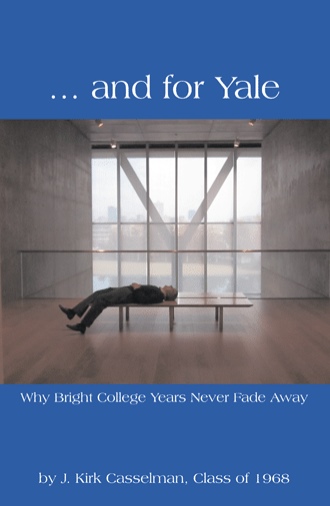
One hundred years have passed since Owen Johnson first published in 1912 his classic book Stover at Yale describing the exploits of the fictional Yale undergraduate, Dink Stover. About half that number of years have passed since Kingman Brewster, Jr., then President of Yale University, in 1968 wrote his introduction to Johnson’s book. 1968 was also the year I was graduated from Yale and was about to begin my work with young people aspiring to attend Yale and with Yale undergraduates enjoying “the shortest, gladdest years of life.”
In his introduction, Brewster pointed out that, despite the difference in argot between Stover's Yale and the then current Yale, the pattern of the Yale experience was the same: “Self-conscious confidence to the point of arrogance enshrouded the young man as he entered Phelps Gateway. Self-doubt festered into self-pity as he found that not all his assumptions about himself and his Yale world were beyond question. . . (Self-pity is followed by) rediscovery, and finally to mature ambition.” These five stages–self-conscious confidence, self-doubt, self-pity, rediscovery and mature ambition–provide structure for the narrative that follows in the early chapters of this book.
On the other hand, Brewster also pointed out that, in his era, “the openness of invitation to the struggle of all against all for campus success” was essentially more a measure of effort and accomplishment and contribution to Yale than it was to inherited status. In this regard, Brewster argued, the pattern of life for Yale undergraduates was a “democracy”, yet the meaning of that term was quite different in 1968 than it was in 1912. The open competition in Stover's time for “corporately defined success” as a standard has been replaced by an “individualistic, almost anarchistic, definition of democracy”.
In the years since 1968, in working with applicants and with undergraduates, I have observed that the pattern of life at Yale has remained essentially the same. In Brewster's terms, “College as a place to ‘find’ yourself, then as now, requires teachers, ad-ministrative mentors, and especially parents to take the terrible risk of letting students get ‘lost’.” This process of maturation is now open to a much greater range of students as a result of many decades of aggressive diversification of the undergraduate student body at Yale.
That diversification began in earnest with a letter written by Kingman Brewster and addressed to John Muyskens, then Director of Admissions, dated March 15, 1967. In it, President Brewster summarized Yale's admissions policy, giving relative weight to intel-lectual capacity, placing a broad construction on the definition of leadership, identifying moral concern as a specific consideration in the admissions process and affirming Yale's interest in qualified sons and daughters of alumni.
More specifically, Brewster wrote, “I do think that where social and economic and racial circumstance has made the testable strengths difficult to assess fairly, it is desirable to go as far as possible to uncover other evidence which might bear witness to special potentialities. The standard of admissibility certainly should not be lower for the disadvantaged, but the best evidence of capacity may lie outside the conventional records.” Moreover, he said, “An excessively homogeneous class will not learn anywhere near as much from each other as a class whose backgrounds and interests and values have something new to contribute to the common experience.”
In the belief that the fullest understanding of the Yale experience will come from matching the historical roots of its institutions with their current embodiment, at least as I have lived with them, I have introduced the early chapters of this book with quotations from Johnson's book appropriate to my own narrative.
Formats

Book Details
About the Book
In 1964, when author J. Kirk Casselman applied to Yale College, more than five thousand other secondary school students also applied for admission to one of the 1,300 places in the Yale Class of 1968. Of those applicants, 1,569 were offered admission, for an acceptance ratio of approximately 30 percent. Today, thirty thousand students apply for admission for the same number of places, for an acceptance ratio of just 7 percent.
The drastic change in the college application process results in today’s students regularly applying to colleges based solely on name and reputation, without knowledge of a school’s profile and character. In the case of Yale, at least, Casselman hopes to correct that lack of knowledge.
In … and for Yale, Casselman provides a subjective—and perhaps even impressionistic—view of his association with Yale, its institutions and traditions, and the effects they have had on his life. In this memoir, he recalls his undergraduate years at Yale and his more than forty years of involvement with the university as an alumnus recruiting, interviewing, and counseling prospective and current students.
This memoir reflects Casselman’s passion and lifelong involvement with Yale and helps applicants and future students to understand the nature of the admission process, the college experience, the institution, and the influence it has on its graduates.
About the Author
J. Kirk Casselman is a member of the Class of 1968 of Yale University and earned a law degree from Columbia University School of Law. In addition to founding Casselman & Associates, he has more than forty years of experience with Yale University. Casselman currently lives in Santa Fe, New Mexico.