
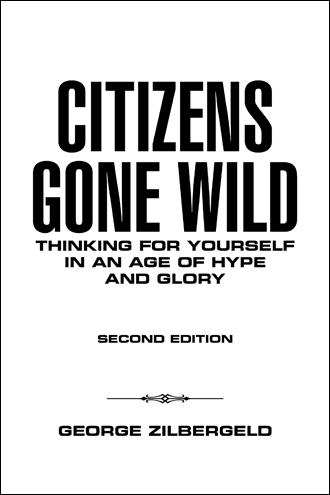
Citizens Gone Wild
Thinking for Yourself in an Age of Hype and Glory
by
Book Cover & Preview Text
The difference should be the ability to analyze public policy in a way that is more objective and sophisticated than what one would expect from a bar hound. This book, while useful in winning bar bets, is meant to do more. It is meant to provide everyone with the tools they need to make worthwhile judgments about public policy issues. If you are or were a college liberal arts major, these tools are particularly important, since they are methods with which you can think in a disciplined and objective manner associated with the natural sciences. I would also like to think that any citizen, regardless of educational level, can get some handy ideas in this book.
I have chosen these particular methods because they have wide application. In addition to helping you make objective public policy decisions, the methods are useful in many careers, and in the life of any active citizen. Once these methods become habitual they are powerful enough to be noticed and rewarded by colleagues, professors, supervisors, and fellow citizens.It doesn’t matter if you are tall or short, liberal or conservative, Democrator Republican, black, white, or pinstriped –– we all have our beliefs and ideas of how the world should and does work. Unfortunately, clear and disciplined analysis often destroys these ideas and brings a feeling of unease. Therefore, it takes a great deal of courage and discipline to question one’s own beliefs.
Still, there is a certain pride that comes with the knowledge that you practice what you preach, when you preach about being open minded, and that you have the will to force yourself to question your own beliefs. It may help to keep in mind how much pain has been caused by people who refuse to rethink their views. Any increase in open-mindedness is a giant step forward. It may also help if we realize that people who appear frequently on television as experts rarely make predictions that are falsifiable and so rarely leave themselves open to challenge. I often wonder if these so-called authorities have much expertise beyond a celebrity’s ability to get the word expert set alongside their names on the screen. The truth is that many public policy decisions would benefit from a healthy dose of common sense, and this book is just a way to encourage people to use common sense.We often hold beliefs unsupported by reason, logic, and facts. Perhaps we believe things because everyone around us believes something to be true, or perhaps because we have been taught by schools, the government, or the media, to believe in a certain view of the world. Sometimes our beliefs are like old friends with whom we are reluctant to part, especially if they have often been there to comfort us.
It is easy to tell people to be open-minded, but it takes tremendous courage to actually be so. The goal of this book is to encourage you to do just that by teaching respect for the scientific attitude. This is an attitude of open-mindedness. Science operates to a large degree by presenting a view of the world, or part of it, and inviting anyone to examine this view and agree or disagree. Although most of the time the audience is one trained in the sciences it is this willingness to allow others to look and see for themselves that is the heart of the matter.Although science is often identified with experiments made in the natural sciences such as biology and chemistry, science also occurs in areas where conducting an experiment is very difficult. The best example may be astronomy, where access to the heavens for experimentation is quite limited. The attitude of being open minded is one of the most important pillars of science. This does not mean that this method is pleasant for scientists. I imagine that very few scientists are pleased to be proven wrong. Still, if you want to call yourself a scientist you must give others the opportunity. I also think that if you want to call yourself an open minded citizen you need to adopt as much of an open minded attitude as you can.
Willingness to be proven wrong doesn’t seem natural to most people. I doubt if it comes naturally to anyone. I assume that being open-minded is a hard to acquire discipline that, like other disciplines, produces wonderful results, but is still hard each and every time it is applied.The goal is to produce a specific model of how the world works, and then test this model using appropriate methods. The implicit premise is that you will be open-minded enough to accept a different finding and adjust your views. It was a bet of the Founding Fathers of this nation that we would produce enough citizens willing to do this in order to make this country work for centuries to come. This book does not focus so much on what your views are, but rather on how you hold your beliefs. Are you willing to modify or give them up if the evidence points you in a different direction?
In the social sciences we have trouble giving a definite answer to any question. We often can only accumulate evidence that supports or contradicts our hypothesis (model of the world). In analyzing situations we face as a citizen or at work, these methods will suffice to take our thinking well above the level of openness used by most students or citizens.
Formats

Book Details
About the Book
Citizens Gone Wild is a practical step-by-step guide for anyone interested in thinking for themselves. In this breakthrough book, author George Zibergeld identifies, explains, and demonstrates twelve specific methods of analysis that anyone can use for critical thinking and decision making. As readers learn these methods, they will also be learning skills useful in any profession and will gain the confidence to confront experts in any field. The methods presented here are easy to learn, powerful, and intuitive enough that using them will instantly instill the confidence needed to speak up. Tested over a period of twenty-five years, these methods have been used in a variety of classes and civic groups for professors, teachers, and activist citizens. Citizens Gone Wild can play an important role in empowering students and citizens by providing them with the right methods to think, decide, and speak up for themselves.
About the Author
Dr. George Zilbergeld is an adjunct professor at Rutgers University, New Brunswick, New Jersey.