
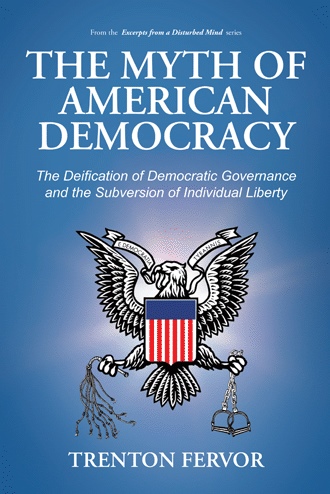
The Myth of American Democracy
The Deification of Democratic Governance and the Subversion of Individual Liberty
by
Book Cover & Preview Text
Democracy as an ideal, is derived from more fundamental conceptions concerning individual sovereignty and autonomy, and the right to ownership and control of oneself. Democratic theory rejects the proposition that a single person or even a limited group of people have any legitimate right to unilaterally rule over others. Human beings are viewed as possessing a fundamental moral and political equality, and an entitlement to self-determination.
The issue of having control over oneself and the decisions which affect one’s life involves, of course, the extent to which these decisions also affect the lives of others—the extent to which they have both public and private dimensions. Since individual choices can involve “externalities” which potentially impact the lives of others, the sovereignty of the individual must at times be attenuated, and operate in coordination with others. “Democracy” is an attempt to preserve for individuals their sovereignty and autonomy over their own lives, and in areas requiring collective management, to conduct that management utilizing a decision process which continues to involve, respect, and heed the individual.
When imagining the concept “democracy,” Americans have historically tended to think quite readily in terms of classical liberal democracy. The American’s democracy must function to preserve individual liberty, prevent oppression and tyranny, and encourage outcomes acceptable to the public. The government exists to serve the people—not vice versa. People are citizens, not subjects, and as such they afford the state their loyalty only while it acts in their best interests and according to their direction.
The image the people have of “democracy” shapes their understanding of authority and power, and consequently their view of government. An alluring image for democracy lends to the State an apparent philosophical legitimacy and evokes acquiescence and allegiance from the public. As such, it should be expected that a “democratic State” would be interested in maintaining an image for democracy which sustains or enhances the State’s power and control. In fact, one might expect the State to inflate democracy’s image and to encourage its veneration. Those in power might be expected to desire a morally flattering explanation for their power, and those who are under that power might prefer to employ rationalizations which compliment their self-image and amplify their sense of comparative national prestige or worth. Quite simply, those in power have an incentive to portray democracy and democratic government in ways which facilitate their power, and to create and perpetuate memes which keep the public acquiescent and obedient. It should be expected that over time the public’s image of democracy (and their expectations for it) would come to be disconnected from reality and eventually become delusional and mythological.
This is in fact what has happened. The ruling class maintains and enhances its reign by cloaking itself in the delusion and deception of democratic imagery. The public’s view of American government is manipulated by the use of the concept “democracy” as a description for this government. Citizens are encouraged to submit to the government based on some ostensible legitimacy of democratic theory, but American democracy is not what it is portrayed to be. It does not function according to the principles or in the manner in which it is justified to the public. Democracy’s beatified image and its ignominious reality are practically inverses. Although the justifying rhetoric remains, the system has been co-opted. It functions as an illusion protecting and sustaining an elite oligarchy, a government-class mega-bureaucracy, and a regime of totalitarian despotism.
Democracy today is a ruse behind which the ruling elites exercise power. It consists of deception and manipulation in both premise and practice. In its premise, the democratic conception is fundamentally absurd: it proposes that an ideologically coherent, consistent, and efficient social policy program can be created by formulating each aspect of the overall program through a process of majoritarian amalgamation of contradictory, incongruent, and confrontational views. It supposes that good things come from rule by meta-ideologically discordant and collectively incoherent government. In its practice, the democratic political conversation itself is a carefully crafted gibberish based on fantasy, flattery, ambiguity, equivocation, demagoguery, beguilement, and inspiring nonsense. The reality is that democracy is an incoherent, dysfunctional, corrupt, manipulative, fraud. It’s a sacrosanct myth; a false pretense used to subvert and control.
The Myth of American Democracy is intended to examine and exhibit the discrepancies between democracy’s promoted image and its actuality. It will hopefully serve to demystify, de-sanctify, disenthrall, expose, and perhaps delegitimize the democratic conception, and dispel the pervasive democratic miasma which sustains a cult of American democracy veneration, delusion, and servitude.
Formats


Book Details
About the Book
In his current work, Trenton Fervor—author of The Last Individual: The Ascendancy of the Sociomaniacal Mindset—delivers a critical exposition of democracy and its defects. The Myth of American Democracy is an unapologetic critique of the American political system and an attempt to dismantle the mystique perpetuated to sanctify and sanction it.
Fervor entreats the reader to reexamine the notion of democracy and its attendant processes—absent the sophistic demagoguery—and to more closely consider the actual nature of the institution, and the establishment behemoth which inhabits and advances it. The reader is encouraged to confront the myth and deception which pervade the contemporary conception of democracy, and to accept the reality that the democratic emperor is naked.
Democracy today is in truth fundamentally absurd: its premise is that an ideologically coherent, consistent, and efficient social policy program can be constructed by formulating each aspect of the overall program through a process of majoritarian amalgamation of contradictory, incongruent, and confrontational views.
The Myth of American Democracy is an important rebuke of conventional democratic orthodoxy which will challenge readers to reevaluate their sympathies for the system. This book is recommended reading for everyone who has wrestled with the troubling suspicion that there is something inherently dubious and defective about the democratic system.
About the Author
Adventurer, philosopher, and writer Trenton Fervor has numerous published works concerning sovereignty, voluntaryism, and the disturbing trend toward the devaluation of both individuality and the liberty of personal discretion. His writings have served as educational materials, and have assisted readers in evaluating their own perception of reality and meaning.