
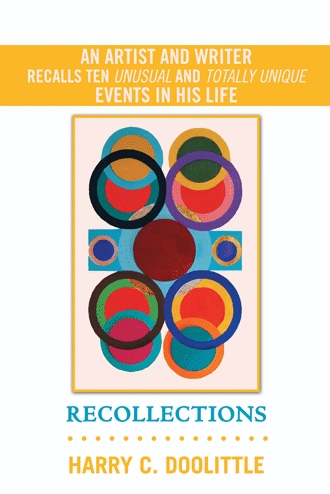
Recollections
An Artist and Writer Recalls Ten Unusual and Totally Unique Events in His Life
by
Book Cover & Preview Text
Howdy Doody
Recollections #6:
It was six PM on a week day in New York City in 1950 when millions of home TV sets all across the U.S. of A. blinked on revealing a group of a dozen or so boys and girls, ages five to fifteen from many nationalities standing in a boxed area nick named The Peanut Gallery and gesturing wildly as an off camera man’s voice shouts: “Hey kids, what time is it?” And the kids screamed back: “It’s Howdy Doody time!” And thus began a continuing episode of the Howdy Doody TV show which ran on NBC’s New York station and later on other stations from 1947 to 1960.
Howdy was a freckle faced red-haired wooden puppet, I guess you’d call it a marionette, manipulated by strings operated by an off-camera hand. And always standing on his stage he had a close companion, Captain Bob Smith, playing the role of Buffalo Bob wearing a cowboy shirt who sat next to Howdy and the stage. The two would engage in conversations but were never seen together doing so. It went like this: when Bob was speaking to Howdy, the two were on camera, and when Howdy answered him, the camera cut to Howdy alone, and then when Bob spoke again, it cut back to show them both. This because Bob Smith was also Howdy’s voice, and it wouldn’t do for viewers to see Bob’s lips moving at the same time as Howdy’s. And while Smith was an integral part of the show, most of the time he was off camera, letting Howdy be the star.*
And so what had I working that year as a TV commercial copywriter at the Grant Advertising Agency ad in Chicago to do with the show? The commercials I was assigned to create were intended to sell Ovaltine, a high-energy-provider chocolate drink for kids such as those who watched the HD show, and for which the agency’s time buyers had bought three minutes of the HD show’s time to run one day a week. And after being written by me, and approved by Ovaltine’s executives, copies of the commercials were faxed to the show’s producers in New York where they became part of its telecast.
All to the good, except for one fly in the ointment. There was a crazy network rule, long since rescinded, which prohibited the name of the product, or service it was selling to be mentioned until fifteen seconds of
Page 2.
the commercial’s sixty, or thirty, seconds had passed. Eureka! Now here was a chance for me not only to be a TV commercial writer but to also become a big time TV show writer, albeit a mere fifteen-seconds one. And how did I do this? I came up with visual concepts which were designed to last a lot longer than fifteen seconds, and thus it appeared as if what I had created was an integral part of the show. For example one was the Ovaltine Balloon Doodle.
This was a visual gimmick used at the start of every Ovaltine Hoody Doody sponsored fifteen minute segment. And it consisted of a six foot long, two foot high board standing on a table in front of of the camera, and printed on it were the letters O-V-A-L-T-I-N-E. And in front of each letter, and concealing it, was a floating balloon attached to the table by its string.
And standing next to it was Clarabell the Clown holding a long nail. So that when the announcer shouts, “Hey kids, what time is it?,” the kids would yell back, “It’s O-V-A-L-T-M-E. time” yelling out each letter separately so that Clarabell, using the nail, and in sync with each letter being yelled, would pop each of the balloons and thus uncover the entire Ovaaltine name.
But this wasn’t all. The word Ovaltine is made up of eight letters, the same number as in an eight note musical scale. And so what could be more appropriate than to have the station’s organist, who along with each of the kids in the Peanut Gallery yelling out the letters, to also play eight musical chords in ascending order as each balloon was being popped. And that’s what Clarabell did. And all of this is what I had originated for it to be used at the beginning of every one of the Hoody Doody Ovaltine sponsored episodes. (“Look, Ma Harry’s in show biz!”)
And here’s another example. It went like this: I’d have Rex Marshall, the show’s announcer speak on camera just before one of my sixty second Ovalitine commercials was to be aired on one of the Hoody Doody episodes. The words he spoke were written by me and Rex spoke them as he stood in front of the camera by all himself, as follows:
“Hey kids, it’s too bad Howdy Doody is on vacation. Because I bet if he wasn’t in (he speaks a made-up place) he could solve this mysterious
Page 3.
message which just came to me over the Lollapalooza before the show began” (if convenient, have the message actually come over the Lollapalooza, if not, write the message on a piece of paper and have Rex hold it up). And then after several minutes had passed, with Rex continuing to speak, he finally gets ar0und to mentioning the sponsor’s name, which is Ovaltine, and that’s when the Ovaltine commercial actually begins.
But why was this happening? That is, why spend so many minutes of the valuable show time telecasting a bunch of trivial nonsense before getting around to mentioning the name of its sponsor? Instead, why not telecast only the commercial itself without having to pad it with a lot of extraneous talking which would use up some of the show’s time? Well, I’ll tell you.
It was because Eddie Kean, the Hoody Doody show’s chief writer was-to use a show biz term- “vamping.” And why was he doing this? Because his job was to originate some twenty or more different sponsored Hoody Doody shows every week; each fifteen minutes in length, and each original. And that meant not only did he have to come up with a different plot for each fifteen minute segment but it also had to get a high rating or else the show’s sponsors would become very unhappy.
As a result, Eddie was going bananas. He needed assistance and one way for him to get this was to call me. My phone would ring, and he’d say. “Hi, it’s Eddie. Can you give me a hand? Could you maybe pad your ad copy, or better yet, give it a longer intro?” Anything which would allow the commercial to take up more of the show’s time. And since there was a network rule that stated we weren’t allowed to mention the sponsoring product’s name in a commercial until after the first fifteen seconds of it had begun the alternative was to do just as I have described above: to “vamp and to pad.” And vamping and padding is what I did best.
But now as an aside, here is a sample of the sort of the additional “paddings” I would include in my commercials which not only made my commercials more fun to watch, but also did what Eddie Kean had asked me to do; namely to help him contribute to the writing of the HD shows.
Page 4.
What follows is an example, and has to do with the Ocvaltine Baloon Doodle. Instructions of this sort were always written in bold letters.
Camera focuses on CB (Clarabell the Clown) standing next to the Baloon Doodle and in CB’s hand there is a long steel nail. And of the original eight balloons only one balloon is left inflated
Formats

Book Details
About the Book
In this memoir, author Harry C. Doolittle offers his recollections and unique stories of Howdy Doody and Kukla, Fran and Ollie—pioneers in the TV entertainment universe—and Charlton Heston, iconic movie star, just to name a few.
About the Author
Artist and writer Harry C. Doolittle resides and paints at his home in Scarsdale, New York, a suburb of New York City. His wife, Misook, is a well-known American designer of women’s clothes. Prior to becoming a full-time artist, he was a copywriter and creative director at some of America’s leading advertising agencies. He began painting in the 1960s and had his first show in 1978 at Evansville, Indiana, where all of his art sold out, giving him confidence to continue painting. Throughout the years, his paintings have been purchased by numerous collectors in America, South Africa, and Asia. Other career highlights include working as a stage manager and actor, a police reporter at Chicago’s City News Bureau, a crew member on TV’s Kukla, Fran and Ollie show, and an assistant to the writer on the Howdy Doody TV program. Born on September 17, 1923, in Chicago, he is a graduate of Northwestern University.