
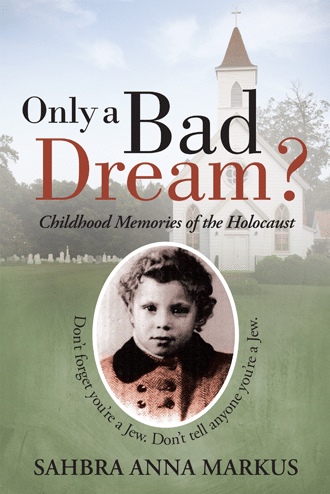
Only a Bad Dream?
Childhood Memories of the Holocaust
by
Book Cover & Preview Text
Brzezine, a vibrant city in Poland, was home to a large Jewish population. Many men and women worked in the tailor shops, factories, and stores of the large textile fashion center. Others were successful shopkeepers or tended their farms in the surrounding countryside. My grandparents owned a large hardware store, a factory, and several small tailor shops.
To serve the Jewish community, several shuls (synagogues) and many shtibls (one-room studies) were available.
There was one very large, beautiful house of worship in the center of the city known as the Big Synagogue. However, the one I will tell you about was small and very much loved by my family.
Rabbi Chaim Meir and Rivkah Efroimowitz attended services there. Reb Chaim’s family had lived in Brzezine for many generations or, as he would declare, “since the beginning of the Diaspora.” The Efroimowitz family had five daughters and a son, the youngest child being Aaron.
Now a young man almost nineteen years old, Aaron spent his days studying the Torah in the synagogue. Handsome, tall, and slender, he was very pale from rarely spending time in the sun. His long, shiny dark-brown payos (sidelocks) curled in front of his ears. His beautiful, big brown eyes always had a hint of a smile in them.
The bright-eyed, serious student of the Torah lived with his secret hope of one day becoming a respected rabbi and having his very own congregation.
One fateful Friday afternoon, he was delayed in his study. It was becoming late, and he needed to go home and prepare himself for Shabbat (the Sabbath). As he was completing the last few lines in a chapter of the Torah, a noise from outside caught his attention. Stopping his study to investigate, he opened the front door just a bit to look out. He saw trucks and Jeeps arriving in front of the synagogue.
Aaron was confused. He had never seen vehicles quite like those before. It was certainly the first time anyone had seen red flags with the black swastika in the middle waving in the Brzezine breeze.
Aaron closed the door and quickly and quietly made his way through the shul toward the back door. He was too late. The Nazis had seen him through the windows.
One of the German officers yelled out, “Go after him; catch him! Bring him out! Let’s make an example of him.”
Soldiers burst through the large front doors as others came in through the back. Aaron stopped running. He was trapped. There was no way out. He could not comprehend what was happening and didn’t know what to do.
Two of the soldiers grabbed him by the arms and started to drag him out. A Nazi officer came in and told other soldiers to take all the Torah scrolls from the big ark where they were stored and take them to the back yard.
Aaron, frightened and bewildered, glared at the men as they gathered up his precious sacred scrolls and carried them outdoors. Why would they do this?
Standing captive outside the synagogue, Aaron watched in horror as all the Holy Torah scrolls were thrown to the ground in front of him, and the soldiers laughed mockingly in his face.
Aaron understood some of the German words they were speaking to one another. His horror was magnified when an officer came to him with a box of matches and announced, “If you do as I say, you will have your life and go home. You must light the fire. You must burn the books!”
To make them burn faster, the officer poured a large full can of benzene (gasoline) on the scrolls.
Aaron stood shaking his head as he mumbled, “No, I cannot and will not do that!”
The first blow to his face from the officer’s fist was a painful surprise. Blood poured from his nose to his mouth. Wiping his face on his sleeve, Aaron asked, “Why are you doing this? My books and I have done nothing to any of you. We are innocent.”
“You will burn the books, or you will die!” the Nazi barked.
Aaron repeated the question. “Why are you doing this?”
They answered with more blows to his body, and he stumbled to the ground. Again they told him to light the matches and burn the books; once more, he refused.
They picked Aaron up roughly and dragged him to the far end of the yard. There they put ropes around his waist and bound him to a tree. They tore off his blood-soaked shirt and tzitzit—the undergarment that signified his devotion to G-d. (Many devout Jews use this English spelling to indicate their reverence and respect for the name of G-d, which in Hebrew is never spoken aloud.) Then two soldiers took turns beating him with a wide leather belt as Aaron continued to declare, “No, I will not burn my sacred scrolls.”
Formats

Book Details
Recognition Programs

About the Book
One of the youngest survivors of the Warsaw ghetto, author Sahbra Anna Markus lived a life only those who have survived Hitler’s hell can imagine. In Only a Bad Dream? she narrates the drama of her early years through her most vivid memories. Sahbra courageously recounts those childhood experiences in her compelling voice, now freed from the repeated warnings: “Don’t tell anyone you’re a Jew.” “Don’t forget you’re a Jew.” “It was only a dream.” “Hang on tight, or you’ll get lost and die.”
She tells of traipsing through forests at night, fleeing certain death, of her parents hiding her in a church, desperate to save her life. A frantic search for surviving family found the Markuses traveling throughout Europe on foot, by rowboat, military train, farm wagon, trucks, and finally the ship Caserta that delivered them to the land of hope, freedom, and new beginnings—the only Jewish homeland, Israel.
Only a Bad Dream? shares how, in the midst of hunger and deprivation, Sahbra still found joy in simple things like cats, the moon, wolves, and fireflies. A story of the triumph of the human spirit, this memoir provides strong insight into the courage, strength, and dignity possessed by those who endured the Holocaust.
About the Author
Sahbra Anna Markus and her family arrived in Israel in 1949 and immigrated to the United States in 1960. She pursued a career in the arts, traveling widely to much acclaim for her dancing. She now lives in Canada, where she devotes her life’s mission to warning of the dangers of hatred and prejudice.