
A Brooklyn Heights Boy Remembers
by
Book Cover & Preview Text
1 A Brooklyn Heights Memoir June 30, 1998 In 1930 or 1931, I was old enough to read and understand signs that l found secreted away in deep drawers in my father’s tailor shop. The signs were actually framed glass-covered prints of stylishly dressed men and women in fashions that even I at that immature age recognized as out of date. There were prices on these signs and that is what amazed me. "Men's Suits Pressed -— $4.00, Cleaned And Pressed —— $5.00." The amazing thing about this was that there were current signs in the window, handwritten on cardboard, that said. "Men‘s Suits Pressed — $.25. Cleaned And Pressed - $.35." Thus the meaning of the Great Depression was made clear to me since l was never aware of how booming the economy had been in the twenties. I was also unaware that l had been born in and was living in Brooklyn Heights, a very special section of New York City. My father, Abraham Moshman, was born in I884 in Sochochov, a small town in Poland 45 miles east of Warsaw. At age ten he was apprenticed to a tailor and learned every nuance of the trade. He was a very intelligent man who read voraciously, had an inquisitive mind and extremely dexterous fingers. He had good spatial sense, was creative and excelled at problem solving. Born under more favorable circumstances he would have entered a profession or some scientific field. Having started his life in what was then part of Russia, he made the most of the limited vocations open to him. Abraham Moshman arrived in the United States in one of the immigration waves of l904-5. Among his possessions was a Hebrew Prayerbook containing an obligatory prayer for the health of the Czar. He settled in the Lower East Side of New York City. A custom clothing factory snapped him up and he quickly rose from running a sewing machine to cutting patterns and then to designing and drawing patterns. Through the immigrant grapevine he learned that a young woman from his hometown named Jennie Laifer, was living in Newark with her aunt, spending her days at a sewing machine in a sweatshop there. He courted her on Sundays, their mutual day off. On one of his trips to New Jersey, while crossing on the Hudson River ferry, he recognized another young man from Sochochov. The other young fellow had learned of a young lady from their hometown who was living in Newark, and he was headed there to meet her. When my father realized the coincidence, he discouraged the other man by telling him that Jennie Laifer was a sickly girl with bad lungs, probably consumption. The other fellow never got off the ferry, but rode it straight back lo Manhattan. My father continued by train to Newark for his date. They were married in 1909 and moved into a honeymoon apartment in the Williamsburg section of Brooklyn. In 1912, with a two-year-old daughter and my mother pregnant with her second child, my father was fired. The clothing factory had decided to cut costs by eliminating its more highly paid employees and moving up those with lower salaries. My father had also joined the union and was negotiating for an increase in salary from fourteen to sixteen dollars a week. By this time Abraham Moshman had mastered his new language orally, and was constantly improving at reading and writing it. He decided that he would no longer be beholden to anyone for a job. He searched the newspaper ads and located a tailor shop for sale at 302 Henry Street in Brooklyn Heights. He found his way by elevated train and trolley car to the tiny one-story building, and negotiated a buyout for almost his total savings—$400. This included a sewing machine, a pressing machine, several large tables that would accommodate large bolts of cloth, and some chairs. His landlord's name was Friedman. Mr. Friedman was a pharmacist whose store occupied the ground floor of the adjacent apartment building on the corner of Henry Street and Atlantic Avenue. This store has most recently been occupied by an optician. The small locksmith shop sandwiched in there now at 304A Henry Street was then connected to the drugstore as its prescription department. My father found a small apartment on Amity Street and that is where my second sister was born. Meanwhile he discovered that the Henry Street store had some serious drawbacks. It was unheated and required gas heaters to make it tolerable in the winter. The floor consisted of wide planks with open joints that allowed frigid drafts to rise from a dirt-floored basement below. In the basement was a toilet that could be approached only by raising a trap door and descending a ladder. Each of my siblings and I fell through the trap door at least once, fortunately without serious injuries. Through hard work, careful saving and planning Abraham Moshman purchased a dwelling at 309 Henry Street. The family moved into the second floor apartment, which is where my brother, my third sister and I were born. The building had no central heating. Water was heated in a gas-fueled tank for each floor separately. Gas heaters warmed the rooms and electric lights coexisted with rarely used but still functioning gas lines. In 1932 the building was propped up so a cellar could be excavated. Central heating was installed, powered by coal. The street-level store, which had been a laundry, was converted to a tailor shop. Our store moved across the street from 302 Henry. It remained there until my father retired in 1965 and has been an antique shop ever since. 302 Henry Street, 300 Henry (which had been a Chinese hand laundry) and 298 Henry (which was a Roulston grocery) have all become private dwellings. My oldest sister, Celia, grew up speaking Yiddish and became English-speaking when she went to elementary school at P.S. 29 on Henry Street at Kane Street. The rest of my siblings, two sisters, one brother and l went to P. S. 78 on Pacific Street between Clinton and Court Streets. The numbers are carved into the brownstone over the front door. The school looks in fine repair, probably because it is now co-op apartments. I occasionally walk out of my way to stand in front and ponder whether the original stone staircases are still there with deep hollows created by the attrition of thousands of little feet. Upon reaching an age when I was deemed capable of crossing streets and carrying bundles, I started delivering clothing for the tailor shop. This familiarized me with some of the distinguished people who lived in Brooklyn Heights in the nineteen thirties.
Formats

Book Details
About the Book
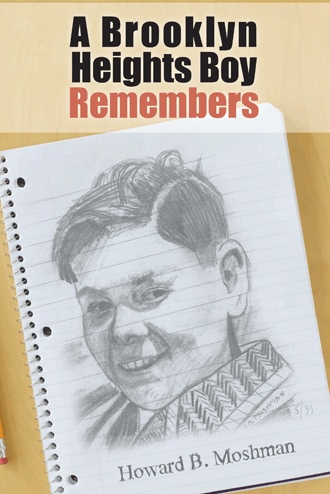
Howard Moshman’s memoirs are collected in an eminently readable book combining high humor and mature comments. In the shadow of the Great Depression he recalls cold winters and hot summers, classrooms crowded with children of immigrants, ancient libraries and 15-cent movies, teachers good and bad. During high school he worked as a soda jerk and handyman in his brother-in-law’s pharmacy. Between college and dental school he helped a researcher at the American Museum of Natural History, then performed Wasserman tests at the New York State Serological Laboratory. He recounts his service as a Navy dentist at stateside training centers, Pacific sea duty on a troop transport, ten cushy months on Oahu with collateral duty as a recorder (district attorney) of the summary court. Meet a cast of unusual characters including two over-the-hill automobiles, a martinet captain, an incident-prone pilot and a long-lost Chinese colleague. The GI bill helped in the transition back to civilian life. A blind date led to a marriage that has lasted 63 years and is still going strong. The last three chapters are reflections on dentistry after 60 years of practice.
About the Author
Howard Moshman was born in Brooklyn, NY, to immigrant parents. Educated in public schools, City College and NYU Dental School during the Great Depression, he served two years as a Navy dentist. He retired from private practice after 55 years. The book’s chapters first appeared as articles in a neighborhood newspaper.