
Hippolyte
Little Known Facts About Alexis de Tocqueville's Lesser Known Brother
by
Book Cover & Preview Text
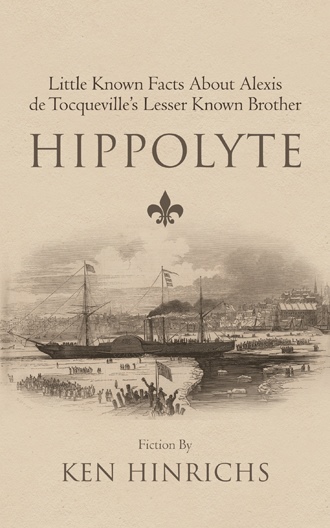
Sunday, May 18, 1845 On too many occasions we have lost our young to the madness of dueling. Men who might have doctored to the poor, created science for the good of humanity, ruled to set the world straight, or perhaps abolished slavery. Their deaths were only that – deaths! They served no greater purpose. Mine is of little value too. If today it is wasted, the loss will be minimal. By ten-thirty, Lafitte had already been at City Park for nearly half-an-hour awaiting my arrival. He stood tall and handsome, almost posed in the center of a shaft of sunlight sipping Rum Punch and looking fine in his best scarlet silks. One of Lafitte’s Quadroons was busy tying his flowing dark locks into a fresh ponytail. Pierre Lafitte, one of Jean’s brothers, was prepared to serve as his Second and there were many of the Barataria pirates present as well. They’d begun to celebrate the anticipated victory somewhat earlier and many were already inebriated by the time I arrived. They laughed and pointed as my carriage drove into the clearing just before eleven. As it rolled to a stop, one pirate threatened, “Hey Fatso, The Corsair has never been beaten, but if you should somehow come out of this alive, I’ll be there to finish the job!” “How comforting,” I thought, but Jean turned to the man and gave him an angry look. “How could one of my own men even joke that I might fail?” Lafitte said in a low voice to his brother. Lafitte radiated confidence and expected nothing but victory. The other pirate, realizing his gaffe, faded back behind his fellows. Life had been a bit on the tough side for Jean and his pirates over the past few years. Lafitte had been dropped from just about every list of notoriety in New Orleans and the Head Pirate missed his limelight. This duel was to signal a rebirth. Jean Lafitte believed with all his heart that he was on the comeback trail. In a matter of moments, he would regain his position as the “Most Adored Man” in New Orleans, or at least move strongly up the path toward it. Local public acceptance for Lafitte had begun to fade in every sector and so it was possible that the assembled crowd was quietly in my corner, however remote the possibility was that I might survive the next hour. Lafitte’s reputation – that dulled brilliance – combined with the federal government’s official cold shoulder for his “crucial” role in the Battle of New Orleans, had forced Jean, his brothers, and their band members though to actually consider packing up their belongings and looking for greener pastures, or whatever it is that pirates look for. Despondent at the turn of events, about two years earlier they announced that they were leaving Louisiana forever and sailed from their Barataria hideout south of New Orleans to Galveston. Perhaps it was greener waters they were seeking instead of pastures. Lafitte hoped to be as welcome in Texas as he’d once been adored in New Orleans, but the Galvestonians chose not to invite him to their social gatherings. Piratry as an art seems to be on the wane anyway. In Texas it didn’t matter whether he called himself a Corsair or a Privateer, the people from who he claimed his booty called him a pirate, a robber, a thief, a murderer, a thug, and a crook. His star in Texas having faded to its lowest zenith ever, this past spring Lafitte and his band gave up on the Lone Star State entirely. They returned to New Orleans and to the scenes of their greatest triumphs. I think that to regain the respect he felt he deserved, Jean committed to be ruder and cruder than ever. “I have been too accepting of your condescension,” it is said he told the Governor not long after his return to Louisiana. “I will not repeat the error.” His welcome back to the Crescent City though hasn’t been the warm one he’d hoped for. Young women often snicker now when they met him on the street. Men sometimes sniff haughtily as he passes. Time is catching up to the old Corsair. And while Lafitte’s reputation has merely soured, his body has visibly deteriorated. Embarrassingly, he is not able to find britches that adequately disguise his widened derrière. Nevertheless, our duel has presented Jean with his last best opportunity at returning to a position of prominence in the only place that had ever given him the recognition he believed he so richly deserved. Word was out that he primped for this New Orleans moment purchasing a splendid new deep red outfit with long tails that somewhat hid his derrière. One of his Quadroons introduced him to a new fragrance just in from Paris called Je Suis Magnifique. I’m sure he expected to dazzle these ies vies fassess pathètiques. That was evident at the moment for a slight breeze fluttered and Jean’s nostrils widened. His eyes rolled back and he proclaimed to no one in particular, “I smell marvelous!” I didn’t. Depressed and dripping perspiration in the morning humidity, my breath was tainted of an upset stomach. That was my only fragrance as I cautiously stepped down from the carriage, hoping not to trip and further embarrass myself. A slight movement from above caught my eyes and glancing skyward I saw Marie Laveau sitting primly high in one of the trees overlooking the dueling grounds of City Park. She waved. I presumed that because she was not welcome among the white crowd that had assembled, that she wanted a seat that offered her a view. I smiled weakly at her, gave a half wave back and began the short walk to the center of the clearing. “So that’s where she’s been hiding,” I said aloud to myself as I paced. “In a tree! No wonder I couldn’t find her.” The Oaks arching high overhead provided an incredible canopy for the event. As I passed below Marie, I could swear that I detected a few drops of lavender perfume fall onto my hair and lapels. Something was in the air all right. A regular from the Sun yelled at me to “Look out, Hippolyte. That Voodoo witch is throwing some sort of incense at you.” Drawing my sword I glanced heavenward again to wave goodbye but I couldn’t find her. She had vanished again. “Just as well,” I thought. “I prefer that none of my friends witness this end.” I’d been told by Tom that Lafitte planned for the duel to last about a half-an-hour so that he might impress the crowd with his skill at the colichemarde and, more importantly, with his endurance and vigor. “En guard, Orphan!” said Jean, smartly saluting me, touching the tip of the blade to his three-cornered hat. He shook his head to free the ponytail that had caught on a point on his collar. It was a theatrical motion that was lost on the crowd, but it impressed me. And apparently, it impressed Jean even more. I too wanted to prolong the outcome as long as possible and stood still, not responding to Lafitte’s challenge to stand ready. I’m certain that from his outward appearance many spectators concluded that I had resigned to myself that these were to be my final conscious moments on earth. Finally, and tardily I brought my sword up and returned the salute. The duel began and Lafitte’s first lunge nearly undressed me. Quickly assessing that his adversary was a poor match to his own skills, Lafitte revised his battle plan and elected to play with me for a few moments, delaying the dispatch as long as possible. “I would have thought a Frenchman would know how to use a sword,” he said mockingly, mostly to the crowd. I took advantage of the conceit and swung wildly at the swashbuckler, missing by a mile. Lafitte stood still. I tried again and missed again. Lafitte moved only slightly to avoid my sword. On that second lunge, Lafitte allowed my sword to come within an inch of his cheek. He smiled to the women in the crowd, making certain that they knew he’d accurately gauged the sword’s trajectory and deliberately allowed the closeness. Then he stepped smartly forward and pressed the attack.
Formats

Book Details
About the Book
Arriving from France in the Spring of 1831 on a mission to learn about America and its unique new government, a young Alexis de Tocqueville – future world renowned writer and philosopher – found many things to excite and inspire him, especially in its third largest city, New Orleans.
At the time, the Crescent City was the most wide open of America’s cities. It was a thriving melting pot teaming with creativity, intrigue, and heavy on personality. Blood was shed nearly every day beneath the huge spreading oaks of City Park. When war came, New Orleans assumed the mantle of largest city in the Confederacy and the Union’s Number One Military Target.
Secretly accompanying Tocqueville to America was his brother, Hippolyte. In December of 1831, the two accidently separated, never to see each other again. Alexis returned to France and fame as a world renowned social commentator, Hippolyte stayed on in America and accomplished even more in his own way.
This is Hippolyte’s story. It is also the story of Abraham Lincoln, steamboating, the pirate Jean Lafitte, a slave named Tom Armstrong, a host of other famous American heroes, of the birth of technology, and of America’s Civil War. It is also the story of Longfellow, Louisiana, Huey Long, and a love affair so intense it is commemorated in one of America’s most famous pieces of classic literature.
About the Author
KEN HINRICHS and his wife are the parents of three sons and share time between Niceville, Florida and Baton Rouge, Louisiana.