
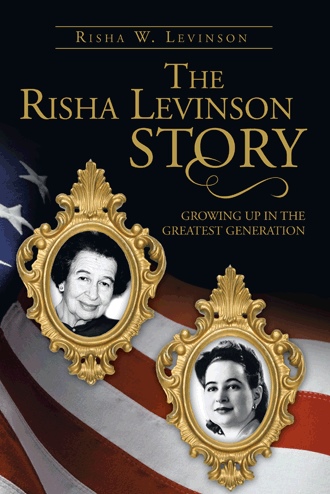
The Risha Levinson Story
Growing Up in the Greatest Generation
by
Book Cover & Preview Text
The Early Years in Milwaukee I was born on September 23, 1920, in Milwaukee, Wisconsin. My sister Sarah was also born in Milwaukee, seventeen months earlier. My brother Joe, who is seven years older than me, was born in Russia and brought to the US, via Japan, by my mother, Dora (Yiddish name Dubba). They were supposed to have gone to Columbus, Wisconsin but went first instead to Columbus, Ohio because my mother asked the railroad ticket agent in San Francisco for a ticket to Columbus but did not specify the state. Dad (English name Harry, Yiddish name Aaron) came from the Russian Empire to America, which was regarded by the Jewish community in Russia as die goldene medina (Yiddish for the golden land), before Mom in 1913. Wrapping a handkerchief around his jaw so as to appear, face hidden, a toothache victim, he escaped the Tsar’s army, traveling by train across the Empire’s border to Poland. After suffering through two nights in the border forest between Poland and Germany, he made his way to the port city of Hamburg, Germany. From there he took a steamship to Quebec, Canada and then traveled to Wisconsin, where his sister and brother-in-law were living, to make a new life for himself and his family. Dad had married mom back in the old country in 1911. She was a twenty-one -year-old seamstress. He was a nineteen-year-old hat-maker’s apprentice. When he was eighteen, he had gone to my mother’s town, Kalenkovich, near the Polish-Russian border, to escape the draft. My mother’s family took him in and my mother’s father, Meyer Pickman, who was known in the village as Meyer der kirshener (the hat maker), taught Harry the hat-making trade. One day Meyer discovered Harry and Dubba walking hand in hand and declared them engaged on the spot. They were married shortly thereafter in a home ceremony and soon after that, within the first year of their marriage, my brother Joe was born. With the assistance of his mishpocha (relatives) Dad made his way to Fort Atkinson, Wisconsin, to try to get a business started and make enough money so he could settle down. Several years later, in Columbus, Wisconsin, he began to make the transition from itinerant peddler of scrap metal to chicken feed supplier to cattle butchering. In 1917, he wrote to his wife to join him. Unable to go through Western Europe because of World War I battles being waged in that large geographic expanse, my mother traveled east with Joe from Kiev to Vladivostok, a distance of over 4,400 miles, on the Trans-Siberian Railroad, the longest train ride in the world. They then took a boat to Yokohama, Japan, and after six weeks there boarded a steamship for San Francisco, finally arriving in the United States sometime in late 1917 or early 1918. (My son Daniel uncovered much of the foregoing information and shared it with guests who came to celebrate my ninetieth birthday party in 2010.) Business wasn’t so good for Dad in Columbus and when an occasion arose for him to open a butcher shop in Milwaukee he grabbed it, moving our family to a four-story brick building in a working-class Jewish neighborhood on the corner of Fourteenth and Galena Street. Our family lived on the second and third floors of that edifice: the second floor contained a kitchen, a pantry, and a dining room with a large round oak table, a walnut carved buffet, and a Victrola record player; the third floor contained our sleeping quarters. The fourth floor of the building had several bedrooms that were occupied by boarders. The first floor was Dad’s butcher shop. Milwaukee was a magnet for foreign immigrants in the nineteenth and early-twentieth centuries. In the 1850s, many German Jews, escaping from the anti-Semitic proclivities of Imperial Germany, arrived in the city and later lots of Eastern European Jews, escaping from the anti-Semitic tendencies of Imperial Russia, streamed in. By 1910, Milwaukee shared the distinction with New York City of having the largest proportion of foreign-born residents in the United States. The basement of our Milwaukee home housed laundry equipment that included huge cylindrical washtubs and a large scrub board over which Mom spent many hours rubbing and scrubbing so long and so hard that she developed tender raw blisters between her fingers. Other laundry items included bleach, starch, and bluing that needed to be prepared with hot water. Clothes for steam ironing were wrapped up in terrycloth towels to retain moisture, and laundry starch was added to produce a smooth, stiff finish when the starched material was ironed. I loved feeling the steam vapor that came up from the boiling hot water in the basement washtubs. One day, while playing, Sarah carried me over one of the steaming tubs. Thoughtlessly, I lowered one foot into the scorching caldron and received a terrible burn. Fortunately, Mom dashed to my rescue, snatching me from Sarah and dressing the burn with Mazola oil. She then covered the wound with baking soda and applied layers of gauze to my injured appendage. I wept uncontrollably through the entire procedure. When I was five, I gave Mom more trouble by falling through our second floor window on the Fourth of July. As it was a very warm day, I had decided to climb up and sit on the screened windowsill. Not a good move! When I leaned against the screen it gave way and I fell, along with the screen, to the cement sidewalk below. Luckily, the screen acted as a buffer and I was fortuitously saved from serious injury. Dad, who was shaving at the time and saw me plummet past the bathroom window, ran down the stairs, picked me up, and carried me into the house. I vaguely remember a bunch of neighbors and passersby in the dining room as Mom, tears cascading down her face, cradled me in her arms. The only other time I remember my mother crying so hard was when Sarah had to be taken to the hospital for a mastoid operation. Regarding operations, the same year I fell out the window I had an appendectomy, which resulted in a ten-day stay at Mt. Sinai Hospital. Mom visited me each day I was there. Poor Mom. She would hold my hand and sleep during her visits, apparently out of sheer exhaustion. Riding the trolley car was stressful for Mom, given her limited eyesight and self-consciousness about making herself understood in English. She was also depleted from hand-washing all the family laundry, shopping for everybody (a difficult task for her because she had “milk leg,” a chronic condition of deep vein thrombosis that she acquired during her pregnancies), climbing the stairs with young children, preparing canned foods and all the meals for our family and neighbors from the old country who stopped by, and sewing everyone’s clothes. Mom battled her fatigue daily until she died at the age of fifty-one, worn to a frazzle from her countless responsibilities. One of those responsibilities was arranging for Pesach (the Hebrew word for the festival of Passover), which involved (a) helping Dad make wine; (b) preparing sour pickles, canned fruits, and the rest of the Pesach meal; (c) thoroughly cleaning the entire house, washing every window, and putting up fresh draperies and; (d) a whole bunch more. I got to hate Passover and cried at night because I worried Mom would never make it through the holiday. Just like the Jews were enslaved to Pharaoh in the land of Egypt, Mom was a slave to a celebration commemorating Jewish freedom in the land of beer and cheese. (NB: Passover is the Jewish holiday of the feast of unleavened bread [matzo]. It commemorates the story of the Exodus, in which the ancient Israelites were freed from slavery in Egypt. One of the most widely observed Jewish holidays, Passover begins on the fifteenth day of the month of Nisan in the Jewish calendar and is celebrated for seven or eight days.)
Formats

Book Details
About the Book
Can a Woman Have it All?
No one can have it all. But I have had a lot: to wit, a long-lasting marriage of sixty-two years, four children and six grandchildren, a highly satisfying family life, and an engaging and productive career. How did this all happen? Read my book to find out.
What Guidelines Did I Follow for Such a Fulfilling Life?
Here are a few.
“Who refreshes others will be refreshed.”
The Book of Proverbs
“Yesterday is history, tomorrow is a mystery, today is the present, that’s why it’s a gift.”
Anonymous
“If I am not for myself who will be for me? And if I am only for myself, what am I? And if not now, when?”
Hillel
About the Author
Risha Levinson, a retired professor of social work, was elected by the New York State chapter of the NASW “Social Worker of the Year” in 1992 and in 2012 received a lifetime achievement award from the Alliance of Information and Referral Systems. She has four children, six grandchildren, and lives in Great Neck, New York.