
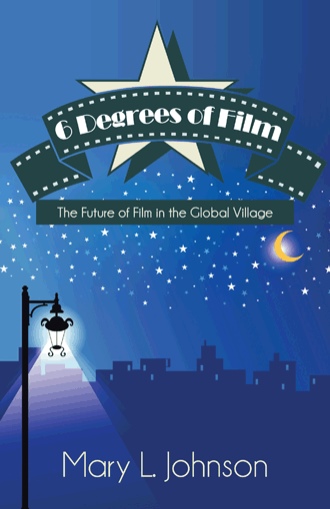
6 Degrees of Film
The Future of Film in the Global Village
by
Book Cover & Preview Text
William S Hart and the Evolution of the Western From the earliest days of film, the Western movie has been a staple of movie making. In fact, one of the very first films made by the team of Samuel Goldwyn and Cecil B DeMille was a Western starring Dustin Farnum. But the man who established the Western “horse opera” early on was William S Hart. Hart was a different type of Western hero in that he was already by Nineteen fourteen an established Shakespearean actor who had been on Broadway. When he took the lead in a Western film in Hollywood, he was almost fifty years old (born in Eighteen sixty–four). One of the most fascinating aspects of Hart’s rise to fame was his interest in making realistic western films. His films at the time were noted for their authentic costumes and props. Also, he was not like many of the other actors who had come West to make their mark in Hollywood. He had not been a “hack” actor from Vaudeville, having honed his craft on the stage in the U.S. and England as a Shakespearean actor. At fifty years of age, his face was a bit craggy and worn, which suited the part of a Western hero. Another noted first for Hart was his distinction of owning the first famous movie horse. He rode a pinto called Fritz. Fritz was the first in a long line of famous Western horses that included Tom Mix’s Tony, Gene Autry’s horse Champion and the most famous of all, Roy Roger’s Trigger. Eventually, Hart’s brand of realistic and gritty westerns gave way to ones with flashier actors and faster action. Determined to continue making his kind of Western, the gritty and realistic version of the Old West, he decided to distribute his own film independent of the studios. Hart also pioneered the independent film, as he was one of the first to rebel against the studio system by making Tumbleweeds in Nineteen twenty–five with his own money. The film was received well by critics but only did a fair amount of business at the box office. Hart became involved in legal wrangling with United Artists over the promotion of the film and the case was finally settled in Nineteen forty in Hart’s favor. Tumbleweeds was his last film and Hart retired to his ranch home in California where he died in Nineteen forty–six at the age of eighty–one. Four Men who Shaped the Movies – and Helped to Shape our World • Charlie Chaplin • Valentino • Fatty Arbuckle • DW Griffith The Four Men who helped to shape the world then and now are still symbolic of the connections between the first decade of film and the film industry of today. DW Griffith was an innovator in the same respect that George Lucas was considered a maverick so many years later. Both men were on the cusp of a new era in film development and both men “bet the farm” on their personal visions that changed the times they lived in. Charlie Chaplin was the first universally recognizable figure that paved the way for the global village of information. Children and adults alike could recognize his character of the Little Tramp and they could connect with him. He transcended speech and age and era. People still associate the Little Tramp with Chaplin and comedy and pathos. Charlie Chaplin as The Little Tramp spoke to millions in a universal language. His comic genius and his poignant character that so often represented the downtrodden and lowliest of beings was an instantly identifiable image. His character survives for that very reason. The Little Tramp is someone children and adults alike could watch and they would laugh at him and with him. Producer Jesse Lasky was so excited when he signed an “up and comer” named Rudolph Valentino. He had signed him for a life contract (“Life” in the early days of the business usually meant a five–year contract–which this was). Before there was a Clark Gable or an Errol Flynn, before Elvis Presley or Cary Grant or Tom Cruise, there was Valentino. When he appeared, women went crazy and men immediately disliked his “phony” stage persona. Valentino started out as a small bit player appearing in a series of forgettable roles until he hit it big in The Four Horsemen of the Apocalypse. Subsequently, he clinched the deal with his starring part in The Sheikh. Valentino was known, for better and for worse, as “The Sheik” and his dark good looks made him an overnight sensation. Valentino was not one who handled success particularly well. He had a difficult personality and was married to a domineering woman who also made trouble on the set. Still, his flared bell–bottom trousers and greased black hair became the latest rage. Tango dancing became enormously popular. For Valentino, his role was the part of the Latin Lover. He was the prototype for the movie star symbol that would dominate the press and the public for so many decades. Part of the mythology that has sprung from Valentino’s life has risen from the fact that Valentino died at such a relatively young age. He was only thirty–one when he succumbed to peritonitis. His was the first celebrity death that was mourned in the mass media age of the twentieth century. Women lined the streets to see his hearse drive by and apparently threw themselves on it. From there, his legacy was secure. He would remain young and unassailable and unchanging as his youthful image continues to be projected on the screen. The uncertainties of life and the changing nature of the film industry never affected him Most likely, he would not have survived the demise of the silent era, but through his death, the mythology is secure. He had the distinction of being the first true superstar to act and live out his life as a bonafide “movie star.”
Formats

Book Details
About the Book
This book is intended for film buffs of all ages, and in fact anyone interested in learning more about the history of fi lm. 6 Degrees of Film will take you on a short trip through the history of the movies where you will learn about the surprising connections between the fi lms of the past and the films of today
Some stories may surprise you, and some will simply entertain. 6 Degrees of Film connects the films and the film makers from the Silent Era and the Golden Age of Film with many of the movies that are made today. You’ll learn why we are in a new Golden Age of Film that is defined by movies like Star Wars and companies such as George Lucas’ state-of the-art special-effects company-Industrial Light & Magic.
About the Author
A lifelong movie buff, author Mary L. Johnson has written a blog on film-6 Degrees of Film-for the past six years. You can find the blog at www.sixdegreesoffilm.com.