
Mr. C's Digest - What a cool trip
MOMENTS OF MAYHEM, MEMORY, MUSIC AND MURDER
by
Book Cover & Preview Text
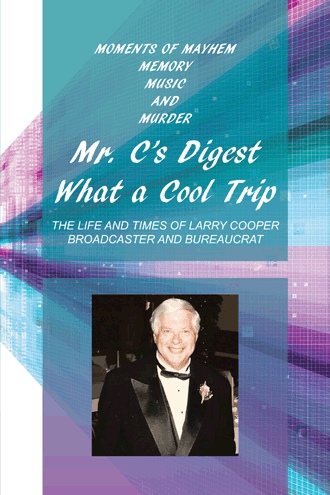
Part of the reason to write this book is to share some thoughts on lessons learned from my diverse career and life experiences that readers might find useful or at least of interest. "The Dance" represents my belief that you often must create your own opportunities by demonstrating your individual strengths and in order to do that you must focus on creating opportunities that clearly lend themselves to those traits. When I attended Middle School, a buddy and I decided to write our own version of a tabloid. We called it The Hot Sheet. Even then I had a vague sense I wanted to be a reporter. We wrote a two pager each week about school activities complete with a gossip section identifying what boys liked what girls and vice versa. We would make copies on a rough mimeograph copier the school owned. When I left a copy of this Hot Sheet lying on a table in the radio station’s control room the station’s manager took notice. A few days later he asked Roland to ask me if I would consider putting together a little fifteen minute radio broadcast on Saturday mornings, reading stories from my “Hot Sheet” and playing songs my friends might like. I said yes and one Saturday morning I awkwardly and nervously did my first broadcast. Because I could type with some skill and the Hot Sheet suggested I might have basic writing skills, I was asked to try writing a commercial. I did, the manager liked it and soon I was working at a typewriter. For the enlightenment of younger readers a typewriter is a mechanical device allowing you to imprint letters on a page by beating on lettered keys, kind of a word processor without computer chips. I worked after school for an hour or so each day writing commercials. Roland then let the manager know I knew how to operate the radio control board and he’d sent a letter off to the Federal Communications Commission to get me a license that would technically allow me to write down required hourly transmitter readings. The announcer on duty was required by law to write down transmitter gauge readings to ensure the station's signal didn’t surpass its allotted strength, didn’t interfere with the signals from other stations and/or shift your location on the dial. I found myself agreeing to work on Saturday afternoons operating the control board, not announcing anything other than the station call letters and town location. I was paid seventy-five cents an hour. I thought that was a great deal. Roland was happy as well for he could spend his Saturday working on the equipment and not worrying about keeping the programs going. One of my tasks was to “engineer” a weekly live broadcast in the studio featuring Adolph Lesser’s accordion students. Adolph and his wife operated a music store in Greeley for many years and led a popular local polka band. Adolph was considered “the Polka Master” and his band was nationally recognized. Adolph first started radio broadcasts in the 1930s on KFKA in Greeley (one of the first radio stations in the United States to hit the air) in later years, the 50s, he moved his broadcasts to KYOU. That was followed by three hours of polka music recordings. When that ended I would play recordings of local commercials, give station breaks and for the last two hours play country western records. Two years later it was 1957, I was fifteen, my voice had started to change allowing me to lower my voice while hoping against hope that my voice didn’t crack. I was allowed to read on the air. I was to host a regular music program working as needed, usually on Saturday afternoons and Sunday mornings. Sunday involved putting the weekly live remote feed of local church services on the air. When I entered ninth grade (1956) rock n’ roll was just beginning to pick up popularity but in our conservative 1950s town most of those over thirty years of age wrote off the new music as “bar blues.” Many believed Elvis was African American, until the world saw him move on the Ed Sullivan Television Show. To locals that music was only to be played at the “just over the city limits” bars. There was an unincorporated area across the highway from the radio station called "Garden City" populated with blues bars and "joints." Blues and soul bands were hired at those establishments because the performers could pick up a few extra bucks before hitting nearby Denver. I wasn’t old enough to get in the door to listen, but I would walk over there and stand outside the front door just listening to the music. Another personal note - life lesson; seek acceptable alternatives whenever feasible. Nonetheless the impact of rock and roll could not be ignored so Roland’s Friday night program eventually became a teenage request show and expanded to five nights a week. That same year I was asked to be the DJ for that teen-age request show because I was in fact a teenager, and to be honest Roland had the personality of a radio engineer, a technical scientist as it were and his "passion" was not music or announcing. The first thing to go was the Muskrat Ramble. By my senior year in high school, I was getting so many song requests at night the manager had to pay a really cute but really shy teenager named Mary to join me to handle phones and write down all the requests. Compared to today's formula-driven cut and paste radio there was a simplicity then that was fun and honest and not really meant to accomplish much more than attract and entertain. Looking back now, it was great fun; the songs were fun and simple, no innuendos, no vulgarity just fun. Sometimes I’d read twenty or thirty “from and to” names per song and the kids loved it. By way of example, I would get a dedication request from a guy who sat by a cute girl in class but was too shy to speak to her. In the course of the evening she was sending songs to him. By the end of the program they would be “hooking up” but the next night the request would change to a song with lyrics like “Breaking up is Hard to do.” Friday and Saturday night shows were the most fun because teens gathered on the main street to drive up and down the street, with radios blaring, waving and shouting. We called it "cruising." Late at night when I would arrive home I would quietly get ready for bed trying not to awaken my Dad, sneaking my battery-powered radio beneath my blankets to listen to “Wolf Man Jack” on a distant 50,000 watt radio station located in Oklahoma City , KOMA. Whenever a station break was announced between Wolf Man’s Howls and the next song, a voice would shout: " KOMA in Oklahoma!" That (listening to tunes in bed), I suppose is easier today with ear-buds and tiny players loaded with thousands of songs. In the 50s that would have been unthinkable but in many ways it is sad for what's missing now is the connection with a local disc jockey. As Wolf Man Jack put it in an interview recorded with him before his death "Computers have no soul."
Formats

Book Details
About the Book
A diverse career in broadcasting and government public affairs is used to reflect on “mind’s eye” memory moments highlighting 57 years of life involvement and observation as a curious reporter and as a human being. Interesting stories and events covered as a reporter, fascinating characters interviewed, events tragic or unique, unusual lifetime coincidences and the trials and tribulations of societal and agricultural evolution provide a fascinating backdrop to the author’s journey.
Share this unusual personal and professional journey spotlighting dramatic, humorous, and personal “Mind’s eye” memories.
About the Author
Larry Cooper attended what is now the University of Northern Colorado in his hometown of Greeley, Colorado. He began his 36 year career in radio and television when he was just 13 working at KYOU radio in Greeley. He’s worked as a DJ, Program Director, Reporter, News Anchor on radio and television, News Director, Talk Show host, Documentary Producer and Farm Broadcast Journalist. He began service as a Public Affairs Specialist for the California Department of Food and Agriculture in 1990 retiring after 14 years in 2004, then spending another 7 years working for the United States Department of Agriculture and again retired in 2011. He’s been married to his first and only wife Patricia since 1966, the couple producing three children, Troy (now in his 40s), Travis (his late 30s) and Katrina (in her early 30s). He’s worked in 6 states with a career that covered a span of 56 years, retiring in 2011. He and his wife Patricia now live in Bozeman, Montana.