
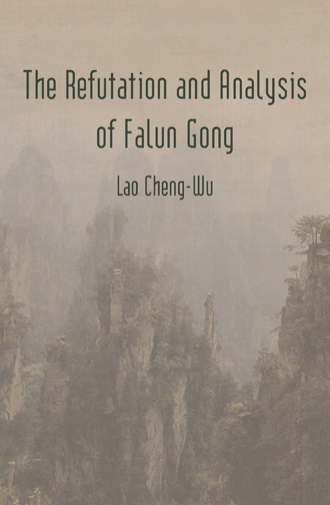
The Refutation and Analysis of Falun Gong
by
Book Cover & Preview Text
Formats

Book Details
About the Book
Falun Gong, founded by Li Hongzhi in 1992, claims to have 100 million disciples. It continues to draw attention from people throughout the world.
Lao Cheng-Wu studied Buddhism in Hong Kong for a number of years, and he had the opportunity to be a disciple of Master Nan Huaijin. In this academic work, he participates in the Buddhist tradition of refutation, taking a critical view of Falun Gong, its beliefs, and its practices.
This study traces the history of Falun Gong, with an emphasis on Taiwan, and considers how it has transformed into a political organization, spreading worldwide. It examines why it continues to attract followers and explores facts about Li Hongzhi, who tried to establish a new religion, claiming that he is superior to Sakamuni, Jesus, and Laozi. It also provides ways in which the Falun Gong created conditions for organizational success and analyses regarding the myths promoted by Falun Gong.
By relying on Confucianism, Taoism, Buddhism of the Orient, and on Western philosophy and Christ’s teachings, it is possible to refute Li Hongzhi’s scriptures. The simple, straightforward language in The Refutation and Analysis of Falun Gong provides keen insights into a misunderstood religion.
About the Author
Dr. Lao Cheng-Wu is a native of Kaiping, Guangdong Province, China. He graduated from the Law Research Institute of the Law Department at National Chengchi University and earned a doctorate of philosophy degree from the Hong Kong Buddhist Institute. He has taught as a professor at National Chengchi University, National Open University in Taiwan, Chu Hai College, and Buddhist College in Hong Kong. He has been involved with a number of magazines and is widely published.