
True Successor
A Novel of the New Roman Empire
by
Book Cover & Preview Text
PROLOGUE
January 19th 1777
Aachen
The snow began just before dawn. By mid-morning, all Aachen and the enormous Imperial palace at its heart was in the grip of the year's worst blizzard. The heavy snowfall left the palace white and silent. By half-past two its rooms and corridors were quiet and empty.
Prince Clovis, the Emperor's brother, was alone, awaiting his final visitor in his cold, high-ceilinged office, a large and luxurious marble room with silver furnishings, hung with tapestries depicting the triumphs of Julius Caesar. Though there were fireplaces at both ends of the room, Clovis stood at the window, which he had left slightly open. He liked the cold because he thought it sharpened his mind . Clovis made a fine figure: a tall, middle-aged man in an ermine-lined jacket, burly, and glowing with health. He had used the blizzard as an excuse to send his staff home, leaving no one else in this room or its antechamber. He wanted no witnesses to what was to come. A few minutes before, an unfamiliar servant had entered the room, quickly made a fire in the second fireplace, and departed as silently as he had come, leaving Clovis alone at his window to watch the snow bury the garden and turn its trees into lace.
A year ago his brother had passed him over for the title of Crown Prince in favor of his own son, the twenty-six year Charles Martel, whom the family called Martin. Clovis took Martin's promotion as a personal insult. Although direct succession was usually the rule, in theory the ablest of the four thousand descendants of Charlemagne could receive the appointment. Clovis was fifty-three and in the full strength of his maturity. A soldier in his youth, he had served the Empire in its long wars with the Mongols and helped to establish a neutral zone between the Empires. Later he had been ambassador to the Danes, governed Cuba, the Empire's outpost in the New World, and acted as his brother's Proconsul in Tunisia before returning to Aachen.
Disaster had followed within a year of Martin's appointment; the Emperor had a stroke. Since then he had been unconscious, and he would soon die. As Crown Prince, young Martin had automatically become Regent, and he would succeed to the throne. Clovis meant to make sure the young thief would never be Emperor. Too bad, thought Clovis. The boy's likeable enough, but the Empire needs a man. Martin can't deal with the Mongols, the Caliphate and the Byzantines on the Empire's borders. The generals might be able to manage the fighting, but who will manage them? At home things would be even worse. The great aristocrats—the Grandees—will roll over both the boy and Karl VII's pan-Roman policies like a carriage over a flat stone.
Clovis had quietly approached the senior members of the government. Those discreet men were careful never to say so directly but they let him understand that if Martin disappeared they would not contest his succession. Only one obstacle was left, the Chancellor,second only to the Regent, to whom the armed guards protecting the palace reported. That morning Clovis had received an unsigned note in the Chancellor's unmistakable spiky handwriting. And though he had thrown the paper in the fireplace, he remembered its words perfectly: An unexpected opportunity has arisen. I will be in your office at five o'clock. Wait for me. Clovis was relishing his anticipation. The boy would be dead tonight, and Clovis would be Emperor tomorrow. The Emperor of New Rome repeats his coronation oath in his own words and swears to it. When he finishes, the crown of Charlemagne is placed on his head, and he imagined himself being proclaimed Emperor:
He shall be known as Clovis, the fourth of that name, Emperor of New Rome and the Western Roman Empire, happy, glorious, triumphant and pious, doer of justice, first magistrate, no despot but lover and protector of the Roman people and their Empire, defender of the true faith and true successor to Charlemagne.
He smiled, savoring the vision of taking this sacred oath, but the smile disappeared when the door opened suddenly, and the room filled with armed men who closed the door behind them. Clovis recognized Martin, Aetius, his half-brother, and three of the young men in their circle: Giuseppe Sforza, Major Valerian den Olivese, and Alejandro de Ausundas, along with half a dozen junior army officers.
What's this, Martin? Clovis demanded in an angry voice. His nephew faced him to say, "Uncle, it's over. The Chancellor provided me with the note to send you. He's not coming and never was. My own grooms, Otto and Fabian, have confessed they were to stage an accident and make it appear that my horse threw me and left me dead . The two guardsmen who were to do the actual killing and your man Rossini are dead too. I killed them myself.
That's a lie.
I have their confessions.
Clovis stood mute and ashen-faced.
The Crown Prince went on, "I loved you more than I loved my own father. You knew it. You always told me you loved me.
What matters is what is best for the Empire," the older man said in a flat voice. "I would have spared your life."
"No one who has confessed has said so, and you would have needed to display my body. If you want a public trial you can have it." I will see that you are convicted. That will destroy your wife and ruin your children's lives. Frederick and Cornelia will live out their lives as the impoverished and despised children of a traitor. He paused before continuing. But, if you take poison here and now, we will announce your death as a heart attack. I will not blacken your memory. I will treat Aunt Vera and your children as family. Frederick will have a prince's upbringing and career and when the time comes, I will find Cornelia a good husband.
Clovis stared at the mosaic Imperial seal inset in the marble floor at his feet for a long minute as if to say farewell. Then he asked, "Is there no other way?"
None.
Clovis stood for a minute before finally nodding. "Give me a few minutes to pray." As he sat down at his desk, he turned to Aetius to spit out venomously,"I suppose, dear nephew, you have the poison in your pocket. The bastard doing his legitimate brother's dirty work."
“Indeed,” Aetius replied. He turned to the Crown Prince, “Martin, you must not be here for the rest of this. Have the soldiers escort you back. We four will stay.”
The Crown Prince nodded and left.
A short time later Clovis said “Amen” loudly and, still seated, opened his mouth. Sforza and de Olivise seized his head and pulled his jaws open. Aetius took the vial out of his pocket and poured its contents into Clovis’s mouth, then Sforza and de Olivese forced his jaws together and held them in place. For a minute, it seemed as if Clovis had changed his mind, struggling with them in a grotesque wrestling match. The four men forced Clovis onto the floor, the chair crashing down with him, and held him even after he started to writhe in convulsions. His breathing first turned deep and rapid, then stopped. In a few minutes, all movement had ceased. Aetius took out a small pocket mirror holding it up to Clovis' mouth and nose. After a minute, he nodded and said to Sforza, “I’ve made the arrangements to have the body found. You know what to do. The Imperial Physician is expecting you, Giovanni.”
The assassins left, closing the door quietly behind them, the body on the floor. Clovis’ twisted mouth still seemed to be in pain. His gray eyes were still open, glaring angrily at the ceiling in silent accusation. Soon, he would be found and those eyes would be closed. It had all been arranged.
Formats

Book Details
About the Book
It is 1812 in Sapoda, a small crossroads town nestled in the neutral zone between the New Roman and Mongol Empires. Mikail de Reuter, a young political officer bored by his job and worried about his prospects, is only there to visit his girl. But Mongol cavalry looking to clear a path for an invasion come to kill him. He knows he has been betrayed and runs for his life.
In New Rome Emperor Charles Martel IV has had to contend with many enemies just to keep Charlemagne’s crown on his head—and that head on his shoulders. So far he has managed to hold things together. In Mikail’s story he glimpses an enormous treasonable conspiracy years in building. As the Emperor begins a frantic hunt for them, the conspirators realize that unless they strike first they will soon be dead.
True Successor is a fast-moving good read and a trip to a fascinating New Rome for Alternate History buffs. Like Mikail we live briefly in that city and meet and hear not only the great men of the realm, but young lovers, clerks, soldiers and ordinary men and women shopping, drinking in its taverns and walking its streets.
About the Author
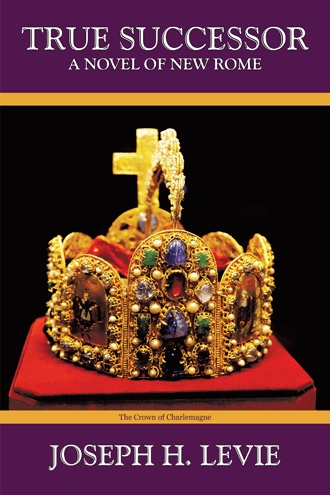
Joseph H. Levie, an attorney and banker, has nurtured a lifetime interest in the Roman and Chinese empires. Since he first saw Charlemagne’s coronation robe and crown as a young man, he has wondered what would have become of Charlemagne’s empire had someone been able to revive it. He currently lives in New York.