
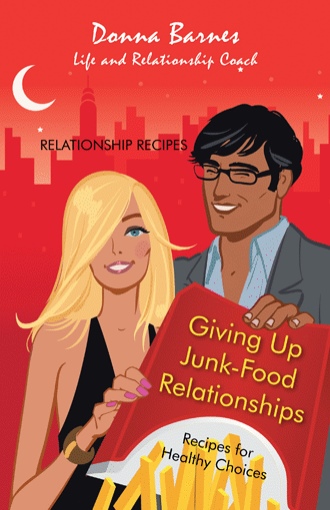
Giving Up Junk-Food Relationships
Recipes for Healthy Choices
by
Book Cover & Preview Text
Introduction: What Is Emotional Junk-Food?
We all have our favorite drive-thru or take-out meal. A burger and fries can taste really good when you’re out and about or in the airport rushing to get on a flight. It might even be a guilty pleasure that you go out of your way to devour. Sometimes when your stomach is growling out loud, you’ll simply settle for what’s readily available to satisfy your hunger.
How do you typically feel shortly after indulging your craving? Do you feel a little bloated? A little nauseated? Maybe you have some heartburn. Do you feel guilty and wish you had eaten something healthy instead? And have you noticed what happens to that scrumptious fast food when it cools off and isn't hot anymore? It’s pretty nasty, isn't it?
Well, bad relationships are pretty much the same as junk food. They usually start out with a hunger or craving for companionship, but if this healthy craving escalates into loneliness and neediness, such people tend to make bad choices. They might just grab whoever’s available or seek out a particular type that at first glance always appears appetizing to them. When it’s hot, it’s fabulous! It’s exciting and fun—very enjoyable. But as the euphoria of the new relationship starts to wear off and the “can’t get enough of you” passion cools down, what’s left isn't exactly satisfying. Sometimes it’s even harmful, and the long-term effects can be devastating. (Ever see Fast Food Nation? )
The difference between consuming actual junk food and indulging in emotional junk food is that with food, at least you usually know what you’re consuming isn't really good for you. With relationships it’s not always as easy to tell it’s not good for you until you've already digested a lot of it. As a relationship coach, I see a lot of people who don’t really know if their relationship is right for them. I even see people who are in downright toxic relationships but don’t know it, or refuse to acknowledge it. Many people think they know, or at least have an idea of, what they want in a relationship. But most people don’t know what they don’t want in a relationship until they've experienced it and didn't like it. I think knowing what you don’t want in a partner is more important. This book is intended to empower you with knowledge—to help you create virtual nutrition labels for potential partners and make healthier relationship choices.
The Symptoms of Consuming Junk-Food
I believe a person’s happiness level dictates his or her degree of patience and compassion. Think about it. When you’re content and life is going well for you, aren't you much more tolerant than when things aren't going exactly as you hoped? If your order takes a little too long, you have to wait in line, or someone bumps into you, it’s no big deal, because you have pleasant thoughts running through your head. But how do you respond when you’re not entirely happy? Are you easily irritated by another’s slowness or mistake? Do you perhaps make nasty comments? Do simple tasks frustrate you? If you find yourself nodding in response to these questions and you’re feeling a bit cantankerous and inpatient, that’s probably an indicator that you’re not entirely happy. If you’re in a relationship and you’re not happy, you’re probably consuming junk-food—or you are junk-food.
As human beings, we are made up of cells, and ours cells produce energy. Some quantum physicists believe our cells are energy. Nonetheless, our energy is powerful. It radiates. When a happy, charismatic being enters a room, others take notice—they’re drawn to that person. That’s because energy is contagious. It makes others feel happy too. But it’s not just positive energy that’s transmittable. Negative energy is highly infectious. If you’re distracted by chemistry and attraction, it’s not always easy at first to realize you’re being changed. It’s usually easier for the people around us to see when someone’s not good for us than it is for us to admit it to ourselves. Perhaps someone else even suggested you read this book. If so, that’s probably because he or she recognized how much futile energy you’re focusing on in trying to make your relationship work. Are you holding on to the fantasy that all the good things that happened in the beginning truly define who your significant other is? Are you hoping he’ll change and go back to being the ideal partner you initially saw him to be?
Well, people don’t change unless they want to. Most people don’t want to. Change is hard. Yet many of us exert too much of our precious time and energy trying to change a lover who doesn't want to change. I know there might be temptation to use this book as a guide to fix your lovable junk-food, but try to resist wasting any more valuable resources on a useless cause. Try focusing all that enthusiasm on fixing yourself! One of my favorite expressions is as follows:
Nothing changes, if nothing changes.
It’s so simple but so true. The only way you can possibly change someone else is by changing yourself, which may in turn change the way he or she responds to you. So, if you are absolutely hell-bent on changing your diamond in the rough, you’ll have to start by shifting your focus back to you.
My hope is that this food for thought will incite cravings for healthier choices. I hope to bring you so many epiphanies that you’ll never crave junk-food ever again. I promise that if you use this book to refuel and claim your own power, you’ll become a magnet for someone fabulous—because energy is contagious. If you are healthy and take care of yourself, you’ll naturally attract a healthy partner. But if you stay with someone who is junk-food, you will end up as junk-food too.
This chapter will show you some of the most common relationship spoilers and offer ways to get rid of them for good.
CONSTIPATION—WHEN FEELINGS DON’T FLOW
Experts often say that communication is the essential ingredient of a good relationship. I couldn't agree more! But do you know why? More importantly, do you know how? I’m always disappointed when I hear the way many people in relationships speak to each other after they have gotten comfortable. They sound so disgusted if their partner doesn't do something exactly as they wanted. They bark orders like their spouse is beneath them. I hear it at the mall, in restaurants, and even in church! If that’s the way they treat each other in public, what are they like at home? What happened to respect?
What’s really going on is more than just a lack of manners. Such behavior usually comes from harbored resentments, unresolved conflicts, and unexpressed feelings. When you hold these things inside and have trouble communicating your needs and desires, you can’t help but become irritable. It’s just like when you eat a lot of junk food and it binds you up. It’s uncomfortable. It makes you sluggish. Sometimes it’s even painful. The longer you go without letting things out, the worse it makes you feel.
How do you find relief? Well, people who are constipated as a result of their diet usually eat something healthy, such as beans, bran, or broccoli with garlic.
Formats

Book Details
About the Book
Are you waiting for someone to change back into the person you fell in love with? Do you fear you won’t find anyone better for you if you leave or let go? Are you confused about what went wrong? This book bottom lines how to make your relationships healthy, and more importantly how to tell when things have gone bad. New York City Dating Coach Donna Barnes lays out all the signs to watch for not just in abusive relationships, but also in dysfunctional and simply wasting your time liaisons. Junk-food! If you’re hungry for a great romance, Giving Up Junk-Food Relationships is valuable food for thought.
Barnes uses illustrative client stories, multiple-choice quizzes, check lists and how-to lists to help you determine what to keep and what to throw out. You’ll learn how to read key symptoms of junk food like Constipation: holding in resentments; Heartburn: cheating, jealousy and insecurity; Leftovers: when the love is gone but you’re still addicted to the sex; and Binging and Purging: recognizing a commitment phobic. You might even be surprised to discover how you are sometimes junk-food.
This Relationship Recipe will detail:
* How to recognize and stop destructive dating habits.
* How to spot and avoid waving junk-food (red) flags.
* How to distinguish true love from true lust.
* How to tell if you’re in a bad relationship and how to call it quits.
* How to be comfortable being alone.
* How to handle rejection gracefully.
* How to improve your primary long-term relationship: The one with yourself.
About the Author
Donna Barnes has been Good Morning America's Relationship Expert and is a Life and Love coach, certified by New York University. She was an on-air expert for three seasons of ABC News' "What Would You Do?" and has appeared on numerous other television programs including "Nightline," "CBS this Morning," and VH-1's "Rock of Love Charm School," and hosts her Broken to Brave podcast.
She has written advice columns for various magazines and websites and has interviewed some of the country's top sex and relationship experts. New York Newsday dubbed Donna "the real life Carrie Bradshaw." With more than 30 years of personal dating experience Donna gives clients a unique perspective — a combination of practical hindsight, intelligence, and academic knowledge. She is based on New York's Upper West Side but coaches clients all over the world virtually.
For more information, please visit DonnaBarnes dot com.