
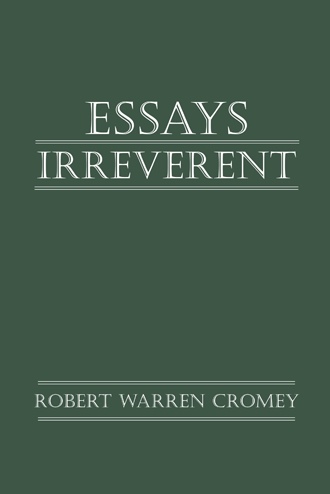
Essays Irreverent
by
Book Cover & Preview Text
No More Faithful Monogamy
Robert Warren Cromey
Life-long, faithful monogamy is on the way out. Many Christians already practice polygamy with successive partners. It is called marriage after divorce. Robert Wright, an evolutionary psychologist, suggests infidelity is in the genes of some percentage of the population. “The good news is that human beings are designed to fall in love. The bad news is that they aren’t designed to stay there. It is ‘natural’ for both men and womenat some times and under certain circumstances to suddenly find a spouse unattractive, irritating, wholly unreasonable.” Natural does not mean unchangeable. The human mind is flexible enough to shape our behavior. But, when we know there are hundreds of millions of people on planet earth, there will be many people who are not going to commit to a life-long, faithful partnership. Why make this demand?
Church and society believe children thrive best in stable families. They are healthier than children from broken homes. The family is the basic unit of society; anything that weakens it destroys the fabric of that society. Stable families produce happier and less violent children than those from divorced families. Let’s assume all that is true, yet one half of marriages in our country end in divorce. Religious bodies cling to the notion of faithful monogamy. They hold it up as the highest ideal for all, especially all their members. Religious groups proclaim the dignity of faithful, monogamous marriages. Many even allow for divorce and re-marriage. However, they fail to provide pastoral teaching and assistance to people who cannot and do not stay faithful, who commit adultery or just need to move on to other relationships.
Suppose people did not have the weight of the vow to a life-long, faithful monogamous commitment. Suppose we didn’t make the breakup of a family a moral disaster. Suppose we in fact prepared people for divorce in the way we prepare them for marriage.
I see a day coming when we will perform marriages between people omitting the promise to forsake all others and to be faithful as long as you both shall live. The church could give the couple the option of not having to promise to be faithful and monogamous. Leave it up to the couple to decide what they are going to do about the future of their marriage. We can prepare young people for the fact that they have only a fifty-fifty chance of keeping their vows. We can teach that relationships change—for better and sometimes for worse.
It is much more common for couples to have extra-marital affairs but stay married. They do not discuss this with their partners. The price they pay is a lack of honesty and deep intimacy. By not sharing with one’s spouse this important, emotionally laden other relationship, they withhold basic energy from their primary relationship. These relationships usually lack real, personal intimacy.
I am in a faithful, monogamous relationship. I am wildly jealous at the thought of my wife having sex with another man. In an earlier marriage, I had relationships with other women outside of my marriage. I kept them secret. While the affairs were delicious and delightful, they adulterated and ruined my first marriage. It caused pain and hardship for my first wife, my children and ultimately for myself.
Formats

Book Details
About the Book
This book covers a broad and varied range of topics from religion to Israel and sermon improvements to politics. The author’s controversial views are sharp, witty and against the grain. He is sure to offend Episcopalians, Jews, Roman Catholics, clergy, preachers, listeners and prudes.
Readers will get a dose of sex, marriage, biography, sexual freedom, church growth, drugs, porn, peace, Palestinians and anti- spirituality. The author has gathered ten years of long and short writings reflecting his personal and professional interests. Some have appeared in newspapers, magazines and blogs.
Nonbelievers will get a glance at the workings of sermon writing. Church goers will learn what to look for in a good sermon. The connections between the gospel teaching of Jesus and politics, ethics, medial care, forgiveness, patriotism, church and state are presented.
The hypocrisy of fundamentalist Christian’s conservative politics and the radical nature of the teachings of Jesus are explored. This book will make the reader think, be outraged and also see the importance of forgiveness and good communication.
About the Author
Robert Warren Cromey was born and raised in Brooklyn, New York. He attended New York University and the General Theological Seminary. An ordained priest of the Episcopal Church, he is also a licensed marriage and family therapist. He is married and has three daughters. He lives in San Francisco, California.