
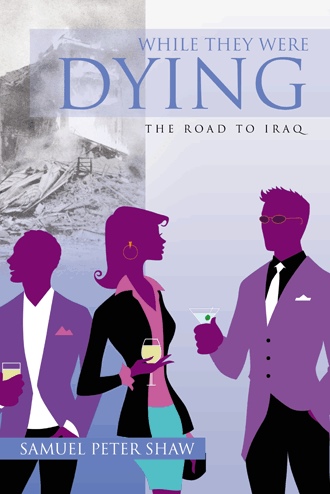
While They Were Dying
The Road to Iraq
by
Book Cover & Preview Text
Like a lonely toy on a piece of string, the boy Rolo was following the three girls, the older two in white tops and hugging jeans, the little one in a faded yellow smock, he trailing behind in the year’s early heat, kicking that day’s special pebble along the narrow, dusty path that bobbed up and down through the hummocks of the wasteland. It was where people took their dogs, dumped rubbish, made fires, smoked pot, drank booze, had sex, watched the sky, escaped the world. What you did depended on who you were and how old you were. That spring day in the second year of the 1990’s, Rolo was eight years and 13 days, Katie Drummond and her friend, Mary Duff were eleven, nearly twelve, and Katie’s little sister, Dodie, was three, nearly four.
At the top of the next hill, Dodie was waiting for him, watching as he threw cluster bombs at an Iraqi patrol, the stones falling short of the chirruping sparrows; trying, instead, a Tomahawk missile, the stick exploding among the Iraqis, the sparrows whirring away; the boy shrugging, running up the hill towards her, swishing nettles with a cane, puffing himself trying to catch a speckled butterfly; flopping down at her feet beneath a bushy tangle as if shot, the boredom of being pushed in each day with the Drummonds still a million times better than Big Mick…
***
… A mobile phone ringing.
“Mr Wolfson?”
“Yes, Bill.”
“Mr Wolfson, can you get round here straight away?”
“What’s wrong?”
“There’s been an accident. A boy.”
“What do you mean a boy? What kind of accident?”
“A little lad. Seven …eight. He must have climbed up.”
“For God’s sake! What was he doing on the site? Where were you lot?”
“He’s hurt bad, Mr Wolfson.”
“How bad?”
“Bad!”
“Bill, get a grip. Tell me what happened. What did he do?”
“He must have fallen off a plank. The men….”
“And?”
“He went straight down.”
“On to the ground?”
“Into the mixer.”
“The mixer? The cement mixer?”
“Yes.”
“Was it going?”
“Yes.”…
***
… He sighed and bowed his head. For that day at least, he had gone as far as he could, ready now to admit that the inferno, that day’s inferno, was not the only cause for his need for sanctuary.
— Lizzie, loving and kind, imagining that the reason for his wretchedness was the same as that filling her own mind that day, not the new war, something infinitely more personal, more compelling; trusting that what was in her mind was in his, but saying that, yes, of course he must go up to the City for his meeting, of course he must.
“It’s only a short drive away and I’ll be fine on my own,” she had said, “of course I will,” stinging him by adding, “I always have been,” stating the opposite of her existence with, “You can’t live in the past, Colly. None of us can,” wounding again, not meaning to, not knowing, with, “You have to let go. You have to forgive. Even when there’s nothing to forgive.”
But what did she know? Thinking only of Robert, their baby son, of the way he, Colly, had blamed her, knowing she wasn’t guilty, that it wasn’t her fault, hating himself for thinking it ever might be, yet never able to cast from his mind the torture that she could have done more, that it might have been different had he been there with her instead of spending the night away on business.
So, yes, she was right. The inferno, his own, personal inferno, was to do with Robert. Both of them knowing that, both of them grieving, but only he thinking of Nico, she grieving Robert’s birth that day eighteen years ago, but she without a thought of Nico, not aware that it was also his birthday, two years to the day before Robert’s; not realising that in his mind the two had become one, that Nico had replaced Robert, that Nico was his new son, that for the past three years he had been helping Angie to take care of him, calling in every other day or so, absorbing the boy’s anger and frustration, helping him to dress and bathe, being there;
Lizzie not knowing this, knowing about the money, the compensation, the damages, but not being told about this later caring so as not to disturb the old wounds, cause new hurt; so that she would not realise he had replaced the one with the other, that the surrogate had taken over, that the few weeks of Robert’s life had gradually merged with Nico’s, that the only way he could deal with the guilt was to abase himself in the suffering.
So there it was — the grotesque fluke. On the day of the re-born war, the shared birthday, intertwining what was and what might have been with what was full stop; the bitter coincidence not allowing either the one or the other to be forgotten, to be put aside.
And this year, the day worse than ever, more involved, more guilt-ridden. For while Nico was not now, had not been for a long time, merely the second tragedy of his life, was instead the engrossing, intimate sun of it, the one around which he increasingly revolved, was drawn to, what Lizzie also did not know, had not yet guessed, been told about, was that there was now in his life another twinned pair, Chloe and Charlie; that he was craving for the one and already joined with the other…
***
…Then something different…new…interesting… Paul and Anna Brownlove ushering in two people he had not seen before: he tallish, thin-haired and thin-cheeked, with a prominent left eye and hands that gesticulated expressively, she also tall, but with red hair that fell to her shoulders, quiet hands that quickly caressed her glass, and a face both demure and worldly, fashioned, it seemed to Colly, from the skin of a pale, exotic fruit; lustrous, unblemished.
“These are our friends, Simon and Chloe,” Anna was saying, “the ones we told you about.”
“The ones you met last year in Vienna,” Charlie recounted…
***
…“I see you’ve reverted to the Neanderthals, darling.” The speaker, her mother, was leaning against the kitchen door, her dressing gown hanging open, her hair in urgent need of the best coiffeur on the High Street, an empty glass in her hand.
“Mother, cover yourself up! What’s that there, then,” nodding at the glass — “your breakfast bottle, your lunchtime bottle, or an advance on your five o’clock bottle?”
“Don’t be so bloody rude”— moving to the dresser, pouring another gin out of spite, demonstrating her sobriety.
“Then don’t be so bloody disgusting about my friends.”
As usual these days, her mother’s words were uttered without heat, a sign that the real crisis lay elsewhere, that they were already well schooled in the charade that allowed them to cope as a twosome, not a threesome.
“Am I to meet this black person?”
“I shouldn’t think so.”
“So all I’m to see of him is his back as he carries you away from the gate on that death trap.”
“Or his face as he brings me back.”
“Are you in love with him?”
“I might be.”
“Then your not.”
“Then don’t be ridiculous!”
Formats

Book Details
About the Book
Samuel Peter Shaw’s drama of love and betrayal is peopled by the Sink Set, a group of fickle, moneyed sophisticates living in London's leafy southern suburbs. For all but one of them, the Iraq War is sobering but coincidental, a backdrop against which they shrug and carry on. Colly Wolfson, a member of the Set, is a forty-something prize-winning architect and builder; wealthy, debonair, popular. But personal tragedy strikes him twice.
Overcome by grief and guilt, he tries to make amends, but keeps his efforts secret. For a time, he believes he might achieve a new beginning. But in 2003 – on the anniversary of his own tragedies – he is horrified by the numbing, hi-tech bombing of Baghdad. It leaves him isolated among his uncaring friends – and it unhinges him.
Increasingly unhappy and with his marriage crumbling, he drifts into two affairs – and the downward spiral begins.
“While They Were Dying” is the story of a man falling apart – and of the efforts of his family and friends to save him; a story of love and devotion, betrayal and deception.
And all the while, among the laughter and the tears, is Colly's ever-present obsession with the monster in the corner – the Iraq War of Bush and Blair.
About the Author
Samuel Peter Shaw was educated at Rotherham Grammar School, England, and was a working journalist for nearly forty years on a variety of newspapers, news agencies and broadcasting setups in Britain and Africa -- a career that took in the pit villages of South Yorkshire, the struggles for independence in what are now Zimbabwe and Zambia, and the marble halls of the BBC World Service in London. During his 29 years there, he enjoyed spells as a defence and diplomatic correspondent and reported at the UN and NATO. But his main BBC work was as a desk editor in charge of bulletin and programme teams, rising to Assistant Editor and recalling three "chaotic" weeks when he found himself in charge of the News Department during a staffing crisis. He retired early to write fiction and "While They Were Dying" is the first of his three novels to be published. He and his wife now live in picture postcard Suffolk, where he struggles with an overgrown but beautiful garden and offers burnt barbecues to his three sons, their wives and his six grandaughters. He is an enthusiastic but incompetent sportsmen, a cricket club vice-president, a golf club veteran, an active supporter of village activities and, for good measure, the founder of a society to promote music concerts in his parish church.