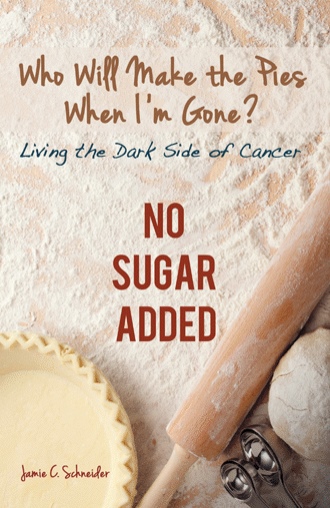
Who Will Make the Pies When I’m Gone?
Living the Dark Side of Cancer (No Sugar Added)
by
Book Cover & Preview Text
I find that having cancer has put me in a strange place. Maybe it’s the fact that it is stage IV ovarian cancer, which means that I’m definitely not in Kansas anymore. And sadly, it ain’t the other side of the rainbow either. From the moment I found out about the cancer, I have been separated somehow from the rest of the world. I’m not really part of the living anymore, but I’m not quite dead yet. This kind of thinking may sound rather morose, but it is a fact. I remember what it was like in that other world. I used to live there, and not so very long ago. It is the place where we hurriedly go about our daily business. We’re a lot like the little field mouse; we generally are only aware of what is right in front of our nose. We don’t really have to think about anything but what we’re dealing with at any particular moment, because there is always tomorrow to think about the rest. On the way to my sister Therese’s house for Easter about two months after the news, I looked out the window hoping my husband wouldn’t see my tears. As he reached over and covered my hand with his, Bill asked, “What’s wrong, Jamie?” “I was just thinking, this could be the last Easter I get to see … get to spend with my family. It could be the last time I get to see the spring flowers.” I watched as the forsythias, in full bloom, sped by. They were in their glory this year—sprays of deep golden splendor, glowing in the sun. They came in all shapes and sizes: little circles or neat little boxes; or my favorites, left to their own devices as they stood in huge clumps that rose into the air. Still others, left to the harshness of life, had huge sections of dieback, only broken up here and there with a touch of yellow. It was just enough to provide a reminder of what they had looked like in their heyday. Maybe I was the most like that last bunch. My body had areas of dieback. Maybe though, I had enough sparks of life left in me to remind those around me of my glory days. Maybe when they looked at me, trying to find some visible sign of my cancer, trying to see just how I had changed, they would still see enough of the old me to make them smile. “Tsk!” He didn’t say any more, but he shook his head, and I saw the tears rolling down his cheeks. “I’m sorry,” I said. “I can’t help it; it’s just what I think. I’m sorry.” I hadn’t even thought about how my comment would affect him. He’s the one who really has the hard part. Once I’m dead, it’s over for me. He is the one who will have to think about all the things we had planned to do when we “got old”—things that will now never happen. I’ll have to be more thoughtful about what I say, I tell myself. No, nothing can be done without that grim reminder that my days are numbered. As I walk through this strange shadowy world, somewhere between being alive and being dead, I am nothing but envious of those who are still alive. I think back to people I have known who have had cancer. Had I not known they had cancer, I would not have been able to tell. Yes, I did it too. I looked at them when they weren’t looking. But I couldn’t tell. Now I know why. I was looking in the wrong place. It was their soul that had changed. They had been doing what I am only now learning to do—pretend. People like it better if you look just like them, because they don’t know what to do if you’re not okay. I was at a Christmas party ten months after my diagnosis, and a friend of mine was there who had recently lost her dear, longtime friend to cancer. My friend had been drinking, and I’m sure her words and actions were heavily fueled by alcohol. “You’re still alive, and my friend is dead. You have to be happy that you’re at least still alive,” she said, slurring her words, on the verge of tears and incoherence. “Well, I am glad I’m still alive, so far. But, you know, it’s really hard to accept and adjust to life like this. I feel crappy all the time. I can’t do any of the things I used to do.” I knew she was drunk, but still I resisted her desperate urges to make me be grateful. She went on, becoming more desperate. “I want to hear you say it. Say you’re happy that you’re alive! My friend is dead, and here you are. Please say it.” I moved away from the small group of women, but my friend followed me, not ready to give up on her quest to make me admit I was grateful to be alive. My own desperation to be understood possibly equaled her desperate inebriated state, and we remained at a standoff. My husband came to my rescue. Bill and I quickly wished everyone happy holidays and made our exit. I was no sooner out the door than the tears started. It was situations exactly like this one that made me reluctant to go out in social situations. I never had been any good at pretending, and now all I could see in my future were situations where I would have to pretend to be regardless of how I felt. Generally, though, because I can’t stand that uncomfortable feeling either, I go along with people. It’s easier for everyone. But when I find that rare soul who really wants to know what it’s like or how I’m doing, I am suddenly pulled from the depths of despair. Just when I thought I was running out of breath, someone has rescued me. And the freedom is indescribable. They ask me questions because they want to understand what it feels like. These people have such courage; they’re willing to get in there with me, walk around with me for a little while, and see where I really am. And they watch for signs of little things that will mean something to me, not things that will make them feel better. This usually means that in the end, we both feel better. Don’t get me wrong, I understand that helpless feeling. But there has to be a better way. I have read several cancer books. They are all about staying positive—not really a bad thing, but it’s just not enough. Maybe we can’t all be good little cancer patients who smile politely and say our prayers of gratitude every morning. “Sure is good to be alive! Thanks, God.” Maybe it’s time we talked about the dark side of cancer. I’m just an ordinary sixty-year-old woman. I have a good life; I love my husband and my children more than anything. I have been fortunate enough to do most of what I have wanted to do in life. Watching my boys grow into men and become wonderful additions to the world around them has been a privilege. Spending day in and day out with a man who loves me, and whom I love, has settled me into a good, secure, wonderful, and adventurous place in this world. The idea that this could all change in a heartbeat is not something you get used to overnight, maybe never. This kind of living on the edge is not exciting. This can’t be the way it all ends. I always thought I’d just plain wear out. But when you have multiple daily reminders that you will likely be dead soon, you have lots of opportunities to think about what that will be like. You realize that along with your very existence, your death will most likely cause only the tiniest ripple in the overall scheme of things. And that ripple will be gone before it comes close to reaching the edge of the pond. Since I found out I have cancer, one of the most difficult things has been figuring out what the point of this new limited version of life is. Now I think it is writing this book. By writing about the dark side of cancer with complete candor, maybe I can make things a bit better for someone else who has to walk this same shadowy world.
Formats

Book Details
About the Book
Jamie Schneider’s life changed with one phone call in February of 2010. After months of sensing something was not right with her body, Jamie was diagnosed with stage IV ovarian cancer, sending her on a relentless search for information about cancer and for ideas on how to survive the devastating news. Facing her diagnosis, Jamie already knew her life would never be the same. Whether she liked it or not, she was now immersed in the dark side of cancer.
As this ancient rogue force claimed its space in her body and she became a stranger in an unfamiliar land, Jamie details how her relentless desire to understand created a voice of validation. She walked through a shadowy world of cancer that left her somewhere between alive and dead. Now Jamie exposes the harsh reality of her experience, the reactions of her friends and family, the treatment and devastating losses, the yo-yo of hope and hopelessness, and the painful paradox of living while dying.
In Who Will Make the Pies When I’m Gone? Jamie shares a powerful, honest glimpse into her world as she struggles to make this new limited version of her life meaningful after a cancer diagnosis.
About the Author
Jamie Schneider earned a bachelor’s degree in psychology from Indiana University of Pennsylvania. Now retired after working for twenty years as a therapist in the drug and alcohol field, she resides in Kittanning, Pennsylvania, with her husband, Bill. They have two sons and one granddaughter. This is her first book.