
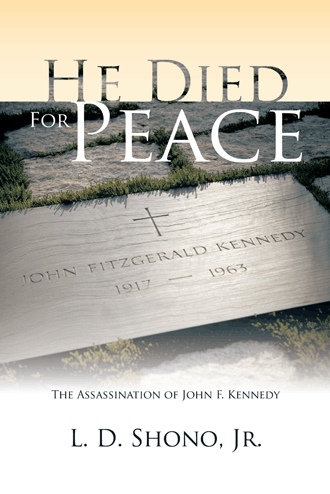
He Died For Peace
The Assassination of John F. Kennedy
by
Book Cover & Preview Text
Chapter 1
“Peace is a daily, a weekly, a monthly process, gradually changing opinions, slowly eroding old barriers, quietly building new structures.” John F. Kennedy
On September 16, 1959, Lee Harvey Oswald sat quietly in his room on the freightliner Marion Lykes. He was headed to Le Havre, France. His final destination was the USSR; Moscow to be specific. He was an undercover agent for the Central Intelligence Agency; an American spy. It was a boyhood dream. His mission was to act as a double agent while he was in Russia. His mission was to try and gather intelligence information on Russia. Normally there was no guarantee he would even be allowed to stay in the Soviet Union. But his case wasn’t a normal situation. He was a former United States Marine with classified information he was instructed to reveal to the Russians. He didn’t like betraying his country, but at this point he had no choice. He stretched out on his bed with his head on his hands. He thought about his life and the decisions he made which led him to this day.
On October 18, 1939, Lee Oswald was born in New Orleans, Louisiana to Marguerite and Robert Lee Oswald, Sr. Two months before his birth, his father died of a heart attack. She was left alone to care for Lee and his two older brothers, John Pic (son from a previous marriage) and Robert, Jr. His mother doted on him to excess, but despite this she was also characterized as domineering and quarrelsome. She feared she couldn’t care for her young boys adequately so she sent them to an orphanage and later to boarding school. Lee was rejected at first because he was too young. But his mother reapplied later and sent him off to the orphanage after he turned four.
At age of 12, Lee and his mother moved to New York City, where they lived with his half-brother John Pic. John had joined the U.S. Coast Guard and was stationed in New York. While Marguerite worked days in a dress shop, Lee spent his time alone at the public library, the museum and endless hours riding the New York City subway system. He was a lonely child. No one was really there for him when he needed someone the most. Although Lee had enrolled in the eighth grade, he didn’t set foot in school for almost two months. One day, a truant officer noticed Lee at one of his favorite havens, the Bronx Zoo. As soon as he saw the truant officer, he turned and ran. But it didn’t take the truant officer long to catch him. He was taken into court and then sent to a youth detention center for three weeks of psychiatric evaluation. His social worker, Evelyn Siegel, wrote in her report: “He was a skinny, unprepossessing kid. He was not a mentally disturbed kid. He was just emotionally frozen. He was a kid who had never developed a really trusting relationship with anybody. From what I could garner, he really interacted with no one. He made his own meals. His mother left around 7:00 and came home at 7:00 and he shifted for himself. You got the feeling that this was a kid nobody gave a darn about.” His truancy resulted in visits to psychiatrist Renatus Hartogs, who diagnosed the 14 year old Lee as having a “personality pattern disturbance with schizoid features and passive-aggressive tendencies.”
One day in New York City Lee came across a leaflet about the impeding execution of Julius and Ethel Rosenberg, who was convicted of spying for Russia. He would later write in his diary: “I was looking for a key to my environment, and then I discovered socialist literature. I had to dig for my books in the back dusty shelves of libraries.” His behavior in school appeared to improve in his last months in New York. While in New York, he threatened his sister-in-law with a knife and punched his mother in the face. She had been downgrading him and his mother. He had grown tired of it. His mother tried to get the knife from him. He didn’t know it was her when he turned and hit her. He would never possibly hurt his mother. He continued to skip school and soon the truant officer came after him once again. Lee and his mother fled New York and moved back to New Orleans, to the edge of the French Quarter. When they left New York there was still an open question before a New York judge if he should be taken from the care of his mother to finish his schooling.
The French Quarter was an area of strip joints and gambling joints where every hustler and pimp in New Orleans plied his trade. But Lee was diverted from the neighborhood’s vices by his interest in socialism. He tried to join the Socialist Party’s Youth League, but there was no chapter in New Orleans. Before the age of 18 Lee had lived in 22 different residences and attended 12 different schools, mostly around New Orleans and Dallas. His mother was of French and German descent and raised him in the Lutheran faith. He read voraciously and as a result sometimes asserted he was better educated than those around him. Around the age of 15, he became interested in Marxist, solely from reading about the topic. He joined his school’s marching band and the Civil Air Patrol, a youth auxiliary of the Air Force. Although a self-proclaimed Marxist, Lee Oswald wanted to join the United States Marines Corps. He idolized his older brother Robert, Jr., who was himself in the United States Marines. He even wore Robert’s U.S. Marine Corps ring. This relationship seemed to have transcended any ideological conflict for him. He tried to enlist into the United States Marines when he was sixteen but was rejected because he was too young. He dropped out of high school and went to work. He failed to receive his high school diploma before he enlisted into the U.S. Marines. Throughout his life he had trouble with spelling and writing coherently. His letters, diary and other writings have led some to suggest he was dyslexic. At the same time some have contended his poor writing and spelling skills were the result of a sporadic education. Just after turning seventeen, he enlisted in the Marines.
Chapter 2
“Political sovereignty is but a mockery without the means of meeting poverty and illiteracy and disease. Self-determination is but a slogan if the future holds no hope.” John F. Kennedy
Lee Harvey Oswald stood to his feet and walked over to his bag leaning against a wall. He opened it and pulled out a folder which was marked: TOP SECRET. He flipped through the pages and photos in the folder. He couldn’t believe that with the contents in the folder he will throw away everything he ever stood for. He will betray the very thing he swore to protect when he joined the United States Marine Corps. He was looking at highly classified information about the CIA U-2 spy plane. He already knew the information he held in his hand. But his CIA handler gave him this folder to hand over to the Soviets. He closed the folder and his returned to his bed. He laid the folder next to him on the bed. He rested his head in his hands. He leaned forward until his elbows were on his knees. When he enlisted in the United States Marine Corps, he had intended to make it a career. But when he met his handler, James Smith, in Japan, Lee’s mind was changed.
Formats

Book Details
About the Book
Two men born with different backgrounds who were destined to collide in Dallas, Texas. One man came from a family of great wealth and power, while the other man came from a family who struggled for everything they ever had. One stood for peace while the other man stood for confusion and deceit. President John F. Kennedy had a dangerous goal in mind: end the Cold War in his lifetime. Lee Harvey Oswald was a pawn used by his employers, the Central Intelligence Agency, to stop President Kennedy from reaching his goal. This is a fictional re-telling of the events which led up President Kennedy's Assassination. It tells how President Kennedy fought to spread his message of world peace, and how the CIA stopped him at every turn.
About the Author
Leonard D. Shono, Jr. lives with his wife, Tracy and son, John Micheal, in Calhoun, Louisiana. He works for a finance company in Monroe, Louisiana. He is currently working on his second novel.