
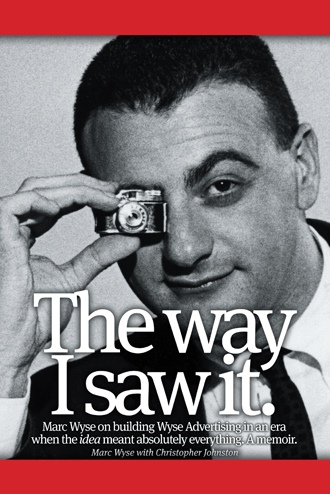
The Way I Saw It.
by
Book Cover & Preview Text
When we got back to our hotel room, Lois and I talked about ... how we had this amazing client, and they needed to break into the biggest market in the country. Right there, I challenged her to write a great radio spot for Smucker's.
"Oh yeah,” she said. "I could write it, but you couldn't sell it."
I pointed to her pink portable typewriter which she always brought along with her. "Let’s see you write it,” I said.
She sat down and typed furiously. In 60-seconds she wrote a 60-second spot for radio that would double as an ad for print. Triumphantly she pulled the paper from the typewriter and handed it to me with a dramatic flourish. I sat down and read it. I read it twice. There it was: "WITH A NAME LIKE SMUCKER’S, IT HAS TO BE GOOD. If we're going to make up a name for a jelly, would we call it Smucker’s? Not on your life. We'd call it Gramma's Best or Ye Olde Jam Pot. But we call it Smucker’s because that’s our family name. The company was started by our grandfather in 1897. And we’re proud of that. And we’re proud of the preserves that we put in the jar. That’s why we call it Smucker’s."
I loved it. I told her I thought it was fantastic, but she just laughed and said, “You’ll never do anything with it.” Ha. I couldn't wait to get to Orville. A few days later, I was there. I was in the Conference Room which occupied the entire second floor of a narrow but neat wooden building above the company's offices. Paul Smucker and Wally Clouser listened while I read the spot. When I was finished I was greeted with silence. And darkness. Willard preferred to spend money on plant production, not office lighting, so I couldn’t quite read their faces. After an awkward little pause, Wally finally spoke.
"Are you kidding?” he said. "If we run that, we'll be laughed out of town.”
"Wait a minute,” interrupted Paul. "Marc,” he said. "Do you think that commercial will sell jelly?"
"Look, Paul,” I reasoned. "Don't people sometimes kid you about your name?"
"Some,” he said.
"Well, then, let's have some fun with it ourselves. After all we're only trying to sell them a little jelly. We're not trying to end the war in Vietnam or anything serious like that."
"OK," said Paul. Then he hesitated. "But . . ."
"But what?" I asked.
"Well," he said. "You know my relatives around here might object. But, if you think it'll help us sell jelly, let's run it on the West Coast where we don't have any relatives."
So that's where it all started in 1962 on radio in Los Angeles, Fresno, Sacramento, and San Francisco. Six weeks later, Paul boarded an American Airlines flight to Los Angeles at the Cleveland airport. Remember how the flight attendant used to check your name as you buckled up? Paul Smucker gave his name. Immediately, the attendant said, "Oh! With a name like Smucker's, it has to be good!" In fact, everywhere Paul traveled on the West Coast people kept smiling and repeating the slogan to him, including the chain grocery buyers with whom he met.
When he returned to Orville, Paul called me on the phone all enthused. “Marc, run that spot in New York. Heck, run those commercials all over the country."
“What about the relatives?” I said.
"Hang the relatives," he said. "They'll be happy with the dividend checks.”
We launched the New York campaign with a somewhat modest $50,000 budget. We coupled the radio commercial with an introductory offer. Customers could mail the jar label back to Orrville for a rebate. New Yorkers quickly fell for the slogan “With a name like Smucker’s…,” and we were on our way on the East Coast. If I do say so myself, it remains one of the true super slogans of advertising, making a strange and funny sounding name that grocers, housewives, and husbands usually misspelled into a household word. Half a century later, it remains the main theme of Smucker’s advertising.
One night, when the company sponsored part of “The Johnny Carson Show,” even television’s most famous late night host uttered the ubiquitous slogan: “With a name like Smucker’s, it has to be good. And they make more than preserves and jellies. Here’s Ed to show you and tell you about Smuckers.” His sidekick Ed McMahon then tried to put scoops of ice cream into a bowl and place Smucker’s chocolate topping on them. “Yes! I hope you’re a lot neater than I am, but lots of topping, lots of ice cream, and it looks something like that, friends. You’ll have a real treat. That will keep you going for the whole show tonight.”
In those days, commercials were filmed live on TV. The commercial went off just fine, but afterwards Carson kept trying to get Ed McMahon to eat the chocolate sundae he had just created. McMahon politely refused. “You said it was so great,” Carson pressed. “Why don’t you eat it?”
“Because I made it. I’d feel funny eating it myself,” McMahon countered. “You ought to have it.” Both men were holding back laughter, until it got so ridiculous that they had to explain. Ice cream melts quickly under the hot studio lights, McMahon pointed out to viewers. Therefore, television programs usually substitute a Crisco-like, vegetable-based substance to represent ice cream in commercials. The segment closed with a sheepish McMahon wondering, “Where will I be working tomorrow?”
After that night, Smuckers developed a new ground rule for studio technicians: When shooting a Smucker topping commercial, use as many takes and as many pounds of melted ice cream as necessary, but no Crisco’s!
For us, the Smucker Company represents the ideal client. Being a good client is not easy. It takes imagination, sensibility, and often courage. It wasn’t easy for Paul Smucker to allow us to poke fun at his name when we coined the phrase, “With a name like Smucker’s, it has to be good.” Can you accept a really new, fresh idea? Do you have the guts to be a pioneer? Do you believe that somebody else can have a great idea for your business? Good clients know that if they have to tell their advertising agency what to do, they should get themselves another agency. They also know that once they’ve hired an agency with some intelligence, creativity, marketing savvy, and backbone, they should sit down with them and set forth a statement of goals. Agree on the long-term and short-term objectives. Then spell it all out with a roadmap on how they’re going to get where they want to go. Take an honest look at their company’s strengths and weaknesses. Take an honest look at their competitors’ strengths and weaknesses. Agree on the positioning of their company in the marketplace. Then sit back and give good advertising professionals the opportunity to perform.
Formats

Book Details
About the Book
Marc Wyse’s father wanted him to be a lawyer. His mother wanted him to be a doctor. Instead, he became an advertising executive. In The Way I Saw It, Wyse narrates his rags-to-riches tale of the American dream come true: cofounding Wyse Advertising and working more than sixty years in the business.
In this memoir he tells his story of the boy of immigrant parents who grew into an advertising icon that spawned famous theme lines like, “With a name like Smucker’s, it has to be good,” “Ask Sherwin-Williams.” An advertising legend and consummate salesman, his client list included American Express, Applebee’s, BFGoodrich, Clairol, General Dynamics, GE Lighting, Goodyear, Kelly Services, Marathon Oil, New York Yankees, Renaissance Hotels and Resorts, Sherwin-Williams, Smucker’s, Stouffer Restaurants Hotels & Resorts, and Timken.
The Way I Saw It shares both the life lessons and business lessons learned on the journey to success. Wyse delivers the message: Act like a turtle and never be afraid to stick your neck out.
About the Author
Marc Wyse cofounded Wyse Advertising in Cleveland in 1951 and became one of America’s premier advertising CEOs, with an extensive client list full of well-known names. He lived in Cleveland with his wife, Sheila, and had three children and five grandchildren. Wyse died at age eighty-eight in July of 2011.