
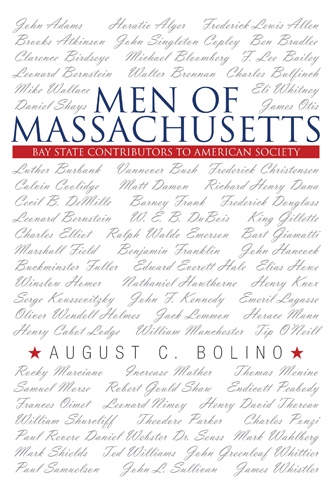
Men of Massachusetts
Bay State Contributors to American Society
by
Book Cover & Preview Text
Chapter 19: Yankee Enterprise “Commerce is unexpectedly confident and serene, alert, adventurous, and unwearied. It is very natural in its methods withal, far more so than many fantastic enterprises and sentimental experiments, and hence its singular success. I am refreshed and ex¬panded when the freight train rattles past me, and I smell the stores which go dispensing their odors all the way from Long Wharf to Lake Champlain.” —Henry David Thoreau Historical Landscape Massachusetts’ manufacturers have diversified their production since the early nineteenth century, when shoes and textiles were dominant. Among the older industries that have continued to prosper are paper, printing and publishing. In the nineteenth and twentieth centuries, the spirit of American democracy was translated into a spirit of enterprise. Those centuries saw the creation of the textile, shipbuilding and watch industries, and the next century produced the cinema, especially in Hollywood, and the auto industry in Detroit. These were followed by commercial aircraft, Polaroid technology and the spectacular growth of computers and the Internet. In many of these developments, Massachusetts men played a key role. During the twentieth century, however, many producers moved their operations to the Southern states to take advantage of lower wages. Durable goods, especially instruments, machinery, and electrical equipment, now occupy the place vacated by these soft goods. Defense and the space age increased research and manufacturing in the areas of electronics, instruments, and nuclear energy. By the late 1980s about two-fifths of the total manufacturing labor force of Massachusetts was working in high-technology firms. The largest concentrations were found in Boston, Cambridge, and the cities of Newton, Waltham, Lincoln, Lexington, Burlington, and Woburn, which lie to the west or north of Boston. These high-tech industries are the leading source of personal income from manufacturing in the state. Their products include computers and peripherals, rolling mill machinery, special tools and dies, turbines and generators, and specialized machinery for the printing, paper, and other industries. Also included are surgical appliances, photographic equipment and supplies, optical instruments, industrial controls, and measurement instruments, electric and electronic equipment, semiconductors, telephones, radios and televisions, and printed circuit boards industries. Paul Revere Paul Revere was one of Massachusetts’ early and most productive industrialists. His practical skills were nearly boundless, as he used his manual dexterity to make surgical instruments, artificial teeth and engraved plates. His most famous engraving, of the 1770 Boston Massacre, made him a leading anti-British propagandist. A self-taught designer and maker of elegant silverware, his finely wrought tankards, bowls, and pitchers were prized in his day, and his carefully crafted tea sets were owned by the Boston aristocracy for over a century. Revere also printed money for the Massachusetts Congress, designed the first official seal for the united colonies (as well as the seal still used by Massachusetts) and established a gunpowder mill at Canton, Massachusetts. This resulted in his being commissioned an infantry major in the Massachusetts militia in April 1776, and in his promotion to the rank of lieutenant colonel of artillery in November. On July 25, 1779, Revere was assigned to command the Penobscot expedition. The American plan was to eliminate the British occupation of the area of Castine, Maine on the Penobscot River. This should have been an easy task; but, somehow, the Americans failed to attack. After his return, Revere was tried by courts martial for disobeying orders, but was acquitted. After the war, Revere continued to operate a brass foundry and, in 1801, when he was sixty-five years old, opened the first copper rolling mill in the United States at Canton. The mill produced sheet copper; it supplied the sheathing for the hull of the new USS Constitution.1 Revere also continued his successful trade as a silversmith and goldsmith. He recognized early that there was a growing demand for goods for the larger upper class, and when there was a revival of church attendance, he became one of the best-known manufacturers of church bells. He also pioneered in the production of copper plating and copper spikes for ships. These profitable endeavors enabled him to retire to a fashionable country estate. In 1795, as grandmaster of the Masonic fraternity, Revere laid the cornerstone of the new State House in Boston; and he also founded the Massachusetts Charitable Mechanics Association, becoming its first president. Having been raised in the tradesmen class, Revere was able to advance to become a “gentleman” and to achieve social standing in the community. Despite his modest beginnings, Revere remained a dedicated conservative federalist, a proponent of the privileged classes. He was able to persuade Samuel and John Adams to support the United States Constitution, but he did not respect Jefferson’s philosophy concerning equality. The Ohio Company On March 1, 1786, a group of Massachusetts men, including General Rufus Putnam and Brigadier General Benjamin Tupper, founded the Ohio Company of Associates in Boston. They planned to purchase land in the newly-created Northwest Territory—the large land mass between the Mississippi River, the Great Lakes and the Ohio River that was acquired after the American Revolution. Ultimately, five states were created out of this territory: Ohio, Michigan, Illinois, Indiana and Wisconsin. Winthrop Sargent became the secretary of the Ohio venture. Both Putnam and Tupper were involved in surveying the land. Although they were first interested in the potential for land speculation, their efforts hastened the development of the region. The company officials called on the Reverend Manasseh Cutler to represent their interests. He worked with Secretary of the Board of Treasury William Duer and President of the Congress Arthur St. Clair to negotiate an arrangement for purchasing the land. The Ohio Company of Associates purchased 1,500,000 acres of land, agreeing to make a down payment of $500,000 and to another payment of $500,000 after all the surveying work was completed. Because the chief investors were veterans, Congress allowed the company to pay for part of the land using military warrants, which allowed the investors to conclude a very favorable contract, paying only eight and one-half cents per acre. To encourage settlement of the region, Congress gave the Ohio Company 100,000 acres (known as the Donation Tract) where any adult white male could obtain one hundred acres of free land. This tract was used as a buffer zone between white settlements in Ohio and Native Americans. Company investors were required to set aside land in each township for education, a church and three sections for future government purposes. In addition, two townships were set aside for a university. The first settlement of the Ohio Company was made on the banks of the Ohio River, which was known as Adelphia, but the community soon became known as Marietta. To protect themselves from Indians, the settlers built a fortification, which they named Campus Martius. Since most of the settlers were from New England, they tried to emulate New England institutions and communities similar to those they had left “back east.” In 1808, the company established Ohio University, and although at first its curriculum was no more advanced than those offered in Eastern high schools and enrollments were low for several years, their foresight was rewarded later. The settlers of Marietta succeeded in creating a civilized town as soon as the Indian threat was removed, with the signing of the Treaty of Greenville in 1795. But this New England approach to settlement later became in conflict with that of the persons who ca
Formats

Book Details
About the Book
As one of the original Thirteen Colonies and birthplace of the American Revolution, Massachusetts has continued the rich tradition of liberty throughout its storied history, becoming a primary contributor to many fields of human endeavor in American society.
Massachusetts native August C. Bolino profiles two hundred significant historical personages from this state in Men of Massachusetts. Beginning with a brief history, Bolino traces the role individual men have played throughout the state’s nearly four-hundred-year history, offering a concise and informative profile of each one. He discusses how Massachusetts has been a leader in reform movements, including education, the abolition of slavery, and women’s and African American suffrage.
In addition, Bolino depicts how people of Massachusetts spread culture in literature, music, entertainment, and sports, championed liberty, encouraged entrepreneurship, and paved the way for us in the twenty-first century. Profiles include such storied figures as John Adams and Oliver Wendell Holmes, Henry David Thoreau and Nathaniel Hawthorne, Elias Howe and Calvin Coolidge, and, of course, the Kennedy family.
A true testament to the remarkable achievements of the people of Massachusetts, this compendium shows the fruits of true liberal philosophy.
About the Author
After completing his doctorate in economics, Massachusetts native August C. Bolino was active in academia and government. He was an assistant to the US Commissioner of Education and a Peace Corps consultant; he also helped to plan the Ellis Island restoration. Bolino has taught at several universities and is currently at the Catholic University of America.