
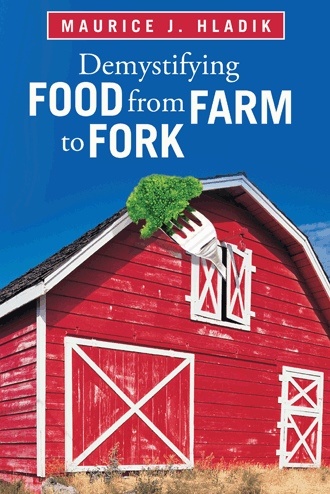
Demystifying Food from Farm to Fork
by
Book Cover & Preview Text
Food Myths Busted
The media and other sources including several authors seem to have developed a herd instinct and all agreed that the food system is in many respects broken. While they clearly believe what they are saying or writing about and reference each other seldom do they go back to the fundamentals of official statistics or other sources such as peer reviewed research that often portrays a different reality. While some of the following are a repeat from elsewhere in this book, perhaps readers will appreciate a condensed approach to some surprising facts.
Myth # 1 – The family farm is a thing of the past.
According to the 1997 US census there were 1.9 million farms of which 86.9 per cent were designated “Individuals/family, sole proprietorship (farms)”. Ten years later in the 2007 census there remained 1.9 million such farms and a near identical 86.5 percent of all farms in the nation.
Myth #2 – Corporate farms are taking over.
In 1997 there were 8,811farms designated as “Non-family corporations (farms)” or 0.4 per cent of all American farms. This increased slightly to 0.5 per cent in 2007 and stood at 10,237 farms. In other works one farm out of two hundred is a corporate farm and these would mostly be specialized dairy, beef, and poultry operations.
Myth#3 – Farms are getting larger and larger.
In 1997 49.2 per cent of all US farms were 99 acres or less. In 2007he percentage rose to 54.4 percent. During these same ten years the average farm size decreased slightly from 431 acres to 418 acres.
Myth #4 - - The farm population is declining.
Again comparing the two census years there were 2.21 million farmers in 1997 and a near identical 2.20 million in 2007. For some it may come as a surprise that women, as principle farm operators, increased by almost exactly fifty percent over the ten years from 209 thousand to 306 thousand. This means that one farm out of six is operated by a woman.
Myth #5 – Fertilizer use is increasing.
According to the USDA, corn growers’ use 50 per cent less nitrogen to produce a bushel of corn in 2005 compared to 1980. From 1990 to 2005 the reduction was 17 per cent less nitrogen fertilizer per bushel harvested. Over the same fifteen year period the reduced usage of phosphorous and potassium per bushel of corn produced was 28 and 20 per cent respectively.
Myth # 6
Organic farming makes a significant difference in the overall supply of food. From the 2007 census there are 8,694 dedicated organic farmers with no conventional food production (less than 0.5 percent of all farms) and another 6,856 farmers who have certified organic production on part of their land. All organic farming utilizes 0.6 per cent of total agricultural land in the US. In most industries this would be considered a mature and stable niche activity. Full recognition and support for organic farming dates back to the 1990 Farm Bill and as organic farming has been practiced for a lot longer than that, it is difficult to expect that the situation will change dramatically in coming years.
Myth #7 Food Miles Matter.
Simple arithmetic makes things interesting. According to the US Federal Railroad Administration of the Department of Transport, railroads move a ton of freight for a thousand miles with a little over two gallons of diesel fuel. Thus it requires two gallons of fuel to move a ton of oranges the thousand miles from Orlando to New York City. By comparison, a typical automobile will get twenty miles per gallon in average city and country driving combined. Thus the one twentieth of a gallon to drive a typical car a mile will move fifty pounds of oranges from the Florida to the New York market. Given that the USDA has fresh orange consumption at twelve pounds per person per year the energy requirement to deliver enough oranges for a family of four for two years is the same as driving a car for a mile. Sea shipments of food have even better food miles while trucking which has the flexibility of moving the product from the orchard to market will deliver about six months supply of oranges or four people for the energy equivalent of driving a few blocks. Only food delivered by air is worthy of any concern. As this later shipment method generally only pertains to the up market perishable and out of season foods such as asparagus and raspberries this should not be an overriding issue of a practical nature as they are easily identified by the individual who has a concern about food miles.
Myth # 8 The Food System is Broken.
According to the FAO the global percentage of undernourished has fallen from 33% of all humanity in 1969 to 16% in 2010 while the world’s population has increased from about four billion to approaching seven billion in 2010 . The number of adequately fed people approximately doubled from a little over 2.5 billion to nearly 5.5 billion today.
The world produces enough food to feed everyone. World agriculture produces 17 percent more calories per person today than it did 30 years ago, despite a 70 percent population increase. This is enough to provide everyone in the world with at least 2,720 kilocalories (kcal) per person per day (FAO 2002, p.9). Globally, the farming sector seems to be doing a fine job in keeping up with major population increases.
The USDA tracks food expenditures and has an excellent table entitled: “food expenditures by families and individuals as a share of disposable personal income”. From 1929 when this was first tracked the percentage of disposable income was generally just under 20 percent until the early 1950’s when modern commercial agriculture is generally considered to have become widespread. Since then the decline has been very steady and reached only 5.5 percent of total income spent on food in 2008. To personalize this rather stark statistic the typical reader would have between three and four times the grocery bill today if it was not for modern agriculture supported by other efficiencies provided by the competitive nature of the industry as food moves from farm to fork.
Formats

Book Details
About the Book
In North America and elsewhere, there is a growing concern by many that they are no longer connected in any meaningful way with the production or processing of the food they consume. Furthermore, many sources portray a negative bias regarding the production, transport, processing, and marketing of today’s food.
In DEMYSTIFYING FOOD FROM FARM TO FORK, author Maurice J. Hladik examines a plethora of issues surrounding the agricultural industry. It answers the questions of what is food, what does farm to market really mean, and whether the food we eat is safe. It also discusses the controversies and socioeconomic concerns surrounding food and the food supply, such as the role of government; farming, environment, and biodiversity; genetically modified food; organic foods; the 100-mile diet; weather, climate, and food; and animal and poultry welfare.
Hladik—a descendant of European farmers who settled on farms in Nebraska, Iowa, and Minnesota as early as 1834—not only provides a lively discussion of food controversies, but also shares hundreds of little-known facts about food and farming.
About the Author
Maurice J. Hladik grew up on a farm in western Canada and was an active farmer into his early adulthood. He earned two degrees in agricultural economics from Canadian and US universities and became an agricultural attaché in New Zealand and Germany. Hladik and his wife, Sharon, live in Ottawa, Ontario.