
The Tears of War
by
Book Cover & Preview Text
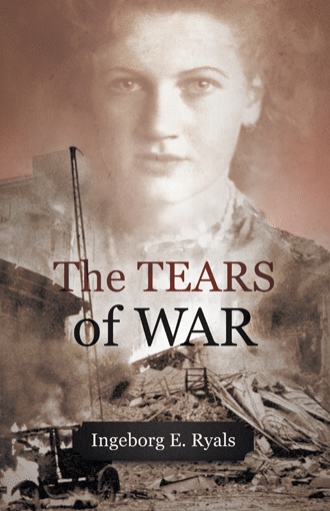
Daily, the line of battle was drawing closer to our small village in Pomerania. We heard from retreating German soldiers that the enemy would reach us in two or three days. In some of the surrounding towns and villages, people were beginning to commit suicide. Many families chose death rather than fall into the hands of this dreaded enemy, the Soviet Army.
We did not sleep regular hours anymore. Fully clothed, we took occasional naps, as the rumble of artillery fire grew louder with each passing day. At night, the eastern sky was still aglow with the many fires that accompanied this war.
By April of 1945, we knew it was time to evacuate, so those planning to leave set their departure for the next day.
Dawn came early in the northern hemisphere. By the first light of day, the village was buzzing with activity as the horse-drawn wagons were hurriedly loaded and piled high with food, bedding and various household items. Should their homes be burned to the ground, they would have at least saved some of their belongings.
By noon, the evacuees were present and eager to leave. The whips were cracking as the horses strained under their heavy loads, slowly setting the wagon train in motion. Soon they were out of sight and on their way to the forest, while I was left standing in the middle of the road. I had never felt so alone. As I looked around me at the empty homes and the deserted street, with not another living soul in sight, I totally lost my composure. I could not and would not stay one moment longer. I had to go and follow the others to the forest. All of the horror stories we had heard repeatedly over the past months from the fleeing refugees—women being raped and people being robbed of their possessions—left me in a state of sheer terror as the minutes ticked away and I was about to come face-to-face with this feared enemy. The unthinkable was now happening: the fast-approaching Soviet Army was practically at our doorstep.
I rushed past my mother and into the house, grabbed a blanket, and threw a few belongings into a bag. Also, I needed a large, white handkerchief to wave at the enemy in a show of surrender. Kurt stared at me in disbelief, probably wondering what had come over me. Usually quiet and reserved by nature, I was totally out of control and acting in an irrational manner, but he did not interfere or attempt to stop me.
My mother tried to reason with me that we had no means of carrying our provisions like food, water, and blankets to the forest while we had easy access to our hidden food supply right below us in the cellar. Besides, she pointed out, there were plenty of places for young girls to hide in the village like attics, barns, or cellars rather than in the open forest. All of her attempts to dissuade me fell on deaf ears. She then tried to physically restrain me, but I pulled away and was out the door in a flash. Never before had I so blatantly disobeyed her, but the fear at that very moment was so great that nothing else mattered more than getting to the safety of the forest.
I ran as fast as my legs would carry me, stopping only long enough to pick up a branch to attach my white handkerchief to.
The road was clogged with people from other villages and everyone was running from the enemy. A young German officer, incensed when he saw my white flag, grabbed it, broke the branch in two, and threw it to the ground while shouting, “There will be no surrender!” He acted as if he was going to take on the whole Soviet Army all by himself.
I had no trouble finding our little group camped out in a thicket of pine trees at the edge of the forest. My mother and two brothers followed later in the afternoon. She did not want me to face the upcoming ordeal alone and was not even angry with me for disobeying her. I felt a lot safer here in the company of the villagers and the sudden panic attack was all but gone.
At dusk, I walked with my older cousin, Lorchen, to the edge of the forest. A peaceful scene awaited us there. Cows were grazing in the meadow and the windmill that for years had ground our wheat and rye was standing motionless at the edge of the creek. Tomorrow, everything would change. The Red Tide would engulf us all.
Sleep did not come easily as we bedded down for the night. It was cold and damp and the ground, covered with pine needles, was so hard that I could not get comfortable. Even the horses were restless. Usually stabled at night, they were stomping and pawing the ground. It was a night of tossing and turning. The fear and anxiety of what the next day would bring robbed many of us of sleep.
The long night finally ended and the day that we had been dreading for so long was here. By the first light of day, I hurried to the edge of the forest to scan the eastern horizon, but all across the meadow a patchy fog hugged the ground, reducing visibility almost to zero. We had no water for freshening up or brushing our teeth, but these things become so insignificant in the face of adversity.
By eleven o’clock everyone was starting little campfires to cook their noon meals, giving little thought to the fact that the enemy might spot our smoke.
By eleven thirty our campsite was attacked; the battle had begun. Shrill, piercing sounds filled the air as artillery shells exploded all around us. Terrified, we ran deeper into the forest; women scooped up their little ones or dragged them along by their arms. We left everything behind us as we ran for our lives. Suddenly, a burst of gunfire stopped us dead in our tracks. Someone shouted, “Down! Everyone down!” and instantly, we dropped to the ground. In our haste to escape the shelling, we almost ran head-on into a Soviet Army unit making its way through the forest. They were pinned down to the right of us by machine gunfire coming from a farmhouse occupied by German soldiers.
We were so close to the battle that bullets were whistling over our heads, hitting the trees above us. We pressed our bodies close to the ground and buried our faces in the musty smelling moss. My little brother, Gerdi, wedged between my mother and me, was ready to get up, thinking this was but a game. We physically restrained him and pushed his little head down repeatedly. Whimpering, he finally stopped struggling and resigned himself to the fact that he simply could not get up.
Suddenly, on command, the enemy soldiers were on their feet ready to attack. With their bone-chilling battle cry, “Ourrah, Ourrah,” and bayonets poised, they pressed forward, only to be driven back to their original positions by a volley of machine gunfire from the farmhouse. They left their wounded and dying behind.
Again and again, they attacked and regrouped as the battle raged on and their casualties mounted. Finally, by midafternoon, they were on the attack once more. With bayonets in place and shouting their “Ourrahs,” they managed to storm the farmhouse and the battle was over at last.
Slowly we got up, shaken to the core but thankful to be alive. Our faces were flushed and our clothes were in disarray as we made our way back to the campsite, with sporadic gunfire and the moans of the wounded and dying echoing across the battlefield.
Oh, how I hated this war! My eyes stung with tears as I thought of the pain, the suffering, and the terrible waste of young lives.
According to one of the wounded German soldiers, who survived by feigning death, the enemy showed no mercy toward the wounded and captured soldiers. They were promptly clubbed and bayoneted to death. Quite a few of them were teenage boys trying to defend their country.
After their gruesome deed, the Russian soldiers moved on to conquer what was left of the place that we called home.
Formats

Book Details
About the Book
The small village in Pomerania in northern Germany provided a peaceful haven for the childhood years of author Ingeborg E. Ryals. But in 1939 the beginning of World War II irrevocably changed her idyllic life.
In this memoir Ryals shares her first hand experiences as the war began to affect every aspect of her life. At the age of fifteen, she had to dig trenches behind the front lines and spent many days hiding in fear of the Soviet Army as it invaded and pillaged her village. Diphtheria and typhoid epidemics swept the country. She survived a bout of diphtheria but lingered near death for days on end with typhoid fever. There was little food to sustain them. At the age of eighteen, she was shipped to a labor camp operated by the Russian military on an island in the Baltic Sea. Ryals also recounts her escape and her eventual marriage to an American.
With photos included, The Tears of War narrates a very real story of the tragedy of war. It shows Ryals’ perseverance and her ability to overcome obstacles in an effort to survive.
About the Author
Ingeborg E. Ryals was born in Berlin, Germany. That’s where she met her American husband who after the Second World War was responsible for restoring the postal and telephone service. After their marriage at Kronberg Castle, they settled in Florida where they raised their children and ran a successful grocery business.