
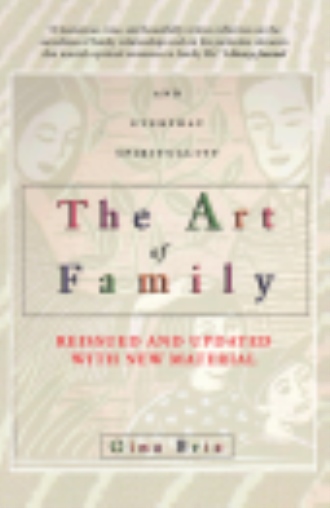
The Art of Family
Rituals, Imagination, and Everyday Spirituality
by
Book Cover & Preview Text
Ritual, in fact, has come to the vital aid of the therapeutic profession. Many families suffering from crises can be woven back together through a ritual putting away of old hurts and a symbolic wiping the slate clean. An attitude of new life always engenders new possibilities. Rituals are used for abused children, enabling them to experience a rebirth into a new set of circumstances. Rituals, too, can be immensely useful to new stepfamilies trying to define their roles, their rights and responsibilities, with new members. Some families even practice an adoption rite for their new children, modeled on the marriage service. “I commit to be your new dad.'' sounds a little hokey, but when that preteen says, “I commit to be your new daughter,'' something powerful has just hatched. Though you needn't be as formal as that, you can at least have your own private rituals with new stepchildren, even if it's Friday pizza, hockey outings, or simply giving them a gift of welcome. Stepfamilies are in the delicate place of having to replace old rituals associated with another life. Don't leave this undone.
In this we oughtn't forget the power of the voice to heal, bless, read, recite, or sing, or the place of sabbath. Sabbath as a ritual has a long history and probably accounts, in the end, for civilization. It is certainly civilizing in the best possible sense. Rest, ritual rest, which no one dares disturb, was thought up by God and passed on only to humans. God did not think up reading the Sunday newspaper, but he's willing to enter into it a little bit, from accounts you put your feet up and, as you read, count your blessings.
As a contemporary twist on Sabbath rest, we have high tea on Sunday evenings. It waxes and wanes in its elaborateness. Certain plates and platters come out just for this event. They are nothing more than thrift-shop finds, but once they hit the table, they become heroic, met with expectation and excitement. We light candles, sing, and nibble on treats. In the days of our early marriage when, as my father-in-law likes to put it, “we didn't have a pot to put a chicken in,'' our treat was popcorn. It didn't matter that we ate like birds, we still soared. We've graduated to Swiss chocolate at high tea now, and sweet pear sandwiches—an invention of my son—but come measles or tax time, we still relish our tea together. Disappointment reigns if we miss it....
You always marry the wrong person, the very person you end up wanting to murder, divorce, or lock in the freezer. It's a wonder that married people are even still alive, given that we only have a poolful of wrong, banged-up, sinking people to pick from. The fable that there is one right someone who'll save us from sinking is the longing for salvation love, just incorrectly aimed horizontally instead of vertically. Salvation never comes from the side, it can only come from above and beyond. We won't, as spouses, rescue one another, but we will float together, we won't suffer the dark waters alone.
A spouse becomes the wrong marriage partner right around the third month of marriage; just when you are in far enough to not be able to exit gracefully. Marta and Jack tell of the critical but still funny moment when he sat up bolt upright in the dead of night, and yelled out, “LOVE you?!? I don't know if I even like you.''
Marta says she remembers the words appearing in her mind, in digital green, as if running like a news band atop a city building announcing headlines, “STAY CALM, STAY CALM, STAY CALM.''
Their photos from the honeymoon weren't even all developed yet. Did they go on to have a midnight fight? Of course they did, and many others, but they fought within the facts that there wasn't somebody better out there who would be the One Who Really Appreciates them, that they had chosen each other to make something bigger than themselves, and that they had already been touched by the sacredness of marriage. Imagine a fight with those things out on the table. Marta, finally exhausted from fighting, rolled over in bed, and pulled up the covers and ventured cautiously, “Well, perhaps you'll like me by morning.''
A living marriage must make new trust, having bridged possible crisis. Making new trust: that makes the wrong person the right spouse. We have to keep making trust, too, night by night, anniversary by anniversary.
But trust often comes through crisis. A good marriage also need crises, many of them, from that first laborious year to the final funeral arrangements. A crisis is a chance to see someone and choose them, after the dirt is kicked in, and keep choosing them, over and over again, not just once. Crisis builds up existential trust, because finding yourselves on the other side of it binds you to the one you went through it with. You wouldn't think of trading in that history.
We make trust not only with crisis, but with routine as well. After ten years of knowing my husband, I had one of those revelatory moments. He walked in from work, as he always does, distractedly taking off his coat, taking out his wallet, throwing it on the dresser, as he always does, he loosened his tie and took the change out of his pockets. While telling me about the day, he fished out all of the quarters, still chatting at me, and walked over and dumped them in a little can we keep on hand for the laundry machines. They pinged, and I stood there dumbfounded. In that gesture I knew he really was on board in our life together. It meant I didn't have to think of everything, we were working partners. Can it really be that mere quarters make marriage work? Yes, it is the small, almost oblivious, ways we assist each other that lay down layer after layer of trust. We are all Kate Hepburn and Humphrey Bogart aboard the African Queen. And every day we are moving toward sinking or toward thrashing out to our destination....
Now that my mother can’t finish a sentence, can’t stay awake, I have new rituals developed on my latest visit. I stayed a week while my sister, the regular on-call presence, flew to Paris to take a vacation with my own daughter, finishing up her junior year abroad.
“Go! Go!” I urged my sister, who’s always hesitant to leave my mom. “You’ll never have this chance again. And you could really use a break.”
It had been only a short month that I’d taken the plane from New York to Michigan on my previous visit, but I could see my mom was slipping to some new place. Ah… place again. What could I do in this new place, though still in the same room? And she had bronchitis. She slept almost that entire week. Yet I had such a marvelous time with her, for her. Even when she slept, I rubbed her feet with oils, lovely lavender and rosemary. I scented a handkerchief and tucked in under the pillow. I clipped her nails and creamed her hands. Yes, new rituals need not only a place to happen, but also little materials, little ministries, to carry them out.
What can ritual do about the not knowing? It gives us something to do, something that can help us shoulder both our unspoken anxiety and our unspoken love. There is a phrase in anthropology, a bit obscure, a bit old-fashioned, called “kin-keeper.” I approach other women my age, shopping in the mall to buy the same, ugly thick soled shoes for their aging mothers, and I pass them this word. I want them to understand what they are accomplishing along with the sorrow.
My husband, my brother, they say I try too hard. For a long time, say the first 10 years, I did feel like a moth frantically hitting the window screen. But now I know: I am helping my mother live, helping her die.
Formats

Book Details
About the Book
It is not the lack of time that crushes our family lives; it is the lack of presence, overwhelmed as we are with the tasks, anxieties, and guilt of being in a family. Between working, housecleaning, and parenting, how do we carve out a minute for ourselves? How can we give ourselves to our spouses and children in the conditions we find ourselves in?
Gina Bria writes, “This is how: by being present—not in every moment [we’re tired enough!]—but in key daily activities such as play, spiritual discussions, tender physical attention, and little daily rituals that can see us through the pace of life today to a strong, coherent, lived family life.”
With a warm, compassionate tone, anthropologist, nutritionist, and public speaker Gina Bria provides ideas for creating families that withstand the pressures of modern society. The key is creating a personal family culture around the domestic rituals associated with family, such as making your home your true haven from the outside world, really understanding how to play with your children and in your marriage, caring for each others’ bodies (young and old!) and finding a spiritual path to travel together. In essence, Gina Bria shows us how to assign meaning to everyday tasks, which builds a family that withstands conformity, rejection and conflict.
About the Author
GINA BRIA is cultural anthropologist of ritual, kinship, play and their modern usage. An independent scholar, speaker and author, she translates scholarly research for practical use. She was designated a Real World Scholar with World Evolved, Inc. a new media enterprise, and she is a guest facilitator at TEDxNY. Her work with ritual, thinking and play has appeared in many forums and sites, including New York’s Grand Central Station. She is the founder of The Art of Thinking Project, a guided-thinking partnership, currently linking ritual and technology as an extension of the human form. Her current research and consulting focuses on mind/body integration, brain science, and nutrition.
Author of The Art of Family: Rituals, Imagination and Everyday Spirituality (first published by Doubleday, Bantam, Dell, 1998), hers was one of the first books featured for sale in Starbucks around the country. Her writing has also appeared in The New York Times, NPR Audio Journal, Redbook, Working Mother, Mars Hill Review, and academic journals. This second edition of her book contains new material written since the book first appeared 13 years ago.
She also is author of Quench: Beat Fatigue, Drop Weight, and Heal Your Body Through the New Science of Optimum Hydration (2018; Hachette). The book has received rave reviews: "For those of you who know or suspect that you don't drink enough to compensate for daily water losses, the good news is you don't have to rely entirely on your liquid intake to remain well hydrated.... That's the message in a new book Quench, by Dr. Dana Cohen, an integrative medicine specialist...and Gina Bria, an anthropologist...of the Hydration Foundation. I feel comfortable recommending an increased reliance on these hydrating foods because, at the very least, they can result in a more nutritious diet and foster better weight control."―Jane Brody, The New York Times "[Quench] is wow-worthy intel about the liquid we can't live without."―O Magazine