
Teaching a Man to Fish by Raising Chickens
by
Book Cover & Preview Text
It was nearing eight p.m., in Brazilian time on October 29, 1964, when we landed in Belem, Brazil. We were held up until close to midnight, while Father Clemente Weirich, who’s official title was Volunteer Coordinator for the Amazon Valley, our Redemptorist connection, worked to clear up the fact that John and I had no documentation stating we had no past criminal records. While waiting, I made a long distance call home to let everyone know I was fine. It was a strange, feeling so lonely with all the activity, but I soon learned that feeling would not be unusual to me, at least for awhile. Father Clemente had to stay at the airport for more arrivals as we were released from customs, which only came after Father promised to produce the proper documents stating that these foreigners were Volunteers for the Church had and no criminal records. We exited the building only to find ourselves overrun with taxi cab offers. With Father’s aid we picked what appeared to be the most reliable cab and we were whisked away at a high rate of speed to Casa Central in to the city of Belem. The driver drove at a breakneck speed without the aid of head lights and, at the crest of each hill the driver would turn off the ignition and coast down the hills to save gas. When we approached the very narrow bridges, the driver would flash his headlights to gain right of way, indicating he was coming through no matter what. I said several silent prayers that the oncoming traffic would honor our taxi’s challenge. In Belem, I could not believe how narrow the cobblestone streets were as we sped to our new home for the next four months. When we arrived at Casa Central, Mother Ventura, a very tall nun of the Order of the Precious Blood, greeted us. She, too, was from Kansas and was in charge of Casa Central, a home owned by the Precious Blood Fathers of Germany, who conducted missionary work on the Xingu River. The good Fathers used Casa Central as a retreat home and a place of respite from their hard labors. The Fathers permitted the schooling of foreign missionaries to learn Portuguese and adapt to the new culture of Brazil. Mother Ventura later told me that when she had heard of this farmer coming from Iowa, she fully expected to see a much larger person than this five foot eight inches, one hundred and twenty-nine pound light weight that stood in front of her. The room I was assigned to was on the second level and had several twin size beds. All of the beds were covered with mosquito netting draped from the ceiling to the floor. A tall wardrobe stood in the corner for all the men to share for hanging things and, by my bed, stood a small dresser for my personal use. The windows to the rooms were slatted shutters, allowing for ventilation, and the floors were of an unfamiliar dark hardwood. A hallway ran the length of the rooms and, looking out from the hallway, a center court yard below was well kept with ferns and a lawn of a wide bladed tropical grass. Directly below the men’s side, was the eating area and commons room. Across the court yard was the women’s side, a chapel and the back side of Casa Central with the laundry and kitchen area. The roof was covered with red clay tile that must have been original and the building was said to be over two-hundred years old. Directly above the laundry room stood a huge cement tank for water which was pumped full of water from a cistern that was filled with city water during the day and the water was warmed by the Brazilian sun. It did not take long to learn the unspoken rule that if you wanted to bathe in warm water, you would have to be first in the shower around five p.m. The water was not safe to drink until it was boiled and then filtered. I thought it strange that the water was not filtered first, and then boiled but I was told that boiling killed most amebas and only by filtering the water after boiling could the liver flukes be removed. This filtering process was completed in house, with two large clay pots, stacked on top of each other, with the filter connecting them together,
Formats

Book Details
About the Book
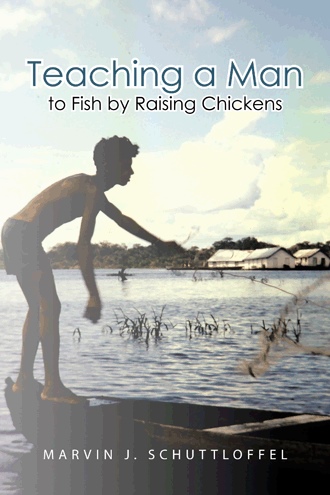
Teaching a Man to Fish by Raising Chickens is the personal story of the struggles of a young Iowa farmer who becomes a Papal Volunteer, attempting to teach farming 1,500 miles upriver in the Amazon jungle from 1964 to 1966. Author Marvin Schuttloffel shares his inspiring tale of the loneliness, trials, failures, and triumphs of his efforts to teach farming to a local population in South America. He describes his encounters with entrenched beliefs, an unfamiliar culture, and traditional ways of agriculture. Working on his father’s farm at the age of twenty, he was recruited to be a Papal Volunteer and teach modern farming techniques to native Brazilians in the Amazon jungle. His interactions within the Brazilian culture proved to be life-changing experiences. Sometimes humorous and sometimes overcome with life’s sad reality, Teaching a Man to Fish by Raising Chickens offers a compelling perspective on Marvin’s life as a Papal Volunteer in a faith-based service program that influenced President John Kennedy to found the Peace Corps. As he reflects back upon his time in Brazil, Marvin realizes that this was a once-in-a-lifetime experience that will forever tie him to the other Papal Volunteers who now meet each year to reminisce, for only they truly understand the depth of this service.
About the Author
Marvin J. Schuttloffel currently lives in Silver Spring, Maryland, with his wife, Merylann. They have two adult sons and four grandchildren. When not writing, Marvin is an avid gardener, photographer and world traveler. He remains a volunteer to various local service organizations.