
Fun "In Store" For Students
by
Book Cover & Preview Text
INTRODUCTION
There are two different avenues you and/or your school can travel when developing and operating a school store. The first avenue is using your school store strictly as a fundraiser. The second avenue is integrating the school store’s development, operations, activities, and concepts into the classrooms and parts of your curriculum as you begin to develop and operate the store.
DEVELOPING A BUSINESS PLAN AND OPENING YOUR STOREComponents of a Business Plan
Market Analysis, Potential Customers, Business Name and Type of
Business(manufacturer, retailer, service provider), Bookkeeping (business records),
Staffing, Location, Equipment, Supplies Needed, Suppliers, Competition, Pricing,
Advertising, Funds Needed to Open for Business
Depending on the depth and scope of your school store integration, the following is where the school store’s concepts and activities can integrate into many of the State of Wisconsin Department of Public Instruction (DPI) Standards. Cross-referencing is also included in parenthesis. These standards may parallel standards in other states. The information contained in the parentheses after each performance standard is a cross reference to a similar core performance standard. Please use the following when cross-referencing: LA = Language Arts, M = Mathematics, SC = Science, SS = Social Studies
Content Standard: Students in Wisconsin will assess the essential role of entrepreneurship ventures within the free enterprise system
Performance Standard: A.4.3 Participate in an entrepreneurial venture; e.g., school-based business (see SS D.4.1, D.4.2, D.4.4; LA E.4.3)
In example one, Marketing Education performance standard A.4.3 is cross-referenced to three Social Studies (SS) performance standards, and one English Language Arts (LA) performance standard. Those “core” performance standards are as follows:
SS D.4.1 Describe and explain the role of money, banking, and savings in everyday life.
A. Mathematical Process
By the end of grade 4 students will:
A.4.2 Communicate mathematical ideas in a variety of ways, including words, numbers, symbols, pictures, charts, graphs, tables, diagrams, and models
By the end of grade 8 students will:
A.8.1 Uses reasoning abilities to
• Evaluate information, Perceive patterns, and Identify relationships
F. Algebraic Relationships
By the end of grade 8 students will:
F.8.2 Work with linear and nonlinear patterns and relationships in a variety of ways, including
• representing them with tables, with graphs, and with algebraic expressions, equations, and inequalities
• describing and interpreting their graphical representations (e.g., slope, rate of change, intercepts), using them as models of real-world phenomena, and describing a real-world phenomenon that a given graph might represent
“Partnerships must go beyond corporations donating money; businesses need to be involved at the curriculum level by donating their time and expertise. Business leaders typically find they get as much as they give to partnership ventures. They often find working with young people a satisfying experience. Schools can...” Anthony P. Carnevale, The Learning Enterprise, Training and Development Journal 40.1, January 1986, p. 18.
Hands-On Student Activities: Calculate Your Monthly Net Income, Rent, Phone, TV, Food, Clothing, and Vehicle Expenses
Simple Business Plan (Elementary), Simple Business Plan (Junior High), Detailed Business Plan For A School Store, School Store Employment Application (Elementary) School Store Employment Application (Junior High), Application Checklist, Interview Checklist, Interview Test
TITLE: NUMBER OPERATIONS AND RELATIONS INVOLVING MONEY GRADE LEVEL/SUBJECT: Grades 3 and up/Math
OVERVIEW: This lesson involves hands-on group activities and workstations to help understand some number operations and relations through the use of the school store.
OBJECTIVES:
1. Rounding to the nearest dollar and tenths (dimes place)
2. Write monetary units as decimals
3. Add and subtract decimals in problem-solving situations involving money
4 Order monetary units
5. Make change
PERFORMANCE STANDARDS:
B.4.1 Represent and explain whole numbers, decimals, and fractions with
B.4.2 Determine the number of things in a set by
B.4.5 In problem-solving situations involving whole numbers, select and efficiently use appropriate computational procedures such as
B.4.7 In problem-solving situations involving money, add and subtract decimals
D.4.4 Determine measurements directly by using standard tools to these suggested degrees of accuracy
TITLE: SPREADSHEET AND GRAPHING ACTIVITY
GRADE LEVEL/SUBJECT: Grades 5 and up/Math/Technology Education
OVERVIEW: An activity that provides development of a spreadsheet and graphs of that spreadsheet so students can evaluate, interpret, and analyze the data of the school store. The development of the spreadsheet and graphs can be done by hand or on a computer.
OBJECTIVES:
1.Make a spreadsheet of the data you have collected from operating your school store business or you can use the data from the “Sample Sales, Profits, and Inventory Spreadsheet” from Appendix A.
2.Determine total sold, total sales, total cost, total profit, percent of profit
3.Use reasoning abilities to: evaluate information, identify relationships, formulate questions for further exploration, justify statements, defend work, evaluate strategies, interpret and analyze data
PERFORMANCE STANDARDS:
E.4.1 Work with data in the context of real-world situations by
E.4.3 In problem-solving situations, read, extract, and use information presented in graphs, tables, or charts
B.4.7 In problem-solving situations involving money, add and subtract decimals
B.8.5 Apply proportional thinking in a variety of problem situations that include, but are not limited to
SECTION 6: ASSEMBLY PLANS FOR A MOBILE STORE
SECTION 7: ADDITIONAL RESOURCES
Formats

Book Details
About the Book
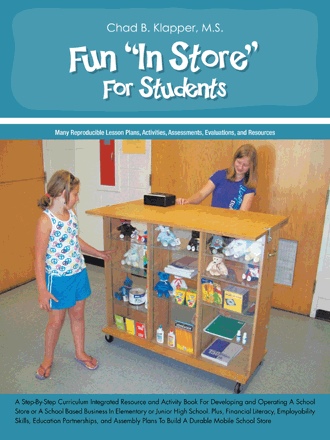
Fun “In Store” For Students is a resource and activity book to help teachers and/or facilitators develop, operate, and/or justify a school store while achieving common core and other academic standards. There are many activities, resources, lessons, assessments, evaluations, and reproducible pages. This book is centered on a school store but it can be used for other school-based businesses. Section 1 contains assembly plans for a mobile school store. Section 2 lists the Wisconsin academic performance standards, and content standards that can be achieved by operating a school store, depending on your scope and goals. These examples may be used as a template for meeting standards in your state. Section 3 is a suggested sequence for developing and operating a school store. During the ‘developing and operating’ process, ideas and examples are given to integrate some of the activities and processes into your classroom. Section 4 has you start thinking about forming business and education partnerships. Section 5 is the financial literacy section. This section is a useful tool because it opens student’s eyes to authentic hands-on learning that connects school work with career work/awareness, and the math associated with real-life living. Section 6 contains the appendices where you find most of your resources, supplemental material, lesson plans, activities, assessments, evaluations, and reproducible pages to be used by the students and facilitators of the school store. Section 7 contains additional resources to investigate. The developmental and operational processes for your school store may vary from school to school depending on your school’s size, your goals, and your objectives for running a store. Some sample goals or objectives include: meeting academic standards, having a continuous fundraiser, developing employability, job-seeking, and consumer math skills, integrating school and work-based learning, expanding awareness of careers including entrepreneurship, and developing partnerships with businesses and the community.
About the Author
As I developed and operated school stores in the schools where I taught, I saw the benefits from these hands-on work-based learning activities. Soon, I began to integrate the store’s activities and data into my classroom and other classrooms. Then, as I earned my master’s in Educational Leadership, I began to share these benefits with other schools. Some of the school store coordinators from other schools asked or more materials and ideas to further their goals as they were developing and operating their school stores. So, I decided to track the materials and ideas that I shared with other schools and school store coordinators. Their feedback encouraged me to create this book.