
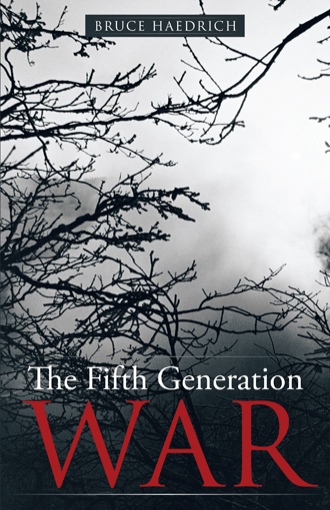
The Fifth Generation War
by
Book Cover & Preview Text
At the first traffic light Henry put on a pair of dark soft cotton gloves and wiped the steering wheel and keys as he waited. Traffic was heavy and he drove cautiously. He made a series of turns and backtracks and when he turned onto East 88th street he stopped halfway down the block. A woman standing by a building walked over and without saying a word got into the passenger seat. She put a backpack on the floor between her feet.
Henry looked over at the only woman he had ever met with a natural beauty that never seemed to change. He acknowledged her with, “You OK?”
“Yes, I‘m ready,” she replied as they pulled away from the curb. No matter what she wore, her gymnast’s figure, long neck, dark hair, black eyes, and Romanesque face turned heads. She looked equally at ease in an evening gown, bathing suit, or uniform. But more than anything else, she reminded Henry of how lonely his life had become.
They drove in silence as he looped Central Park and out of the City. They crossed the George Washington Bridge, exited at Fort Lee, and followed secondary roads for thirty-five minutes. He pulled into a wooded turn-out three hundred yards from the spot he had chosen. He was tactically pleased with the position. The hillside was heavily wooded and provided excellent physical cover and protection from the flash of his rifle.
To her American friends, the woman sitting beside Henry Baker was Maria Alateri, a first generation Italian-American brought to the United States by her parents when she was six. Her story was that her parents had been killed in an automobile accident when she was seventeen and now she was alone except for cousins in New Jersey. She was enamored of the big city and seemed well adjusted to her loss. Working as a waitress, she had aspirations of appearing on Broadway but things hadn’t worked out -- ‘yet’ she would always say. Her friends were amazed how upbeat she was despite the rejections. “Someday,” was all she would say when she returned from yet another failed audition. Maybe her accented English was the problem and her friends suggested she take voice lessons. They would have been shocked to learn that their sweet, beautiful Maria Alateri was really Lieutenant Haifa Karim serving under Lt. Colonel Hassan Baktur, aka Henry Baker, aka Henry Gibson, commander of I Battalion of the Army of Liberation. She was playing a role, and to the hilt, a role she suspected was a tragedy.
Hassan put the walnut stock of the Marlin rifle against his chin, grasped the grip on the neck, and put his right index finger on the trigger. He peered into the scope.
The ground was cold but only a slight chill came through the down filled suit. Then he thumbed the hammer back to the “full cocked” position. With all the lectures, long training sessions, hours of physical workouts, years of pretending to be Baker, and thousands of practice runs behind him he now operated on instinct. He was America’s apocalypse.
When Hassan Baktur squeezed the trigger he felt nothing but the recoil of the rifle against his shoulder. There was no joy, no excitement, no adrenalin rush, no feeling of failure or victory. Every nerve in his body was on alert to the task at hand, the job of a clinically perfect shot. Only he and Haifa heard the rifle crack over the din of the traffic as the spinning, copper jacketed bullet; the tripwire signaling the beginning of chaos, exploded across the highway. Seconds later a speeding gasoline truck veered to its right and smashed into a green Ford pick-up and Volvo sedan.
The truck’s rear tires slid and the woman beside them screamed as she jammed on the brakes of her SUV. Her heavy car swerved, tottered, and then rolled over. Cars and trucks spun and crashed as they gyrated and slid to avoid the jackknifing truck and rolling SUV.
The trailer separated from the cab and became a 60 mile an hour missile. Sparks flew as metal grated against concrete and the tires blackened the road as the freewheeling gas tank swung back across the road again. It veered then slammed into the center guardrail but the rail did not hold and the trailer rolled into the traffic coming the other way. The tank ruptured and spread a fireball that could be seen for miles over the sliding, crashing, cars.
The Interstate on both sides was blocked by crushed, overturned, burning cars, trucks, and running people. Emergency crews would later find there was no way to get to the carnage. Other gas tanks caught fire in the inferno and exploded creating their own smaller fireballs. People tried to back away from the fires but were blocked from behind. The only way to safety was to run and hundreds of panicked people clambered over one another to get away. The elderly were trampled while the infirm and immobile could only sit and watch as the black smoke, like a robed ghost, heralded their deaths.
It was November eleventh. Americans were to have another 11. 9/11 would pale in comparison to 11/11. This terrorist war was one no conventional army could stop.
Formats

Book Details
About the Book
Wilson Kraft, a retired history professor, having lived through America’s darkest years, has recorded his insider's story. Now, toward the end of his life, battling two disparate allegiances, he tries to find the courage to expose the grisly historical truths that could destroy his family.
His story unfolds as the U.S. is attacked by a terrorist army embedded within the country and intent on annihilating what they consider a predatory American Empire. The guerillas, known as the International Army of Liberation, outmaneuver the American military superpower with low-tech, potent, and repeated attacks on American citizens. They create enough chaos to break the social order from within.
As the government tightens security controls and scrambles to identify its enemies, a web of intrigue draws the reader into a thrilling quagmire of greed and corruption that lead us to a sterile world where freedom is sacrificed for security. The Fifth Generation War warns us of what could happen if current trends continue to organize and define the American way of life.
About the Author
Bruce Haedrich is a former pilot of the US Air Force and of commercial airlines. He has a degree in psychology as well as an MBA. He writes full time and lives with his wife in Maine.