
Qualified
Candidate Resumes and the Threshold for Presidential Success
by
Book Cover & Preview Text
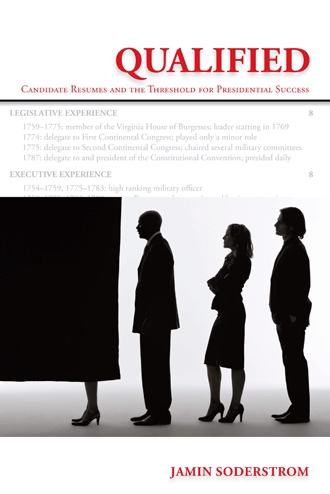
PRESIDENTIAL RESUMES
Collectively, American voters are without a doubt the world’s most important hiring managers and employers. They are always searching for candidates for local, state, and national political positions, and they spend big money doing it. Their search results help to hire mayors, members of city councils and state assemblies, governors, representatives and senators, and, most importantly, vice presidents and presidents.
Nevertheless, voters are still forced to compile for themselves—using the Internet, the media, candidate speeches and interviews, and any other available sources—whatever information they can find that they think may be relevant to their voting/hiring decisions. No simple, standardized system is used to help evaluate all of the potential candidates for political office at the beginning of the hiring process and to help weed out any unqualified candidates.
The current election process skips the crucial step of reviewing a candidate’s basic qualifications (as would be summarized on a resume) and moves straight to the later step of interviewing the candidates. Voters and the media ask which candidates are “most liked” or “most agreed with” (or “least disliked”) rather than which candidates are most qualified. Fancy campaign advertising and polished presentations in debates, interviews, and stump speeches seduce voters and the media alike. But come Election Day, all any voter can do is guess whether one candidate’s qualifications are better or worse than the others’. As recently as the 2008 election, the American voters/employers still used a backwards hiring process. And to date, no presidential candidate has ever followed the most basic job search requirement by proactively distributing an official resume to his or her prospective employer, the American voters. With all that can be gained from evaluating a candidate’s professional resume, there is no good reason why voters are not already insisting that all presidential candidates submit their official resumes to the American public prior to the 2012 election.
. . . .THE RESUME CHALLENGE
Every four years, the Constitution vests in the American voters a crucial decision with profound national and global implications. They must select who will serve as the next American president. Every presidential election is a momentous occasion, regardless of the current state of the Union. Every election has potential either to keep America on the current course (good or bad), or to take America in a brave new direction.
The bad news is that the problems America is now facing, and will continue to face over the next decade and beyond, are large and are mounting. These problems include war, deficits, debt, immigration, tax revenues, healthcare, and terrorism, among many others. Each is important to the future of the nation, and each has been consistently demagogued by excessively partisan politicians, media personalities, newsmakers, and voters. Without leaders who possess a willingness to listen, to seek common ground, to find compromise—indeed, a willingness to be friends with those with whom they disagree—none of these issues will be resolved soon or in an acceptable manner. The failure to solve the problems in one’s own generation unfairly burdens future generations, and such is a failure of leadership on all sides of the political spectrum.
The good news is that history often repeats itself in a positive way. America has quite frequently found strong and enlightened leaders in times of crisis. Under the leadership of highly qualified presidents and other political leaders, America has generally held a steady course and has continued to pursue the collective American dream of life, liberty, and the pursuit of happiness. America can be brought back from the partisan precipice at which it now stands because it has been brought back before under the leadership of great presidents.
Selecting qualified presidents is the collective responsibility (and should be the fundamental goal) of professional politicians, the media, and the American voters in each presidential election. As the results of this book’s resume analysis demonstrate, more qualified candidates become more successful presidents. This leads naturally to the resume challenge:
Voters should insist that every presidential candidate submit an official resume to the American public prior to the 2012 election and every election thereafter.
Using the tried and true resume submission process will be a new and better way to ensure that future presidents will be leaders who are qualified—by constitutional, historical, and practical standards—to hold the office once held by Washington, Lincoln, and Roosevelt.
Obviously, requiring resumes from presidential candidates is not an earth-shattering proposal. But it is unquestionably a sensible step in the right direction. Candidates who can show from the outset of their campaigns that their basic qualifications—the sum of their experiences and abilities as would be listed on a resume—make them qualified to become president deserve serious consideration by the American voters. Candidates whose resumes show that they are unqualified for the presidency do not deserve such serious consideration.
RESUME PREVIEWS
The resume challenge and the underlying analysis of the most relevant presidential qualifications are the most important parts of this book. The concept of the QUALIFIED THRESHOLD is the most important result. But the most interesting and useful pieces of information contained in this book appear in the appendices.
Appendix A provides forty-three presidential resumes, each of which describes in exacting detail (based on exhaustive historical research) every president’s qualifications upon first taking office. Some of the most interesting (and surprising) presidential resumes include:
- the resumes of the ten presidents who took office with Great qualifications, most of whom became successful presidents;
- the resumes of the biggest presidential overachievers (Abraham Lincoln, Grover Cleveland, and Lyndon Johnson) and underachievers (Richard Nixon, John Quincy Adams, and Herbert Hoover); and
- the resumes of the most recent presidents, including Barack Obama (Average qualifications), George W. Bush (Below Average qualifications), and Bill Clinton (Near Great qualifications).
- Perhaps even more interesting than the past presidents’ resumes provided in Appendix A are the sample presidential resumes provided in Appendix B.
In an attempt to prompt public discussion of presidential qualifications, and to convince one or more current or potential presidential candidates to accept the resume challenge and release an official resume, Appendix B provides resumes for seventeen of the top or most talked about contenders in the 2012 presidential field. Unsurprisingly, the candidates’ qualifications range from Great to Poor, and their personal backgrounds are equally diverse.
Some of the most interesting (and surprising) current candidate resumes include:
- Hillary Clinton’s and Condoleezza Rice’s resumes, which demonstrate that they are by far the most qualified potential candidates in the 2012 election;
- Sarah Palin’s, Michele Bachmann’s, and Chris Christie’s resumes, which show that each of them is clearly unqualified to become president (at least in 2012); and
- Ron Paul’s and Newt Gingrich’s resumes, which show that they are each highly qualified but also that they have certain intangible characteristics that may harm their electability (e.g., old age, partisanship, past indiscretions).
Formats

Book Details
About the Book
There is no more important decision an American voter can make than selecting who will become the next president of the United States, and voters should not be forced to guess whether a candidate is qualified to become president. In Qualified, author Jamin Soderstrom proposes a resume challenge that could revolutionize the election system and help to bring the presidential hiring process into the twenty-first century.
Qualified presents a tool, developed by Soderstrom, to help voters compare presidential candidates with each other and with past presidents. This resume-based approach focuses on the candidates’ experiences and abilities and evaluates legislative, executive, military, foreign, and private experience; education and intellect; and writing and public speaking ability. It ensures that future presidents will be leaders qualified by constitutional, historical, and practical standards.
A blend of analysis and insight, Qualified seeks to provide information to voters to help ensure the public elects presidents who have the experience, ability, and temperament to rise above the fray and become historically successful. The innovative resume challenge will help shed light on which candidates in 2012 meet the QUALIFIED THRESHOLD for presidential success.
About the Author
Jamin Soderstrom has been an avid reader of presidential and American history for more than a decade. He has a degree in broadcast news and an MBA, and he graduated magna cum laude from Pepperdine University School of Law. He lives in Houston with his wife, Lisa.