
England and Another Shore
A Life
by
Book Cover & Preview Text
We were on the third floor and felt the house was falling in on us, so forgetting our gasmasks we rushed for the staircase and the wall opposite cracked. I felt it was going to fall in on us but it fell outwards, the other way. We ran down the naked staircase in the midst of the most awful din, crashing glass, falling masonry, distant bombs and then our guns began. We reached the street and it was at least two feet high with broken glass. I wondered if one could run on broken glass or would it leap up and tear your legs. We could run on it. Every block had an air raid shelter which was really nothing but a basement , the kitchen quarters in old houses. The windows had been covered with sandbags, and the steps left open for entrance. and we all knew where it was for our block. Dreadful bits of jagged metal were falling all around, the shrapnel from our guns, but we reached the shelter where we were greeted by a cheerful Cockney: “’ere’s a cuppa tea, ducks, where was your bomb?” Quite a few people were already there, someone had a mouth organ.
I spent four months in that shelter. The German bombers were very punctual, coming at 6 p.m. so we were left off work early to go home and get something to eat or take to the shelter. They left at 6 a.m. We slept on rubber mattresses, noplastic in those days, and men blew them up when we were ready for bed, if not sleep. Some people could sleep. They always kept dim lights on. Our guns seemed to make as much noise as the bombs. People tried to reassure me, “Those are ours, the ack-acks” but theyall made the same dreadful noise to me. I could not believe that women were manning some of those guns, the A.T.S trained women to fire the ack-ack guns.
There were about thirty in that shelter, most of them cockneys, and very funny .One was a great wit. If a bomb fell far away he would say “nah, that’s only a tuppeny (two pence) one.” If it were nearer it might be “a tanner’s worth(sixpence)” But one night a bomb fell on the gas main near us and we felt what we had most dreaded had come to pass, gas! The lights went out and a creeping miasma seemed to fall on us, so he came up “Well, that’s a bob’s worth! “ (the old shilling) When torches (flashlighrts) were switched on we realized what had happened. The bomb had released the soot in the old chimney which probably had not been swept for years and we were all black with soot, that was the creeping miasma and the gas came from the main outside. No one could ever get the soot out of the clothes we were wearing that night. They had tobe thrown away.We sang a lot in the shelter. I learned “Green grow the rushes,O” and the “Twelve Days of Christmas” together with another lovely song, “All in yellow, all in yellow” and “St. Peter let her into heaven for her yellow , yellow hair” which I never heard before or since.
E. was right. The young men refugees were rounded up and sent to Australia; I hoped it was for their own sake. E. did not have to go; he went to look after his brother who was a pianist, hoping he could help save his hands. I came to stay with his mother and sister. The moonlit nights were the worst for landmarks were lit up. Buckingham Palace was bombed on a moonlit night. Queen Elizabeth, George VI’s wife, became very popular for saying she felt closer to the East End after she had been bombed. The East End, the Docks, were the worst hit. The gas and electric mains were often hit but men were at work on them at 6 .3O and they seemed to get them working so that we could always get tea or something warm to eat at night before going to the shelter.I grew fond of E’s sister. She was very funny. She could knit well and started knitting socks and gloves for the troops while her mother read to her from “Gone with the Wind” hoping that in this way they would both improve their English. I asked her how she liked the book. “Ein Wunsch, ein Mann, Rhett!” she said. ( One wish, one man, Rhett!} Friends of theirs found them a small cottage in S. Wales where they could live and get out of the bombing in London. They took me to meet these friends, the Polaks, who were very wealthy Dutch Jews who had lived in England a long time. Their children had been born there and all spoke perfect English, but also French, German and of course Dutch. They had helped a lot of refugees and their house was always full of musicians.
They were also very good to me inviting me to music evenings from the first time I met them.My family meanwhile had moved to North Wales where my aunt had found a house suitable for the children’s home she wanted to start for the children of the Works. My mother went with her to help At first they stayed in an old Welsh house. According to tradition if one could get enough friends to help and build a house of stone in one day it belonged to you. There was no mortar in the houses, they were just built stone on stone, like the walls. I remember going up for a weekend to see them and I slept in the attic and saw a star through a crick in the roof. I wondered what would happen when it rained but I was enchanted by this star. I think the walls downstairs were of many layers of stones, very thick walls. They did not stay there long; my aunt bought a beautiful house overlooking Cadogan Bay with a view of the mountains and sea, so peaceful. My mother had a small flat with Mr. And Mrs. Morris in the village.
My sister had taken Ronnie’s advice and had joined the RAF as a driver. She did very well and soon became a Corporal with several women drivers under her. She could drive the large 32 seater Dodge coaches but many women drivers just drove cars to get the big wigs around. She told a wonderful story of what had happened to one of her drivers. She was driving a General through the night to some far off destination; and the call of nature became urgent. She stopped the car, got out beyond the headlights, and nipped smartly back. She arrived at her destination without the General. He had nippied out too, and she left him stranded! Bettina always told new drivers this story and warned them always to check that they had their passengers in the back.Bettina had obtained a “compassionate” posting to be near Mummy in Wales and by working extra hours in the week could visit her at weekends. She had kept the secondhand car Auntie had given her to drive her at Blackheath. She called it “the old lady” and I am sure only she could have got it to go. I do not know how she scrounged the petrol. Actually she was posted at an airfield not too far from Mummy. Wales was very different from England with a different language and the place names were hard to pronounce. Bettina was phoned one night by a Canadian group who wanted transport She asked where they were:”I was afraid you were going to ask me that, sister,” said the Canadian,” at far as I can make out it looks like “Peelyweely.” It was Pwhylli, pronounced Perthelly.
I did not know what to do. The Quaker committee was folding up but they wanted German translators at the BBC and they sent me over there but it did not seem that I was doing anything very important for the war effort. However, I became ill and had to leave London and the bombing for awhile.
Formats

Book Details
About the Book
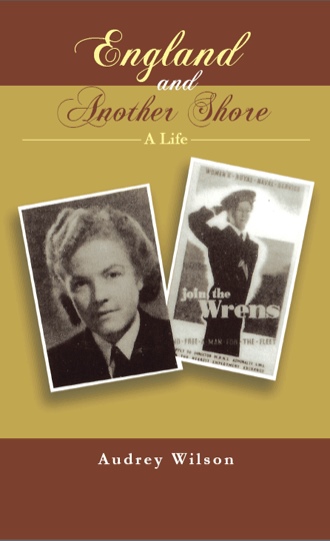
Audrey Wilson was born in England and grew up in the twenties in the country and London when milk was still delivered in bottles by pony and cart. She was bombed out in the Blitz of l940 and spent four months in a public shelter.
She joined the Women’s Royal Naval Service, W.R N.S., and, after training as a radio technician, was assigned to MI-5 to listen to German U-boat communications.
After the invasion in l944 she was sent to London to translate captured German documents at the time of the V1 and V2 rocket bombs. After the war she married an American musician who taught piano at FSU Music School.
Audrey’s husband died young and she was left with three young boys and no college education. She took her B.A in English Summa cum Laude at Florida State University 1968, M.A. 1969, and Ph.D. in Humanities in ‘72. She taught Humanities from 1969 through 1997 at FSU. She taught at the Florence Center for six months in 1980. She also accompanied student groups on several occasions to Europe, teaching Art History.
About the Author
I was born in England and bombed out in the Blitz of l94O. I joined the Women’s Royal Naval Service, and was assigned to MI-5 listening to German U-boat communications. I married an American musician, who died young, I received my Ph.D. in Humanities and taught at FSU. I am now over ninety and have written my Memoirs.