
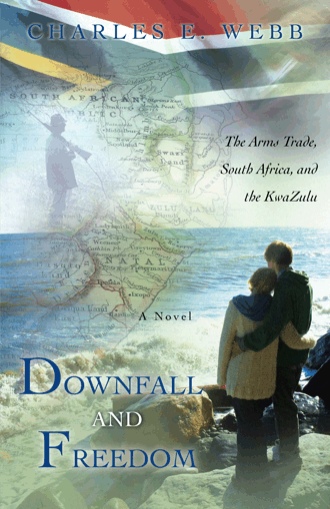
Downfall and Freedom
A Novel about the Arms Trade, South Africa, and the KwaZulu
by
Book Cover & Preview Text
Free Preview #1: John Wesley Zooma was on his way home from the grade school with three of his friends on this mild, mid-winter day in Natal. Usually, they stopped by Bulewessi’s, a small, local food shop in the township and bought a cold soda or candy before they continued home. Today, a police township truck was coming from the other direction in a hurry, beeping its horn to get people out of its way. The "Kaspir", as it was called, pulled up at the store. The township police truck was very imposing. Painted a medium green, it sat on very large, treaded tires almost ten feet high, and was made of armored and bullet proof steel. It was more like an armored personnel carrier than a truck. A .50 caliber machine gun was mounted in the front on the top. Ten soldiers jumped out from truck. Two were white, but the others were black. They rushed into the shop. The four boys ran to the other side of the street. A small crowd gathered to see what was going on. Zooma and his friends moved to the front of the crowd. From inside the shop came the ear piercing screams of women and shouting. Six soldiers appeared from the store carrying the owner, Mr. Bulewessi, a friend to the many children in the village. They carried him to the middle of the intersection, tied his hands behind him, his feet together, and sat him down. Two more black soldiers followed and went to the huge army truck. The two white lieutenants next came out of the store, pistols drawn. The women inside poured out like a flood, shrieking and crying at the top of their lungs. The noise could be heard everywhere in the small village, and the crowd swelled around the intersection from all directions. Two soldiers went to the Kaspir and came back with a car tire and a gasoline can. The six soldiers that had brought out Mr. Bulewessi were facing the crowd with rifles ready. Mr. Bulewessi was in the center of the soldiers’ circle and wailing. It happened so fast. Zooma had heard about these things but it was spoken about only in whispers. The soldier with the tire placed it around the neck of Mr. Bulewessi who was pleading for his life, but to no avail. The soldier poured the gasoline on the tire and Mr. Bulewessi, soaking him thoroughly. He dropped the can in the road and moved to the truck as the first soldier let a match and threw it at the tire. Immediately, the flames shot upward and Mr. Bulewessi was totally engulfed and screaming. The crowd gave a collective gasp in horror as the first flames began. Almost everyone was screaming or crying. The leader of the soldiers, a young lieutenant, pointed his pistol in the air and fired two shots as the crowd moved forward, but it was already too late for Mr. Bulewessi. The flames had finally gotten to his brain. His pain and life were ended. The lieutenant waited and now there was just the sound of soft sobbing. He said, "This man was subversive and dealing in contraband. This is a lesson to all of you not to engage in actions against the government!" And with that said, the soldiers retreated to truck, climbed in, and drove off with rifles still pointed at the crowd… That night after dinner, Zooma went out to visit his three friends. They talked about all that had happened and how they felt. Each one was ready to fight and die for their homeland. Then and there they made a pact with each other, as friends do when something like this happens. They would get revenge for this and all the many government oppressions and killings. They would gain control of their country. Natal had always been Zulu. Someday it would be again. Free Preview #2 Clarence van Dyke Jackson was fifty-five now, an Afro-American, very rich, and was thinking that it may be time to quit the dual life he had been living for the last twenty years. He owned a legitimate, large electrical contracting business in New Orleans, very successful over the years, especially since it was a minority business and gained many local contracts because of that fact. His other business was supplying arms as needed to Special Forces, armies of "liberation", and foreign nationals in selected lands. His contacts from the US Army and National Guard knew how to make their own extras from the "surplus" that always seemed to be available when Jackson needed it. Jackson was born in Wiggins, a small town in south Mississippi whose economy was fueled by the local lumber industry. His father drove a logging truck and his mother worked at the local hospital. During the 40's and 50's, growing up in this small town, he saw the Klu Klux Klan, knew well the art of keeping out of trouble with white folks, and learned the art of the street and survival. He had not started his life with hatred. It had only come to him once. In late November, 1953, he was clearing the dishes for his mother after evening dinner when he heard a noise behind the back barn. He looked around the kitchen for his mother, but didn't see her. His dad was in the living room reading the paper and listening to the radio. He went outside to see if the noise was a raccoon looking for something to eat from the garbage. Clarence walked outside and closed the screen door behind him. He walked quietly through the back yard, past the large oak tree with the branches that reminded him of a large octopus, and toward the garage. He moved even slower as he neared the garage for his worst fears were upon him now. As he rounded the garage, he was grabbed from behind by strong arms and held very tightly. A big hand was over his mouth, and the voice from the arms and hand said, "Keep quiet, boy, we have no quarrel with you anyhow." It was useless to yell, now, and Clarence couldn't break free. Several others in white KKK robes and masks came out of the timber stand behind the barn. There were ten in all. They walked quickly to the back yard and yelled for Clarence's dad and mom to come out back, that they had their son, and to not make any trouble. James van Dyke Jackson and his very beautiful wife, Cynthia, came to the back kitchen door and looked out on the back yard scene with eleven, white, strong armed men in KKK robes standing there. And their son was held by one of them. The apparent leader of the group now came forward. "Y'all come on out here now. We jus' want to talk some" Clarence replied, "Why y'all here? We ain't done nothin', and my son always shows his respect." "We ain't got no quarrel with your son, Jimmy. We jus' needed to talk a while with you and the misses. You see, we been hearin' that you tryin' to get yourself moved up at the mill, and you better learn now that those foreman jobs are for us whites. Do you understand me?" "Yes, I understand. I haven't asked for one. I heard talk, you know, but if someone goin' to give me another job managin' the rest of the drivers, I ain't heard it yet. I jus' tryin’ to do my job like I told. I lived here all my life and ain't bothered no one. Y'all know that." "Well, some of that's right. But we got to show you we mean business. Grab her, boys!" Three of the KKK took hold of Cynthia, while four others each took hold of an arm and a leg of Jimmy. Jimmy struggled to get free but they were too many and too strong. From out of nowhere a fist came forward and knocked him in the stomach and then in the face. The men holding Cynthia dragged her to the big oak tree as she screamed. They put her up against the tree, face first, and held her arms around the sides. The trunk cut into her arms and face. The leader came forward and ripped her dress, baring her back. "Clarence, we do this so that each time you see your wife's back, you goin' to know we always behind your back as well." The leader pulled a whip from under his robe and let go with ten lashes on Cynthia's back. The cuts were deep and blood ran down and stained her dress. Jimmy yelled, but was hit again in the stomach and the wind knocked from him. Clarence screamed, the tears
Formats

Book Details
About the Book
Thousands of miles apart, John Wesley Zooma and Clarence VanDyke Jackson witness horrific events in their young lives—events that ultimately shape the direction of their future. Zooma is a full member of the Zulu tribe in Natal, South Africa, and Jackson is an African American in a small town in south-central Mississippi. Following the traumatic events of their youths, they vow to exact revenge someday. Years later, the two become connected through Jackson’s illegal arms trade business. When Jackson falls in love with a Brazilian woman, he decides it’s time to leave the arms trade behind—but not before brokering one last deal with his partner, a German man named Carl Durnbacher. But Durnbacher doesn’t take well to Jackson’s defection from the partnership, and he orders a hit on Jackson. In the meantime, trouble is brewing in South Africa, where Zooma is privy to the details of the impending uprising. He uses his resources to aid friend Michael Stephens, who had saved his life during a work accident, escape the country with his family instead of being killed. Through a tangled web of relationships, Downfall and Freedom follows the illegal arms trade business as it becomes involved in the South African revolution.
About the Author
Charles E. Webb earned electrical engineering degree from Rose-Hulman Institute of Technology in Terre Haute, Indiana. He worked forty-four years in the global electrical, mining, petroleum, and safety industries and for more than twenty-three years in international business. Webb lives in Allen, Texas, with his wife, Eileen, and has three grown daughters.