
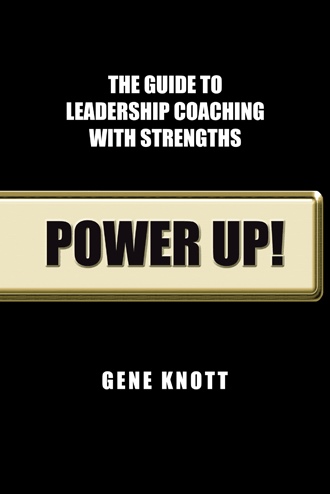
Power Up!
The Guide to Leadership Coaching with Strengths
by
Book Cover & Preview Text
Excerpt from Power Up: The Guide to Coaching with Strengths Chapter 3: Why Strengths? – The Positivity Revolution Most college and professional teams in major sports have employed for some time now a staff specialist called the strength coach. S/he is responsible for the maintenance of a conditioning regime and expansion of strength-building by team members. Not surprisingly, most head coaches of those teams have reported significant gains in performance and durability from such additions, to the point where those coaches and their work are now well-paid fixtures in those organizations. In a world where seemingly small differences in preparation and self-confidence often are rightly seen as difference-makers, coaching often catalyzes those differences. In other words, being in better condition than before at the head of the organization, and using a strengths lens to appraise heritage, current demands, and future desires, can all lead to greater success and higher, aspired to levels of excelling. So, practitioners of strengths coaching can be seen as personal strengths (not physical strength per se) “aides.” Similarly, their impact can be impressive and vital to the improvement of many managers, leaders and other professionals at many levels across diverse areas of human endeavor. Personal & Professional Strengths As the strengths movement generally has evolved, a number of related, yet somewhat distinctive aspects of what ‘being strong’ entails have been developed, including identifying and fortifying abilities, character, and talents. So, let’s examine briefly the ways in which that has occurred and the resulting distinctions. First, one must acknowledge the several angles from which strengths are viewed, including values and character, transactional and intrapersonal capacities, as well as skills and technical expertise that people possess to a high degree. Just what are personal, non-physical strengths, and how can we measure, enlarge, appreciate, and use them beneficially? Perusal of dictionaries yields a fascinating and telling array of types of strength, from physical to cognitive, and from potency to effect, as well as a range of measures and labels for them. Words like power, potency, force, vigor, and might appear as synonyms, and, in a bit of a paradox for our consideration of strengths as positive entities, many dictionary references regard a strength as an ability to deter, reduce, or withstand a force! Even a majority of our idiomatic language has adopted that stance about being strong. Consider phrases like “coming on (too) strong,” or “using strong language” or “having a strong stomach, or even the metaphorical “strong as an ox” (bear, bull, lion, etc.).” So, there is an etymological tradition of viewing strengths usage as a countering agent, and even a somewhat overdone behavior. When I coach about a client’s strengths, we are focusing together on their capacities not just to fend off reactively, but to be proactive with assets, the attributes that make them more capable of positive action, not merely or primarily withstanding some force or event. We are looking to personally “play with” those strengths, accessing their best assets, “playing to” them when working with and relating to others, and “playing on” all of them collectively when exercising strengths in the organizational whole. Types of Strengths My experience with leaders and executives, managers and entrepreneurs has also shown me that not all strengths are equal or used in similar ways. In my practice, I have come to note a number of types of strength, each relative to the others, and fairly uniquely employed by each person. For example, what some have referred to as key themes or signature strengths, I call Primary or Lead strengths. By that, I mean they are the main ones that a person employs both to function at their best and to build up their capacity to excel. They are the aspects of their performance that come to characterize them, and enable them to stand out, to enlarge their abilities to succeed and to be an exceptional performer. Then there are some less often used, yet still important strengths that I view as Auxiliary. In this case, I mean they are literal companion ways of acting that fortify a person’s primary gifts and abilities. For example, a person strong in analytic ways often employs an auxiliary strength such as their deliberative talents to reinforce one another. Thus, Auxiliary strengths are supportive or supplemental to the Primary or Lead strengths. A third form, a Complementary strength, is that which balances the tendency of one strength, for instance, belief or valuing—a strong interest in core principles, with an empathy and openness to differing opinions and views, thus avoiding tunnel vision and exclusion of differences. So this pattern sees a less frequently used strength completing a pattern with one that has affinity, and together they make a more potent set. I refer to a fourth and final type of strength that is even less frequently expressed as a Contextual strength, drawn on situationally to address a specific need that is outside one’s usual ‘best’ styles, talents or ways of being. Perhaps a person who is usually less well connected to others will encounter a relationship or situation that calls on them to be a relator, to exhibit a willingness and capacity for engaging a coworker more personally and intensely, perhaps even with an intellectual and affective intimacy not easily or often employed. This is the most difficult type of strength to engage, and to appreciate, and the least often seen of the strengths, but it can offer a way of broadening one’s ability to excel, and to perform at a higher level. This discussion of strengths types also brings to mind the old psychological concept that distinguishes a ‘state’ from a ‘trait.’ This long-standing behavioral science distinction sees a state as a response to a situational stressor or stimulus, while a trait is viewed as a behavioral tendency exhibited across time and in a number of varying situations. In strengths coaching parlance, we seek first to have clients identify and optimize their use of traits—naturally occurring talents developed and used routinely (Primary/Lead or Auxiliary), as opposed to those lesser strengths (Complementary and Contextual ones) that occur not naturally, but more often in response to recurrent situational demands. As noted earlier, the many labels and euphemisms that apply here and are utilized by various researchers and writers, including strengths, talents, assets, gifts, preferences, and similar others, all convey the positive nature of their contribution. I generally tend to refer to all of them in discussion with clients and trainees simply as strengths, and define them collectively thus: Strengths are the unique features of one’s internal and relational repertoire relied on for their high level of prowess in performance. Put more simply, strengths are one’s unique set of ideas and behaviors developed and used to optimal effect.
Formats

Book Details
About the Book
If you supervise or mentor anyone in your work life, these pages will expose you to the mother lode for helping others grow, succeed, and excel. POWER UP!—THE GUIDE TO LEADERSHIP COACHING WITH STRENGTHS gives those who coach others the reasons, formats, skills and tools to thrive in that practice. Strengths coaching accesses that “sweet spot” between having a personal counselor and a wise consultant to provide optimal assistance. With a clear outline of the chief skills, tools, and critical mindsets for thriving with strengths-based coaching efforts, POWER UP! is an especially rich resource.
Gene Knott is a widely sought “coach’s coach,” whose diverse client roster spans the range of leadership roles found in both for-profit and not-for-profit settings. Grounded in current knowledge about positive psychology principles and management scholarship, POWER UP! draws on the author’s 24 years of experience coaching executives and working with a range of organizations to deliver a robust, highly useful manual.
In these pages you’ll find:
o strengths coaching’s mental maps, lenses and platforms
o the 7 key skills for coaching others using positive power
o more than 40 easily adopted activities, instruments and tools
o numerous case examples, stories and learning devices
o a special chapter on leader, team and organization coaching
o “strongboxes” with wisdom for coaching with strengths
- Gene Knott is a master coach, bringing to life the power of strength-based methods in the coaching process. His straightforward approach makes the theory and research easily understandable, with practical activities, insightful stories, and key takeaways in every chapter. Anyone interested in coaching and being part of the strengths revolution will profit from this book.
- Tony Silbert, MSOD, Founding Partner, Innovation Partners International; co-author of Healing Conversations Now
About the Author
Gene Knott has 40+ years experience in systems consulting, facilitation, and training design and delivery for many public and private sector organizations globally, and has been an executive coach for over 24 years. Dr. Knott has worked extensively with six sectors: health care, human services, finance, high tech, professional associations, and higher education. Primary areas of related professional interest include professional coaching, organization change, leadership development and succession planning, team building, and cultural competency. He is also the author or co-author of 4 books and dozens of articles, and has made several hundred invited presentations on 4 continents about his areas of expertise.
Dr. Gene Knott was a university administrator for 27 years at 3 different schools, and is an Emeritus Professor in the Department of Human Development and Family Studies at the University of Rhode Island, where he taught for a dozen years in the College Student Personnel Masters program. Dr. Knott also taught in the University’s MBA program, where his courses included Leadership, and Organization Development, and he has been an adjunct faculty member in Psychology, Nursing, and Adult Education, and a Fellow in Gerontology.